August 2026 / 15 min read / Written by our editorial team
The hiring climate is constantly evolving, and sourcing candidates depends on speed, precision, and the ability to make sense of more candidate data than ever. Luckily, AI sourcing tools have evolved from basic keyword matching to flexible natural-language searches, uncovering relevant candidates across vast pools of talent and existing recruitment databases. But with so many platforms promising smarter sourcing, which one is right for your team? We've compared the best AI sourcing tools for 2026. We'll also walk you through how to choose the right platform for your recruiting needs.
Our Top Picks
- Hire-Match: Best for sourcing and evaluating candidates in one workflow
- Eightfold: Best for talent rediscovery
- SeekOut: Best for combining external sourcing & existing talent pools
- Juicebox: Best for agent/conversational candidate sourcing
- Gem: Best for rediscovering & re-engaging past candidates
- Findem: Best for prioritizing warm talent across multiple sourcing channels
- Pin: Best for automating sourcing, outreach, and scheduling
- Fetcher: Best for automated outbound candidate sourcing
- Fountain: Best for high-volume & frontline candidate sourcing
- Manatal: Best for affordable sourcing & ATS functionality
Short on time? Jump straight to the reviews.
How We Chose the Best AI Sourcing Tools for Recruiters
We prioritized platforms that have external and internal sourcing abilities, semantic search, flexible ATS integration, and capable automation. To identify the best AI-enhanced candidate sourcing tools, we looked beyond database size to assess how effectively each platform uses AI to find, match, rediscover, and prioritize relevant candidates.
- Internal and external sourcing: We looked for tools that can discover new candidates externally, rediscover existing talent, or provide a strong combination of both.
- Advanced search: We prioritized semantic, natural-language, and Boolean search capabilities that go beyond basic keyword filtering.
- ATS integration: We considered how easily each tool connects with popular ATS platforms such as Greenhouse, Ashby, and iCIMS and fits into existing workflows.
- Automation: We assessed how AI can reduce manual sourcing work through candidate matching, prioritization, outreach, talent rediscovery, and other automated workflows.
- Distinct capabilities: Each platform needed a clear reason to recommend it, such as frontline sourcing, specialist talent search, candidate evaluation, or human-assisted sourcing.
- AI value and transparency: We favored tools that clearly explain how AI is used, maintain recruiter oversight, and apply AI where it can genuinely help recruiters work faster and more efficiently.
Disclosure: Although Hire-Match is included in this comparison, every platform was evaluated against the same criteria to ensure a consistent and transparent review process.
The Best AI Sourcing Tools Compared
The best AI sourcing tools vary considerably in where and how they find candidates. Our quick overview comparison table can break it down below:
| Platform | Best for | Talent rediscovery | AI matching | Outreach | ATS integrations | Pricing |
| Hire-Match | Sourcing with deeper candidate intelligence | Match from Pool searches existing candidate data | Explainable matching | N/A | Works alongside existing recruiting systems | Based on active job openings, not candidate volume |
| Eightfold | Enterprise talent rediscovery | ATS/Talent Network | Nurture campaigns | Nurture campaigns | Workday, Greenhouse, Oracle, SAP + more | Custom |
| SeekOut | Specialized external talent search | ATS rediscovery | Semantic matching | Personalized campaigns | ATS integration available | Self-service + custom plans |
| Juicebox | AI-powered sourcing automation | Limited | AI ranking | Automated sequences | 40+ ATS integrations | Free + paid plans |
| Gem | Sourcing and candidate rediscovery | ATS + CRM rediscovery | Explainable match scores | Excellent multichannel outreach | Greenhouse, Workday, Lever, iCIMS + more | Custom |
| Findem | Warm talent sourcing | Prioritizes existing talent | Contextual matching | Personalized outreach | Greenhouse, Lever, Ashby + more | Custom |
| Pin | Autonomous candidate sourcing | Limited | Skills + fit | Agentic outreach | 120+ ATS integrations | Free + paid plans |
| Fetcher | AI + human-assisted sourcing | Selected ATS integrations | AI ranking | Automated emails | Broad ATS support | Self-service + custom plans |
| Fountain | High-volume frontline sourcing | Fountain Pool | Matching + scoring | Re-engagement campaigns | Job board, HRIS + hiring integrations | Custom |
| Manatal | All-in-one sourcing + ATS | Existing database matching | Semantic matching | Email campaigns | Built-in ATS + HR tech integrations | Transparent per-user plans |
Every AI sourcing tool works a little differently. We'll go into more detail below.
The Best AI Sourcing Tools in 2026 Reviewed
We reviewed 10 of the best sourcing tools for external talent, talent rediscovery, and flexible integrations.
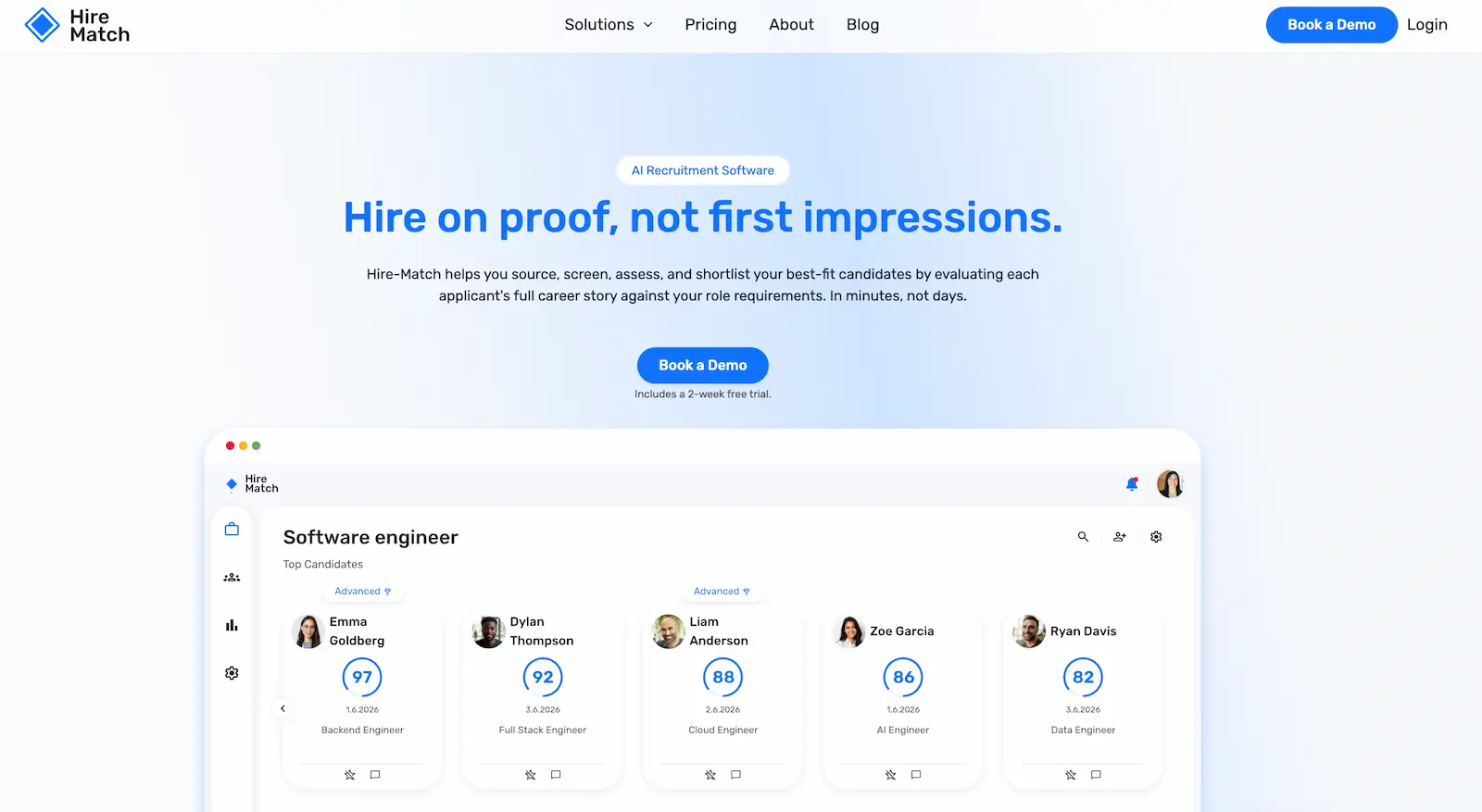
1. Hire-Match
Best for: Recruiting teams that want to rediscover candidates from existing talent pools and connect sourcing with deeper candidate evaluation.
Key features
- Match from Pool talent rediscovery
- Existing candidate database search
- Explainable AI candidate matching
- Adam Total external candidate-pool integration
- AI resume screening
- Candidate assessments
- AI interviews
- Predictive candidate insights
Why We Chose Hire-Match
Hire-Match takes an internal-first approach to AI sourcing. Its Match from Pool feature lets recruiters search existing candidate data for people who match the requirements of a new position. The search is initiated on demand for each role, and AI provides explainability around why candidates have been matched. There is no limit on how many candidates recruiters can source from their existing data.
Unlike many of the AI sourcing tools on this list, Hire-Match isn't designed primarily for discovering candidates across large external databases. Its only current external candidate-pool integration is Adam Total. Instead, its biggest advantage is what happens once a potential candidate is identified: recruiters can use Hire-Match's broader screening, assessment, and AI interviewing capabilities to gather more evidence about their suitability. This makes it particularly useful for teams that want to turn existing candidate data into new hiring opportunities and connect sourcing with the next stages of candidate evaluation.
Pros
- ✓ Strong focus on existing candidate rediscovery.
- ✓ Explains why candidates match a new position.
- ✓ No practical candidate sourcing limit.
- ✓ Connects sourcing with screening, assessments, and interviews.
- ✓ Provides deeper candidate intelligence beyond initial matching.
- ✓ Can complement an existing recruitment stack.
Cons
- − Very limited external candidate sourcing compared with specialist sourcing platforms.
- − Not designed for teams primarily looking to build new external talent pools.
ATS integrations
Hire-Match can work alongside an existing recruitment stack, with integrations supporting its broader hiring workflow. For sourcing specifically, its only currently confirmed external candidate-pool integration is Adam Total. Hire-Match can also search existing candidate data through Match from Pool, although the exact depth of historical candidate access can depend on how candidate data enters the platform.
Pricing
Hire-Match includes its features within plans based on the number of simultaneously active job openings rather than applicant or candidate volume. This can be particularly useful for talent rediscovery because recruiters aren't charged according to the number of candidates searched or processed. A free trial is also available.
2. Eightfold
Best for: Enterprise organizations that want to source across existing talent databases and external talent pools.
Key features
- AI-powered internal and external candidate sourcing
- ATS talent rediscovery
- Skills- and potential-based AI matching
- Explainable candidate recommendations
- AI-built talent pools and pipelines
- Talent Communities for passive candidates
- Personalized nurture campaigns
- Internal talent matching and mobility
- Agentic recruiting workflows
Why We Chose Eightfold
Eightfold sees the value in an organization's existing candidate data to source candidates. Its AI updates records imported from an ATS and searches the Talent Network to rediscover previous applicants and other known candidates. It prioritizes talent on skills, experience, and potential rather than relying solely on exact keyword matches. The explainable AI also shows recruiters why a candidate has been recommended.
Eightfold supports external candidate sourcing, passive talent pools through Talent Communities, AI matching, and personalized nurture campaigns. This makes it particularly suitable for large organizations that want sourcing to connect with a broader talent intelligence strategy. Eightfold also offers an extensive talent acquisition suite spanning interviewing, internal mobility, workforce planning, and talent development.
That automation extends across much of the recruitment process. Zoho can automatically parse emailed resumes into candidate profiles, score applicants through pre-screening assessments, send personalized email or SMS updates, schedule interviews and reminders, trigger background checks, and generate and track offer letters. Recruiters can also use Zia AI to match candidates with suitable roles and summarize profiles.
Pros
- ✓ Strong talent rediscovery capabilities.
- ✓ Searches internal and external talent.
- ✓ Goes beyond keyword matching to consider skills and potential.
- ✓ Explains why candidates are recommended.
- ✓ Combines sourcing with broader talent intelligence.
- ✓ Well suited to large existing candidate databases.
Cons
- − Might be less suitable for smaller teams looking for lightweight sourcing.
- − Pricing isn't publicly available.
ATS integrations
Eightfold is designed to work alongside existing HR and recruiting systems, including Workday Recruiting, Oracle Recruiting, SAP SuccessFactors, and Greenhouse, with Eightfold acting as a talent intelligence layer rather than requiring organizations to replace their existing systems.
Pricing
Eightfold does not publish standard pricing for its Talent Acquisition platform. Organizations need to contact Eightfold and request a demo for pricing.
3. SeekOut
Best for: Recruiting teams that need to source hard-to-find talent across specialized external databases while rediscovering candidates already in their ATS.
Key features
- AI-powered semantic candidate search
- Search across 1B+ public profiles
- Specialized GitHub, healthcare, academic, and cleared-talent databases
- ATS talent rediscovery
- AI-generated searches from job descriptions
- 300+ Power Filters for targeted sourcing
- AI-personalized outreach campaigns
- Labor market intelligence and talent insights
Why We Chose SeekOut
SeekOut is one of the best AI sourcing tools because of its exceptional external sourcing depth. Rather than relying primarily on a single talent database, it lets recruiters search across more than 1 billion public profiles, as well as specialized talent pools for developers, healthcare professionals, researchers, and security-cleared candidates. Its semantic AI search understands intent when using natural language in searches, while more than 300 Power Filters help recruiters narrow searches by skills, certifications, career history, and other highly specific criteria.
SeekOut also excels in talent rediscovery. Its ATS integration can surface silver medalists and previous applicants, refresh candidate profiles with updated information, and match dormant candidates against new job requirements instead of forcing recruiters to start every search from scratch. AI-generated searches, personalized outreach campaigns, and labor market insights make it a strong choice for sourcing teams that want both broader external reach and better use of their existing candidate database.
Pros
- ✓ Excellent external sourcing across specialized talent pools.
- ✓ Strong ATS talent rediscovery capabilities.
- ✓ Semantic AI search goes beyond keywords.
- ✓ 300+ advanced sourcing filters.
- ✓ AI-generated personalized outreach.
- ✓ Built-in labor market intelligence.
Cons
- − Many advanced features are reserved for higher-tier plans.
- − Public pricing is limited beyond the self-serve plan.
ATS integrations
SeekOut is designed to work alongside existing recruiting workflows through ATS integrations that support talent rediscovery and candidate synchronization. It also offers an MCP integration that allows recruiters to search SeekOut directly through AI assistants like ChatGPT, Claude, Gemini, and Microsoft Copilot using natural language.
Pricing
SeekOut offers a free trial, with plans ranging from a self-serve option for individual recruiters to custom packages for larger teams. More advanced plans add capabilities such as ATS integration, talent rediscovery, and broader recruiting workflows, with pricing scaling based on the package and team requirements.
4. Juicebox
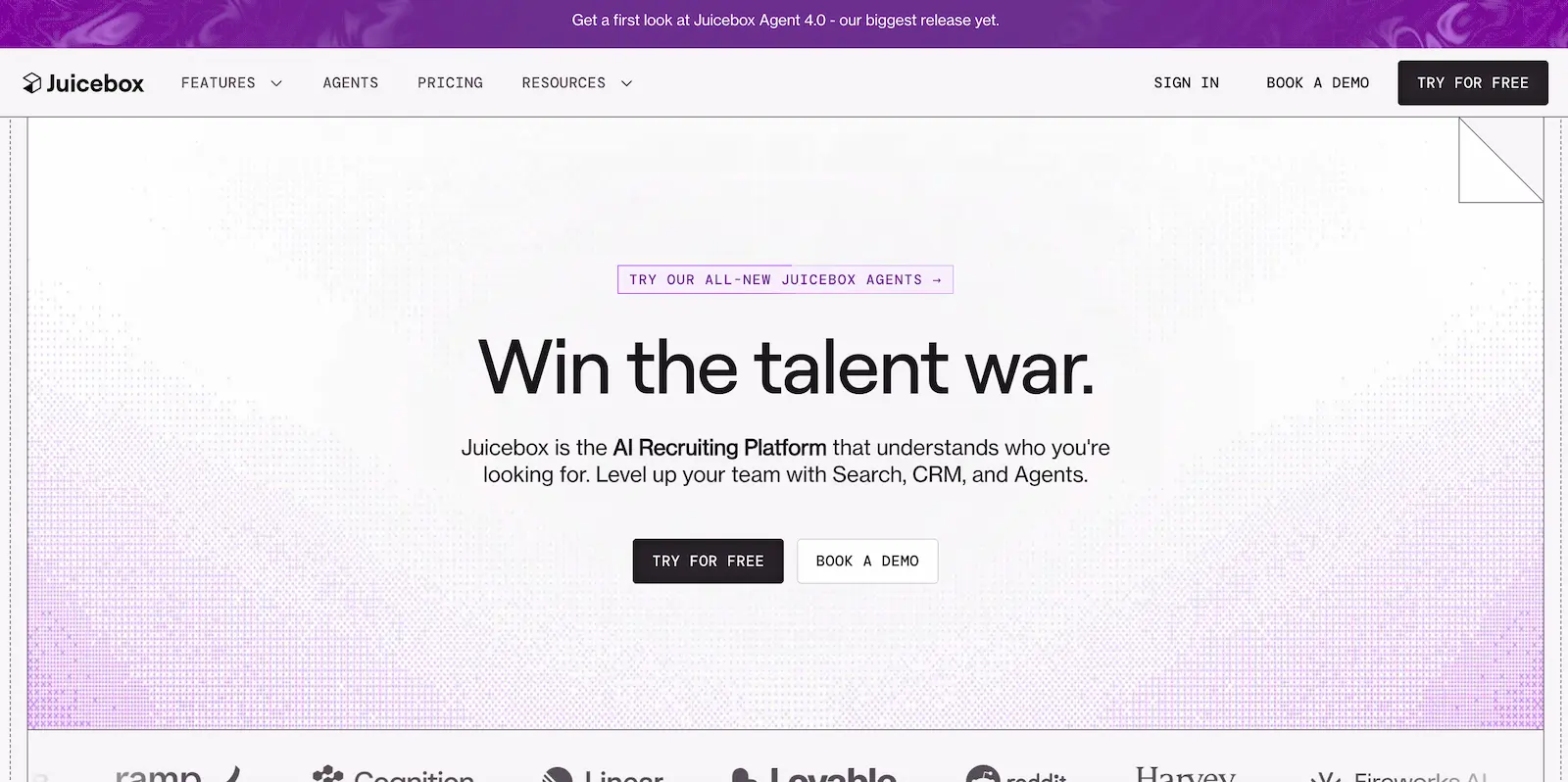
Best for: Recruiters who want to automate candidate search and outreach using conversational AI agents.
Key features
- Natural-language PeopleGPT candidate search
- 800M+ profiles across 30+ data sources
- AI candidate matching and stack-ranking
- AI sourcing Agents
- Social and technical candidate signals
- Talent market insights
- Verified candidate contact data
- Automated personalized outreach
Why We Chose Juicebox
Juicebox is one of the more AI-native AI sourcing tools we've reviewed. PeopleGPT lets recruiters describe the candidates they're looking for in natural language, then translates the request into a targeted search across more than 800 million global profiles from 30+ data sources. Recruiters can refine results using filters, while AI-generated summaries explain candidates' relevant skills and experience. Juicebox can also evaluate thousands of profiles against specified criteria and prioritize the strongest matches.
Its AI Agents take this a step further by automating more of the sourcing workflow. Agents can gather context about a role, calibrate searches conversationally, analyze candidates against hiring criteria, and conduct personalized outreach. Recruiters can choose how autonomous this process should be, including adding manual checkpoints before candidates are shortlisted or contacted. Juicebox is a solid option for recruiters who want to use generative AI for sourcing.
Pros
- ✓ Simple natural language candidate search.
- ✓ Large global candidate database.
- ✓ Strong AI automation from search through outreach.
- ✓ AI prioritizes candidates against recruiter-defined criteria.
- ✓ Recruiters can control Agent autonomy.
- ✓ Free version and trial options make it relatively accessible.
Cons
- − ATS integration is reserved for its higher-tier Business plan.
- − Its strongest talent rediscovery capabilities appear less developed than dedicated rediscovery platforms.
- Some functionality, including contact/export capacity, varies considerably by plan.
ATS integrations
Juicebox integrates with 41 ATS platforms and 21 CRMs, including Greenhouse, Lever, Ashby, Workday, iCIMS, SmartRecruiters, and SAP SuccessFactors. Candidates can also be exported via CSV, while Gmail and Outlook integrations support outreach workflows.
Pricing
Juicebox has a free plan alongside paid options for individual recruiters, growing teams, and larger businesses. Higher plans increase contact and export allowances and add capabilities such as talent insights, team collaboration, ATS/CRM integrations, and network sourcing. AI Agents are also available as an additional paid feature.
5. Gem
Best for: Recruiting teams that want to combine external candidate sourcing with continuous ATS/CRM talent rediscovery and candidate nurturing.

Key features
- AI Sourcing Agent
- 800M+ candidate profiles
- Natural-language candidate search
- AI Talent Rediscovery
- ATS and CRM candidate matching
- Explainable candidate match scores
- LinkedIn and 20+ site Chrome extension
- AI-personalized multichannel outreach
Why We Chose Gem
Gem stands out among AI sourcing tools because it searches both outside and inside an organization's existing talent ecosystem. Recruiters can describe their ideal candidate in natural language, and Gem's AI Sourcing Agent searches more than 800 million profiles alongside previous candidates in the company's ATS and CRM. Results include updated candidate data, previous engagement history, and an explainable match score, helping recruiters understand both who fits and why. Its Chrome extension also lets recruiters add candidates from LinkedIn and more than 20 other sourcing sites.
Talent rediscovery is an especially strong feature of Gem's. When a new role opens, its AI can resurface past applicants, silver medalists, and previously sourced prospects who now match the requirements, while retaining context such as interview history, notes, and previous engagement. Gem can then connect those candidates to personalized email, SMS, and InMail outreach and longer-term nurture campaigns. That combination makes it particularly useful for teams that want their candidate database to become an ongoing sourcing channel rather than an archive of previous searches.
Pros
- ✓ Strong external sourcing and talent rediscovery.
- ✓ Searches ATS, CRM, and external candidate pools together.
- ✓ Natural-language search reduces reliance on Boolean queries.
- ✓ Explains candidate matches rather than only producing rankings.
- ✓ Chrome extension supports sourcing from LinkedIn and 20+ sites.
- ✓ Strong nurturing and multichannel outreach capabilities.
Cons
- − Pricing is largely customized for established organizations.
- − Some AI functionality requires AI-powered rather than standard seats.
ATS integrations
Gem integrates with major ATS platforms including Greenhouse, Workday, Lever, iCIMS, and SAP SuccessFactors, and supports more than 100 integrations overall. Its ATS connections allow candidate information and recruiting activity to flow between systems, supporting Gem's ability to rediscover candidates without requiring teams to replace their existing ATS.
Pricing
Gem primarily uses custom pricing based on company size, with organizations able to layer its sourcing, CRM, outreach, and other recruiting capabilities onto an existing ATS or adopt its broader all-in-one platform. It also offers discounted packages for eligible startups, while access to some AI-powered sourcing and rediscovery capabilities depends on the selected seat and package.
6. Findem
Best for: Recruiting teams that want to prioritize previous applicants, referrals, alumni, and other warm candidates before expanding external sourcing.

Key features
- AI-powered ATS and CRM talent rediscovery
- 850M+ external candidate profiles
- Natural-language candidate search
- Continuously enriched 3D candidate profiles
- Explainable AI candidate ranking
- Referral, alumni, and employee-network sourcing
- AI-assisted personalized outreach
- Talent market and sourcing analytics
Why We Chose Findem
Findem doesn't automatically assume the best candidate needs to be sourced from somewhere new. Its AI assistant, Fia, searches across inbound applicants, ATS and CRM records, referrals, alumni, and external candidates while intentionally prioritizing previously engaged candidates first. Previous applicants and finalists can be rediscovered and compared against current requirements before recruiters expand their search to Findem's database of more than 850 million profiles.
Its approach to matching is also more contextual than straightforward keyword search. Findem continuously enriches candidate profiles with its "3D" career data, including factors such as career scope, outcomes, tenure, and trajectory. Fia uses these signals to rank candidates and shows recruiters which factors influenced each match. Combined with personalized outreach, relationship signals, and sourcing analytics, this makes Findem especially compelling for teams that want to get more value from talent they've already encountered while retaining the option to expand externally when necessary.
Pros
- ✓ Excellent talent rediscovery capabilities.
- ✓ Prioritizes existing talent pools before external sourcing.
- ✓ Searches across multiple sourcing channels in one workflow.
- ✓ Continuously refreshes existing candidate profiles.
- ✓ Automation extends into onboarding and scheduling.
- ✓ Matching considers career context beyond keywords.
Cons
- − Less suited to teams without an established talent database.
- − No transparent pricing.
ATS Integrations
Findem integrates with existing ATS and CRM systems rather than requiring recruiters to replace them. Confirmed ATS integrations include Greenhouse, Lever, and Ashby, with candidate data used for rediscovery, enrichment, and sourcing alongside external talent pools. Its Greenhouse integration, for example, can enrich historic ATS profiles and surface previous candidates who match a new requisition.
Pricing
Findem does not publish standard pricing for its sourcing platform. Organizations need to contact Findem for a demo and customized pricing based on their requirements.
7. Pin
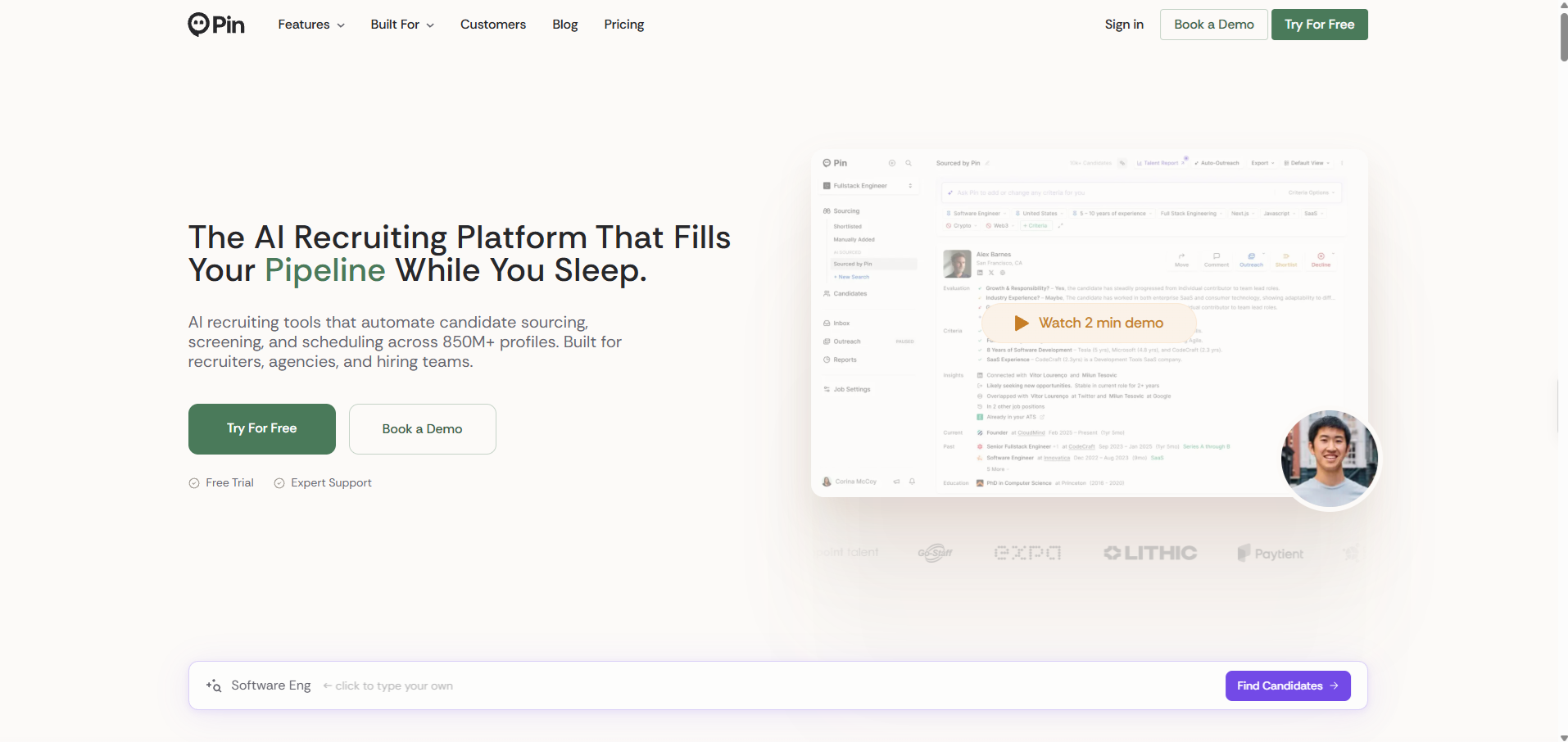
Best for: Recruiters and agencies that want AI agents to continuously source, prioritize, and engage external candidates with minimal manual work.
Key features
- AI sourcing across 850M+ profiles
- Multi-source search across LinkedIn, GitHub, Crunchbase, Kaggle, and more
- Natural-language candidate search
- Skills-based candidate matching
- AI-ranked shortlists with match reasoning
- Continuous AI sourcing agents
- Recruiter-feedback learning and search recalibration
- Automated multichannel outreach
Why We Chose Pin
Pin surprised us with how much of the outbound sourcing process its AI agent can take over. Recruiters can describe an ideal candidate in natural language, and Pin searches more than 850 million profiles across multiple data providers. Its matching considers skills, experience, career patterns, and overall fit, then creates ranked shortlists with AI-generated explanations rather than relying only on titles or exact keyword matches.
The agentic capabilities are where Pin stands out. Its sourcing agent can continuously replenish candidate pipelines, learn from recruiters accept/reject feedback, recalibrate searches, and connect qualified prospects with personalized outreach. Recruiters can still set approval points and pause automation, making Pin one of the stronger AI sourcing software solutions for teams that want significant sourcing automation without completely giving up human oversight.
Lever is also extending these workflows with AI. AI Screening Companion can surface stronger applicants and automate follow-up actions, while AI-powered screening can turn high application volumes into ranked, summarized shortlists and collect additional candidate information through chat or voice conversations. This combination makes Lever particularly useful for teams that want to automate both candidate movement through open roles and ongoing relationship-building with future talent.
Pros
- ✓ Strong multi-source external candidate search.
- ✓ Natural-language search removes reliance on Boolean expertise.
- ✓ Continuously sources and replenishes candidate pipelines.
- ✓ Learns from recruiter feedback.
- ✓ Provides reasoning behind candidate matches.
- ✓ Connects sourcing directly with automated outreach.
Cons
- − Talent rediscovery capabilities are unclear compared with platforms such as Gem, Findem, and SeekOut.
- − Some of the most advanced integrations and functionality are reserved for higher plans.
ATS integrations
Pin integrates with more than 120 ATS platforms, including Greenhouse, Lever, Ashby, Bullhorn, iCIMS, and Jobvite. Candidate records, notes, and activity can sync between systems, and Pin also offers integrations with Google Calendar and Outlook for downstream scheduling.
Pricing
Pin offers a free plan alongside paid packages for individual recruiters, recruiting teams, agencies, and larger organizations. AI sourcing and recruiting agents are included in its paid plans, while higher tiers add greater contact allowances, team collaboration, advanced agent sourcing, and premium ATS integrations.
8. Fetcher
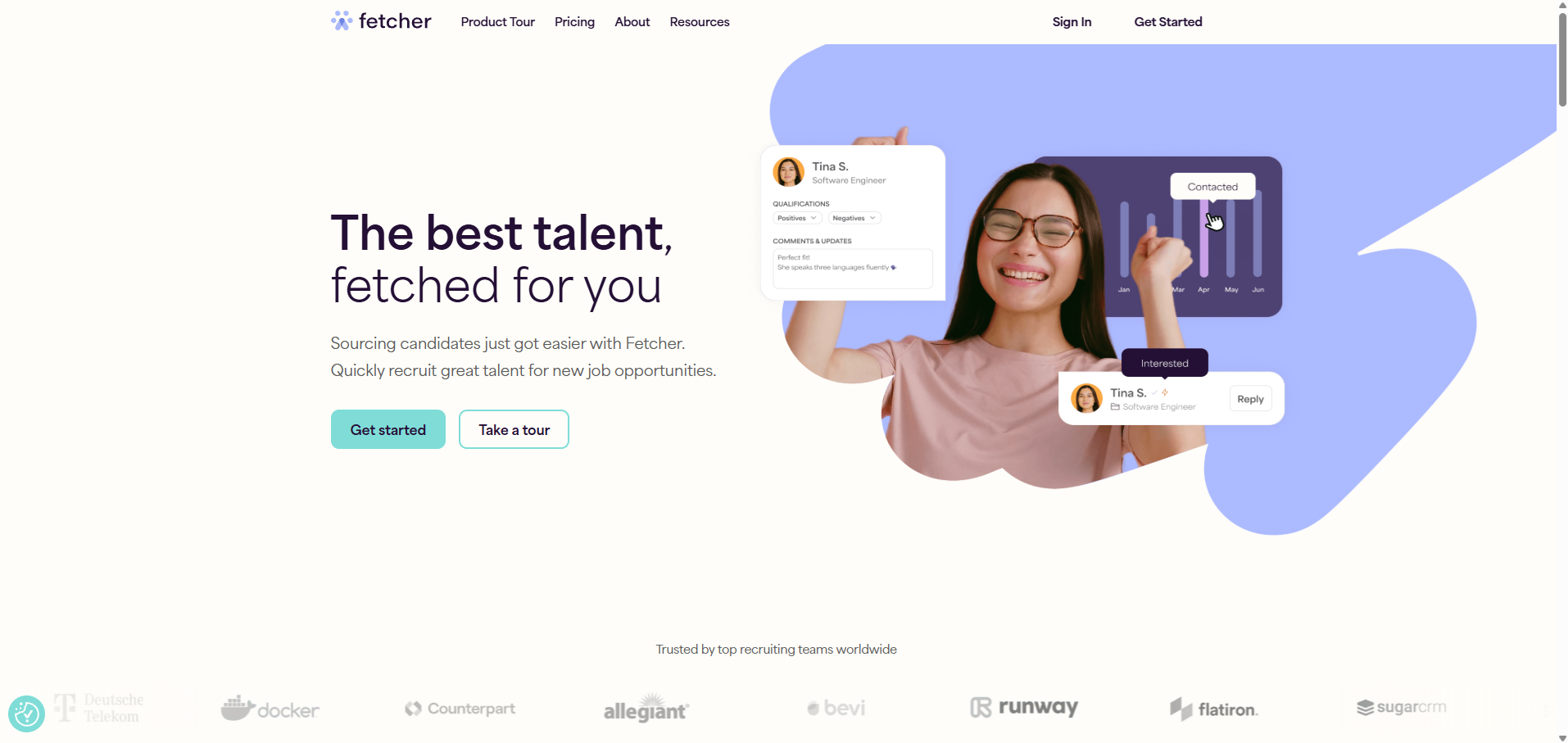
Best for: Recruiting teams that want AI sourcing technology backed by hands-on human sourcing support.
Key features
- 500M+ candidate database
- AI-assisted candidate search
- AI-ranked candidate recommendations
- Human-assisted candidate sourcing
- ATS talent rediscovery
- LinkedIn sourcing plugin
- Automated personalized email outreach
- Candidate sourcing analytics
Why We Chose Fetcher
Fetcher takes a different approach from many AI sourcing tools by combining its technology with human sourcing expertise. Recruiters can search its database themselves using filters or AI-assisted search, which can turn a job posting, skills list, or other requirements into relevant search criteria. Fetcher can then evaluate and rank candidates, while higher-tier plans also include candidates sourced by Fetcher's team.
It also goes beyond purely external sourcing. Fetcher's newer ATS integrations support inbound and outbound recruiting, and its documentation confirms talent rediscovery functionality for integrations including Workable and Tellent Recruitee, where previous ATS candidates can be re-engaged and ranked by relevance. Automated email campaigns and candidate engagement analytics help recruiters turn sourced prospects into active conversations. This makes Fetcher attractive for teams that want to increase sourcing without handing the entire process over to autonomous AI agents.
Pros
- ✓ Combines AI with human sourcing support.
- ✓ Supports both self-service and managed candidate sourcing.
- ✓ AI-assisted search reduces manual search setup.
- ✓ Talent rediscovery is supported through at least some ATS integrations.
- ✓ Built-in automated outreach.
- ✓ Accessible options for smaller recruiting teams.
Cons
- − Smaller advertised external database than some competitors on our list.
- − Talent rediscovery capabilities appear to depend on the ATS integration.
Some advanced sourcing and integration capabilities are restricted to higher plans.
ATS integrations
Fetcher integrates with a broad range of recruiting tools, including ATS platforms such as Greenhouse, Lever, Workday, iCIMS, Ashby, SmartRecruiters, SAP SuccessFactors, Workable, and UKG, alongside CRM, email, and Slack integrations.
Pricing
Fetcher offers several packages ranging from a self-service sourcing plan to more comprehensive options for larger recruiting teams. Higher tiers increase sourcing capacity and add features such as Fetcher-sourced candidates, ATS integrations, candidate relationship management, profile refreshing, and broader recruiting support. Enterprise volume pricing is also available.
9. Fountain
Best for: High-volume employers that want to optimize sourcing channels and reactivate previous frontline candidates.
Key features
- Agentic sourcing spend optimization
- Multi-channel sourcing analytics
- Automated budget optimization
- Candidate source-to-hire tracking
- Talent rediscovery through Fountain Pool
- Automated candidate matching and scoring
- Trigger-based re-engagement campaigns
- Frontline and multi-location hiring workflows
Why We Chose Fountain
Rather than giving recruiters another enormous external candidate database to search, Fountain Source uses agentic AI to analyze sourcing channels, campaigns, and budgets for high-volume frontline hiring. It tracks candidates from their first interaction through hire, identifies which channels are producing results, and can continuously adjust sourcing spend based on performance. This makes it particularly relevant for retail, hospitality, logistics, healthcare, and other employers hiring hourly workers across multiple locations.
Talent rediscovery is handled through Fountain Pool, which brings previous applicants, workers, referrals, and other known candidates into reusable talent pools. Candidates can be automatically surfaced, scored, and re-engaged based on factors such as skills, location, open roles, and seasonality.
Pros
- ✓ Purpose-built for frontline and high-volume recruitment.
- ✓ Strong candidate rediscovery for repeat and seasonal hiring.
- ✓ Connects sourcing activity to downstream hiring results.
- ✓ Particularly useful for multi-location employers.
- ✓ Automated talent rediscovery.
- ✓ Combines external sourcing-channel optimization with existing talent pools.
Cons
- − Not designed primarily for searching large external professional databases.
- − Less suitable for specialist professional or executive sourcing.
ATS integrations
Fountain connects with job boards and other recruitment systems to track sourcing activity and candidate outcomes, with integrations including Indeed. The broader platform also supports HRIS and other hiring-system integrations, while Source connects directly with Fountain Hire, Pool, and Onboard.
Pricing
Fountain doesn't publish standard pricing for Source or Pool. Organizations can request a tailored demonstration and pricing based on their hiring requirements.
10. Manatal
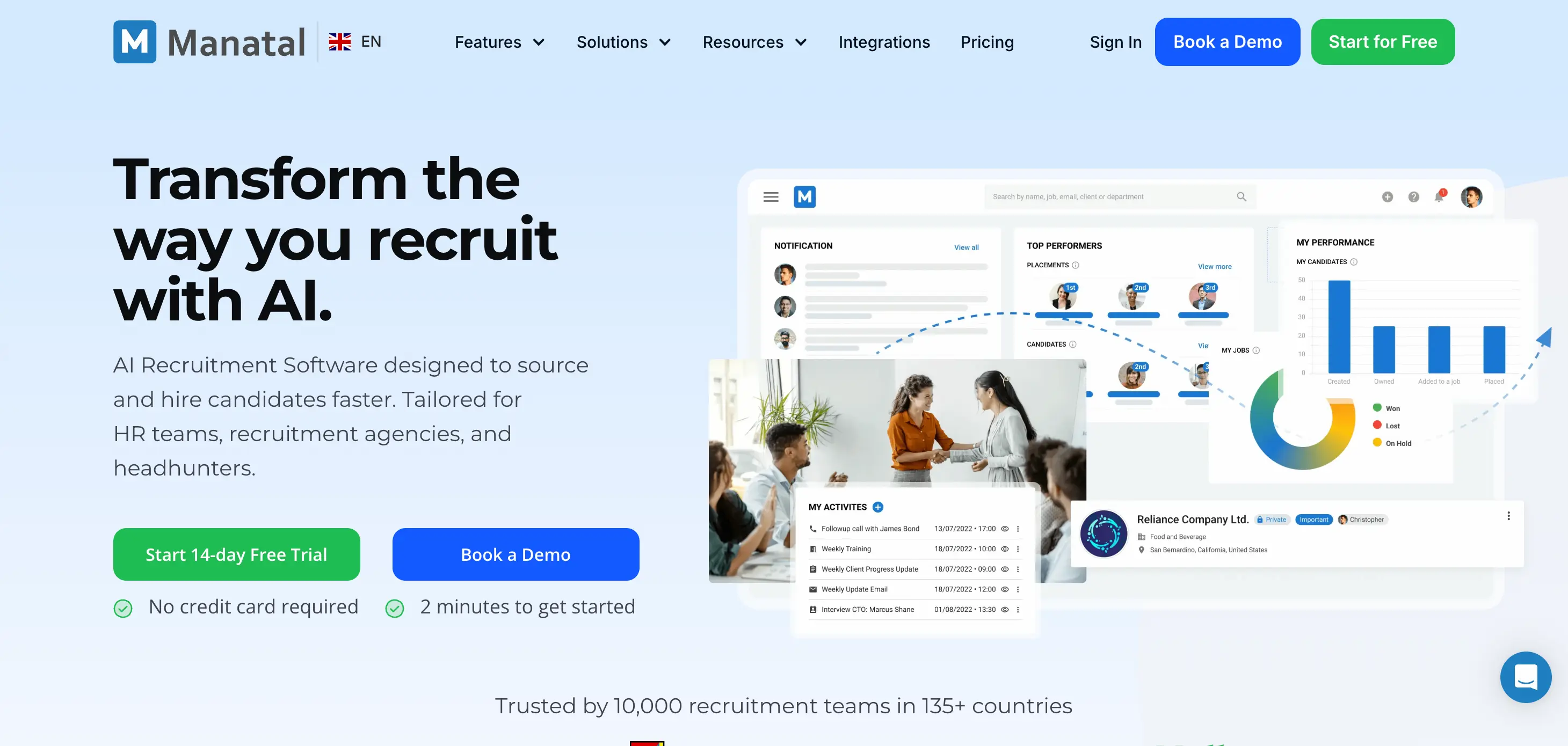
Best for: Small and midsize recruiting teams and agencies that want AI sourcing capabilities built into an affordable ATS.
Key features
- 700M+ external candidate profiles
- AI semantic candidate search
- AI candidate scoring and recommendations
- People-Match AI sourcing extension
- Candidate sourcing from LinkedIn and 10+ platforms
- 2,500+ job board channels
- AI candidate profile enrichment
- Existing candidate database search
Why We Chose Manatal
Manatal is one of the more accessible AI sourcing tools for recruiters who don't want to purchase a separate sourcing platform and ATS. Its Sourcing Hub provides access to more than 700 million external professional profiles, while its People-Match AI extension lets recruiters capture candidates directly from LinkedIn, Indeed, GitHub, SEEK Talent Search, Xing, and other platforms. Recruiters can also distribute vacancies across more than 2,500 job board channels from the same system.
Manatal also makes existing candidate data searchable. Its AI extracts job requirements and scores candidates in the database against them, while semantic search can uncover relevant candidates that exact keyword searches might miss. Profiles can also be enriched with updated information from more than 20 social and public sources. This isn't as explicitly rediscovery focused as Gem or Findem, but it does give recruiters a practical way to resurface candidates they've previously collected and assess them against new opportunities.
Pros
- ✓ Large external candidate database.
- ✓ Semantic search and AI candidate matching.
- ✓ Browser extension for sourcing from multiple platforms.
- ✓ Searches and ranks candidates already in your database.
- ✓ Broad job-board distribution.
- ✓ Combines external sourcing with an ATS.
Cons
- − Sourcing is one part of a much broader ATS rather than its sole focus.
- − Existing-talent rediscovery is less sophisticated than specialist platforms such as Gem and Findem.
- − Some advanced functionality is reserved for higher plans.
ATS integrations
Manatal supports integrations through Zapier and n8n, connecting it with thousands of applications, alongside integrations with tools such as Slack, Salesforce, and Microsoft Teams. Its broader HR tech connectivity includes BambooHR, HiBob, SAP SuccessFactors, Oracle Taleo, and ADP, while an Open API is available on higher plans.
Pricing
Manatal has transparent per-user pricing with several plans for individuals, small teams, growing organizations, and larger businesses. A free trial is available, while higher plans increase candidate and job capacity and add functionality such as workflow automation, advanced reporting, API access, LLM integrations, and custom integrations.
How to Choose the Best AI Sourcing Tools
Start with the problems in your current sourcing process, then consider how well each platform fits your team, recruiting stack, and long-term hiring needs.
Start With Your Sourcing Challenges
Before comparing features, identify what you actually need to improve.
- Are recruiters spending too long searching for candidates?
- Are niche or passive candidates difficult to find?
- Do you have thousands of previous applicants sitting unused in your ATS?
- Or does outreach take up too much recruiter time?
Once you've identified the bottleneck, prioritize AI sourcing tools designed to solve that specific problem.
Consider Talent Rediscovery
Don't assume every search needs to start with new candidates. Previous applicants, silver medalists, sourced prospects, and former employees can all become relevant when another position opens.
Look for tools that can search your existing ATS or CRM, refresh outdated candidate information, match previous candidates against new vacancies, and explain why someone is now relevant. This can help you get more value from the talent pool you've already invested in building.
Evaluate Ease of Use
Powerful sourcing software isn't much use if recruiters struggle to use it. Consider how easily your team can create searches, adjust requirements, understand recommendations, build talent pools, and manage candidate workflows.
Check ATS Integrations and Implementation
Check whether the platform integrates with your existing ATS, CRM, email, calendar, and other essential recruiting tools.
Ask:
- Does the ATS integration simply export candidate profiles
- Does it provide two-way synchronization and allow the sourcing tool to rediscover existing candidates?
- How long is the setup process?
You should also consider recruiter training and any technical support required.
Think About Team Size and Scalability
A solo recruiter, a staffing agency, and a multinational talent acquisition team have very different requirements. Look at pricing structure, user limits, candidate allowances, active job limits, collaboration features, and administrative controls.
The platform should work for your current hiring needs without becoming too expensive or difficult to manage as your team, candidate database, or hiring volume grows.
Review Security & Safeguards, and Transparency
AI sourcing platforms can process large amounts of candidate and company data, making security and responsible AI important considerations. Look for safeguards such as encryption, access controls, independent security certifications, privacy compliance, and audit trails.
Look Beyond Candidate Sourcing
Finally, consider what happens after you've found someone. Some of the best AI sourcing tools for recruiters also provide personalized outreach, resume screening, candidate evaluation, interview scheduling, assessments, CRM functionality, or recruitment analytics.
Consolidating several tasks within one platform could reduce manual work and simplify your recruitment stack.
Our Verdict
The best AI sourcing tools depend on your recruiting needs, whether that's finding niche talent, automating outreach, or rediscovering candidates already in your database. We'd prioritize strong talent rediscovery and ATS integration, while also considering what the platform can offer beyond sourcing to support the next stages of hiring.
Hire-Match is our top pick because it connects talent rediscovery with deeper candidate intelligence. Recruiters can identify relevant candidates from their existing talent pool before using AI-powered screening, assessments, and interviews to understand who is genuinely right for the role.
Frequently asked questions
Some of the best AI sourcing tools for recruiters include Hire-Match, Eightfold, SeekOut, Juicebox, Gem, Findem, Pin, Fetcher, Fountain, and Manatal. The best choice depends on your needs, whether that’s external candidate discovery, talent rediscovery, or high-volume or automated sourcing.
AI can automate significant parts of candidate sourcing, including searching talent pools, matching candidates to job requirements, prioritizing profiles, and personalizing outreach. However, recruiters should remain involved to refine criteria, review recommendations, and decide which candidates to pursue.
Manatal, Pin, Juicebox, and Fetcher offer accessible or self-service options that may suit smaller recruiting teams. However, compare pricing alongside candidate limits, sourcing credits, integrations, and other restrictions to determine which offers the best value for your hiring volume.
SeekOut is a solid choice for technical sourcing because recruiters can search specialized developer profiles, including GitHub data. Other AI sourcing tools, including Pin and Juicebox, provide large external candidate databases and AI matching that can help recruiters quickly narrow searches for technical talent.
AI candidate sourcing tools include Hire-Match, SeekOut, Gem, Findem, Eightfold, Juicebox, Pin, Fetcher, Fountain, and Manatal. Their capabilities vary, but common features include semantic candidate search, AI matching, talent rediscovery, candidate prioritization, and automated outreach.
Yes, some platforms can search existing ATS or CRM data and match previous applicants, silver medalists, and sourced candidates with new vacancies. Eightfold, Gem, Findem, and Hire-Match all provide talent rediscovery or existing-talent matching capabilities, though the depth of functionality varies across platforms.
Many AI sourcing software solutions integrate with popular ATS platforms such as Greenhouse, Lever, Ashby, Workday, and iCIMS. However, integration depth varies. Some simply transfer candidate records, while deeper integrations can synchronize data and enable AI to search and rediscover candidates already stored in your ATS.
Gen AI sourcing software solutions use generative AI to support tasks such as natural-language candidate search, candidate matching, profile summaries, and personalized outreach.
Our recruitment solutions.
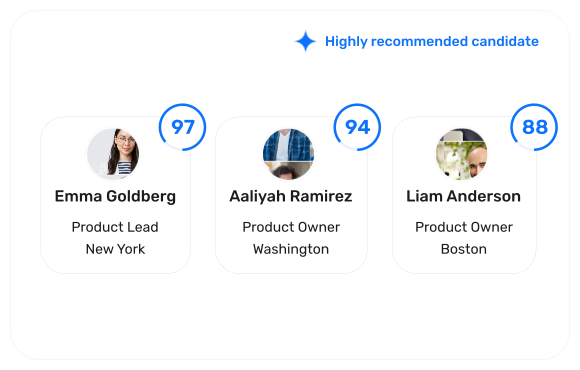
Resume screening software
Turn a pile of resumes into a ranked shortlist, backed by clear hiring evidence.
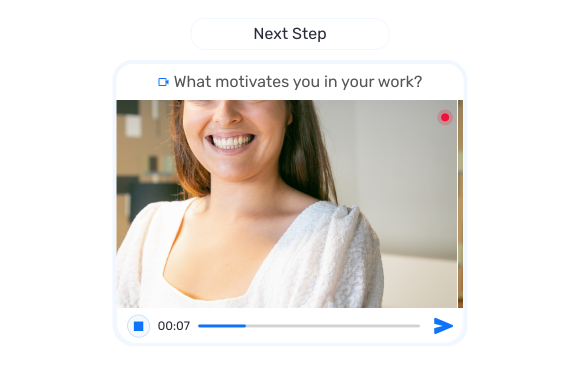
Interview software
Screen candidates with structured video, audio, and conversational interviews.
AI recruiter
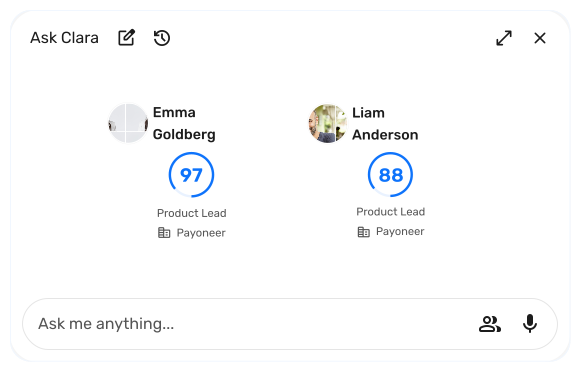
Ask Clara, your recruiting assistant, anything about any candidate in your hiring pipeline.
Candidate assessments
Validate cognitive ability, behavioural fit, and job-specific skills.