September 2026 / 10 min read / Written by our editorial team
If you’re a recruiter, then thinking about the future is just part of your job. Will this candidate perform well? Will they succeed in the role? Unfortunately, recruiters don’t have a magical crystal ball to get these answers, but predictive hiring software is the next best thing. Predictive analytics for hiring uses historical data and patterns to estimate potential hiring outcomes.
In this guide, we’ll explain what predictive hiring is, how it works, where predictive analytics can be used throughout recruitment, and the benefits and limitations to consider before relying on its predictions.
Key Takeaways
-
Predictive hiring uses historical data to identify patterns that can help estimate future candidate and recruitment outcomes.
-
Success must be clearly defined before organizations can determine which candidate signals are relevant to the outcome they want to predict.
-
Candidate evidence needs validation. Skills, experience, assessments, and interviews only become predictive signals when evidence connects them with later outcomes.
-
Predictive analytics can support multiple hiring decisions, from evaluating and prioritizing candidates to forecasting wider recruitment outcomes.
-
Predictive hiring should be a continuous feedback loop. Comparing predictions with actual post-hire outcomes can help organizations learn from results and improve future decisions.
What Is Predictive Hiring?
Predictive hiring uses objective historical data to identify patterns and estimate future recruitment outcomes.
The type of data gathered includes:
- Candidate resumes
- Candidate assessment or interview results
- ATS records
- Employees tenure
- Current/past employee performance
- Company retention
Predictive analytics in recruitment can be used to estimate a range of outcomes, including:
- Candidate success or job performance
- Candidate-to-role fit
- Employee retention
- Ramp-up time
- Offer acceptance
- Time-to-fill
- Other role- or organization-specific outcomes
For example, an organization might compare the skills, pre-employment assessment results, and interview scores of previous candidates with their eventual job performance. If certain pre-hire signals are consistently associated with stronger performance, those patterns could help inform predictions about future candidates.
Predictive Analytics vs. Recruitment Analytics
Recruitment analytics is a broad term for using data to understand and improve recruitment. This often involves looking at past or current metrics, such as time-to-fill, cost-per-hire, application numbers, or candidate conversion rates.
Predictive hiring analytics goes a step further. Rather than only reporting what has already happened, it uses available and historical data to identify patterns that can help estimate what might happen next.
|
Recruitment analytics |
Predictive hiring analytics |
|
|
Primary purpose |
Measure and understand recruitment activity |
Estimate potential future outcomes |
|
Typical question |
What was our average time-to-fill last year? |
How long is this vacancy likely to take to fill? |
|
Candidate example |
What assessment scores did successful hires receive? |
Are particular assessment results associated with future job performance? |
|
Common outputs |
Reports, dashboards, KPIs, and trends |
Predictions, probabilities, forecasts, and candidate insights |
|
Time focus |
Primarily past and current performance |
Future outcomes informed by relevant current and historical data |
In short, recruitment analytics helps you understand what has happened, while predictive analytics uses relevant patterns in that data to help estimate what could happen next.
How to Use Predictive Analytics in Recruitment
Good predictive hiring starts with a simple question before diving into a mountain of data. First, you need to decide which hiring outcome you want to understand and what evidence could be relevant to it.
The process can then become a continuous cycle where actual hiring outcomes provide new evidence for future predictions.
1. Define What Success Looks Like
First, decide exactly what you are trying to predict. Depending on the role or hiring objective, success could mean:
- Strong performance after 12 months
- Employee retention
- Meeting sales targets
- Faster ramp-up time
- Higher productivity
- Offer acceptance
A “successful hire” isn't a universal outcome. A salesperson may be measured against revenue targets, while success for another role could be based on performance metrics, retention, or a combination of factors. The outcome needs to be clearly defined and measurable before you can determine which signals may predict it.
2. Collect Relevant Candidate Evidence and Historical Data
Next, organizations need data that connects what was known before a hiring decision with what happened afterward.
Pre-hire candidate evidence could include:
- Career and resume history
- Skills and experience
- Qualifications
- Competencies
- Assessment results
- Structured interview evidence
- Candidate-to-role matching
This can then be compared with outcome data from previous hires, such as:
- Job performance
- Retention
- Ramp-up time
- Productivity
- Sales results
- Hiring manager feedback
The data you need will depend on the prediction you are trying to make. For example, predicting retention requires different outcome data from predicting first-year sales performance.
3. Identify Patterns Between Candidate Evidence and Outcomes
Predictive hiring software can analyze historical data to understand connections between pre-hire candidate signals and later outcomes.
For example, an organization could investigate whether candidates who demonstrated particular competencies during assessments and structured interviews subsequently performed better in the role.
However, finding a relationship doesn't automatically mean one factor caused the other or that it should become a hiring criterion. Any potential predictive signal still needs to be relevant, reliable, and appropriately validated.
4. Apply Those Patterns to Current Candidates
Once useful relationships have been identified, they can inform the evaluation of new candidates.
Depending on the software and prediction being made, recruiters might receive:
- Predicted likelihoods or probabilities
- Candidate prioritization or rankings
- Strengths and potential risk indicators
- Predictive candidate insights
- Areas that may warrant further investigation
The aim is to use what an organization has learned from previous outcomes to add context to the evidence available about current candidates.
5. Make the Hiring Decision
Predictions should provide additional evidence rather than make the final decision.
Recruiters and hiring managers can consider predictive insights alongside the candidate's wider evidence and their own evaluation. A high predictive score or ranking shouldn't automatically result in a hire, just as a lower score shouldn't automatically exclude someone from consideration.
6. Measure Actual Outcomes
Predictive hiring shouldn't stop once someone accepts the job. Organizations also need to determine whether the outcome they predicted actually occurred.
If a candidate demonstrates signals historically associated with strong first-year sales performance, then you should measure their actual sales performance after 12 months. This will help you understand whether the original prediction was accurate and useful.
7. Learn and Improve Future Predictions
Each new hiring outcome provides additional evidence to evaluate and improve future predictions.
Organizations can ask:
- Which candidate signals were actually associated with the desired outcome?
- Which signals proved less useful than expected?
- Are certain factors being given too much or too little importance?
- Do the same relationships continue to appear across newer hires?
This creates an ongoing predictive hiring feedback loop:
Define success → Collect evidence → Make predictions → Hire → Measure outcomes → Learn → Improve
Rather than treating predictive hiring as a one-time score, this approach allows organizations to continually test what they believe predicts success against what actually happens.
What Can Predictive Hiring Software Actually Do?
There are multiple ways predictive hiring software can support the recruitment process. The right way depends on the question you want predictive hiring software to answer and the outcome you are trying to predict.
Predict Candidate Success
One of the most common uses of predictive hiring software is estimating how likely a candidate is to succeed after being hired. Organizations can look at historical relationships between employee outcomes and pre-hire evidence such as:
- Skills
- Relevant experience
- Career history
- Competencies
- Assessment results
- Structured interview evidence
For example, if assessment results have consistently been linked with stronger performance in previous hires, this evidence may be useful when evaluating new candidates.
However, an assessment or interview isn't automatically predictive simply because it produces a score. There needs to be evidence that what is being measured has a meaningful relationship with the outcome the organization wants to predict.
Predict Candidate-to-Role Fit
Predictive analytics can also help organizations understand which candidate characteristics have historically been associated with success in a particular role.
This goes beyond simply determining whether someone meets the requirements listed in a job description:
- Candidate matching: How closely does the candidate's evidence align with the stated requirements of the role?
- Predictive analysis: Which candidate signals have historically been associated with the outcome we're trying to achieve?
For example, an employer may assume that five years of industry experience is important for a role, while historical data could indicate that a particular combination of skills and competencies has a stronger relationship with successful outcomes.
Predict Employee Retention
You can analyze previous hiring and employee data to investigate whether certain factors are associated with retention and apply those findings when making future predictions.
However, retention shouldn't be treated solely as something that can be predicted from the candidate. Management, compensation, progression opportunities, workload, workplace culture, and other experiences after hiring can all influence whether an employee stays.
Retention predictions therefore need to account for the wider employment context rather than interpreting attrition simply as a candidate characteristic.
Improve Future Hiring Criteria
Predictive analytics can also challenge assumptions about what makes a strong candidate.
By comparing hiring criteria and candidate evidence with actual outcomes, organizations can ask:
- Are years of experience actually associated with stronger performance?
- Does a particular assessment measure something relevant to later success?
- Are certain interview competencies more useful than others?
- Are recruiters placing too much emphasis on signals that don't correspond with outcomes?
Over time, these findings can help organizations refine job requirements and evaluation criteria around evidence that is more relevant to the outcomes they actually want to achieve.
Forecast Other Recruitment Outcomes
Predictive analytics in recruitment can also be applied beyond individual candidate decisions. Historical recruitment data can help organizations forecast outcomes such as:
- Time-to-fill
- Application volumes
- Offer acceptance
- Future recruitment demand
- Potential hiring bottlenecks
For example, previous hiring timelines for similar positions could help estimate how long a new vacancy may take to fill, allowing recruiters to plan resources and timelines more effectively.
Benefits of Predictive Hiring Software
When used appropriately, predictive hiring analytics can help organizations:
- Make more evidence-based hiring decisions: Use historical outcomes and relevant candidate evidence to supplement recruiter judgment.
- Identify more meaningful candidate signals: Understand which skills, experiences, competencies, assessments, or other factors are actually associated with desired outcomes.
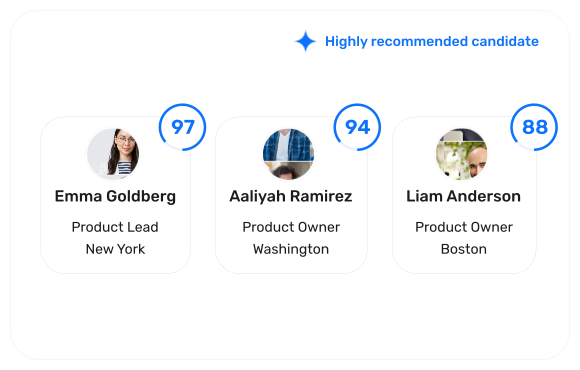
- Prioritize candidates more efficiently: Identify candidates whose evidence aligns with relevant historical patterns and determine where further evaluation may be most valuable.
- Improve consistency: Apply more structured evidence and criteria across candidate evaluations rather than relying entirely on individual judgment.
- Improve recruitment forecasting: Use previous patterns to anticipate hiring timelines, demand, application volumes, and potential bottlenecks.
- Learn from previous hiring decisions: Turn actual outcomes into evidence that can help test assumptions and improve future hiring criteria.
However, the benefits of predictive hiring software depend on the quality, relevance, and validity of the data behind it.
All our recruitment solutions
Resume screening software
Turn a pile of resumes into a ranked shortlist, backed by clear hiring evidence.
Interview software
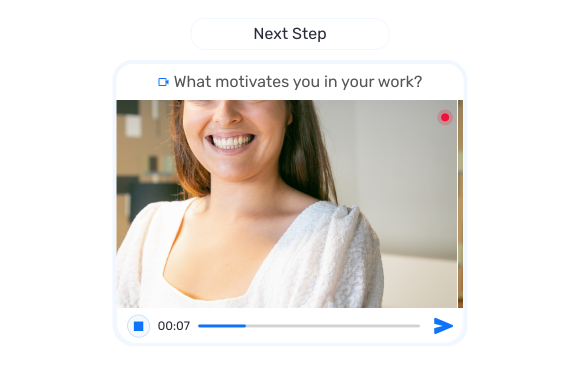
Screen candidates with structured video, audio, and conversational interviews.
AI recruiter
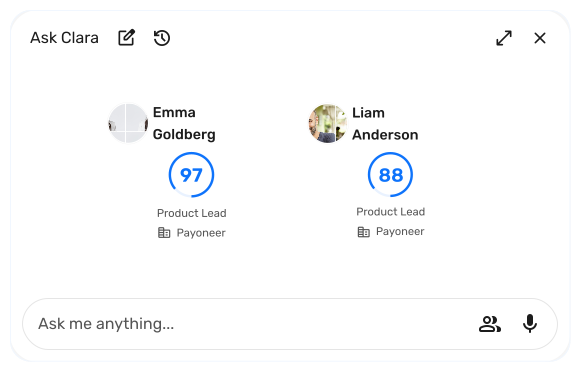
Ask Clara, your recruiting assistant, anything about any candidate in your hiring pipeline.
Candidate assessments
Validate cognitive ability, behavioural fit, and job-specific skills.