Asynchronous Video Interviews: A Guide for Recruiters
August 2026 / 9 min read / Written by our editorial team
Trying to review hundreds of applications while keeping your strongest candidates engaged can feel like spinning plates. The longer it takes to screen applicants, the more likely your best candidates will accept another offer before you reach them.
An asynchronous video interview helps you move through the initial screening stage faster by allowing candidates to answer pre-recorded questions in their own time.
We’ll guide you through how asynchronous video interviews work and how to use them to build a more efficient workflow.
Key takeaways of async video interviews
- Speed up early-stage candidate screening without requiring live scheduling.
- Assess communication skills, motivation, and job fit
- They're most effective at the top of the hiring funnel
- A fairer and more consistent hiring process.
- Best methods combine video interviews with other AI candidate screening tools
What are asynchronous video interviews?
Asynchronous video interviews allow recruiters and candidates to complete the interview at different times, providing greater flexibility than traditional interviewing. The term “asynchronous” simply means “not happening at the same time.” They’re also known as one-way video interviews, pre-recorded video interviews, async interviews, or AVIs.
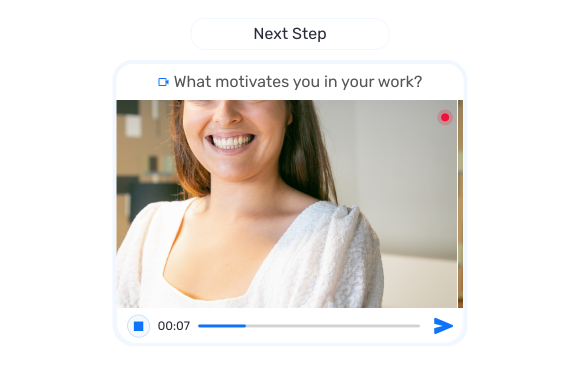
Unlike a synchronous interview, where the recruiter and candidate speak live, the recruiter uploads a set of questions for candidates to answer independently. The recruiter can then review the responses whenever it best fits their schedule.
You might have just heard of them, but AVIs have been used by employers for over a decade. One of the earliest large organizations to adopt this approach was The Walt Disney Company, which introduced them to help screen the high volume of applicants for its Disney College Program. Other big companies already using one-way video interviewing include Amazon, Microsoft, Coca-Cola, and Target. Async interviewing has become an established screening method for organizations looking to make early-stage hiring faster and more scalable.
How do asynchronous video interviews work?
An asynchronous interview is a painless process for the recruiter and the candidate, allowing much more flexibility for both.
- The recruiter creates the interview. Questions can focus on behavioral competencies, job-specific skills, technical knowledge, or culture fit. Some platforms have additional AI tools to help recruiters craft a set of questions most relevant to the role.
- The candidate records their answers. Most asynchronous video platforms give candidates 30–90 seconds to prepare before recording a response lasting up to 3 minutes. Most tools allow candidates to re-record answers, providing a more polished result.
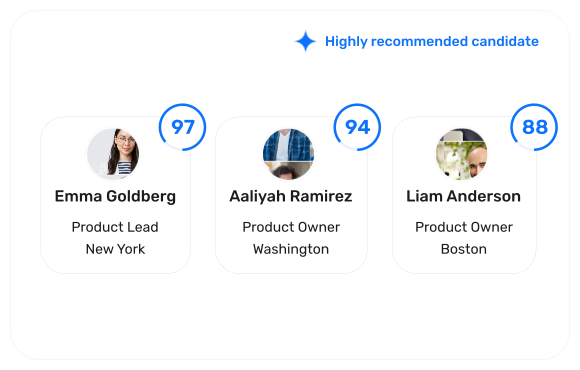
- The recruiter reviews the responses. Once submitted, interviews can be watched whenever they suit your schedule. Platforms like Hire-Match use AI interview software to further streamline the process by summarizing responses, scoring candidates against predefined criteria, and providing insights that help prioritize the strongest applicants.
How asynchronous video interviews can improve your hiring process
An async interview helps you screen more candidates in less time without sacrificing consistency. Here are the biggest advantages:
1. Save time
Time-consuming repetitive phone screens and first-round video calls are replaced with a structured interview that candidates complete on their own schedule. You can quickly identify candidates worth progressing before investing your time in a live interview.
2. Improve consistency
Every candidate answers the same questions under the same conditions. This creates a fairer, more consistent evaluation process and makes it easier to compare applicants objectively. Platforms like Hire-Match have additional tools integrated to ensure objectivity, such as skills-first hiring and regular fairness audits to prevent bias.
3. Review interviews on your schedule
Instead of coordinating calendars, you can review interviews whenever it's convenient. Most asynchronous video platforms also let you pause, replay, or watch responses at faster playback speeds to speed up the screening process.
4. Review a wider talent pool
Candidates can complete interviews from anywhere using a computer, tablet, or smartphone. This removes scheduling barriers and location issues, making asynchronous video screening particularly valuable for remote hiring and global recruitment.
5. Make better hiring decisions together
Because interviews are recorded, multiple team members can review the same responses without attending the same meeting. This improves collaboration and creates a more transparent decision-making process.
6. Gain more accurate insights
Many asynchronous video software platforms, such as Hire-Match, use AI to summarize interviews and score candidates against predefined criteria. When combined with resume screening, skills assessments, and candidate ranking, these insights help you identify the strongest applicants more efficiently.
7. Create a better candidate experience
Research suggests that candidates appreciate the flexibility to complete interviews at their convenience, while structured interview formats help improve perceptions of fairness and transparency. By having time to prepare and re-record answers, candidates also feel less pressure, which helps them perform at their best.
Are there any drawbacks to asynchronous video interviewing?
While asynchronous video interviews offer excellent advantages, they also have some limitations that recruiters should consider.
1. No real-time conversation
Unlike a live interview, candidates and recruiters can't ask follow-up questions or respond to each other in the moment. This can make the experience feel less conversational and make it harder to explore answers in more depth.
2. Some candidates may feel uncomfortable
Not everyone is comfortable recording themselves on camera. For candidates who haven't completed an asynchronous interview before, speaking to a screen instead of a person can feel unnatural and increase anxiety. Luckily, most asynchronous video software allows applicants to prepare and re-record answers, which can help minimize pressure.
3. It can feel impersonal
Some candidates prefer building a relationship with the hiring team early in the process. Because there is no live interaction, one-way video interviews can feel more transactional than traditional interviews. However, they’re often more well-received than AI interviews, which can be clunky and feel fake.
4. Questions around AI transparency
Some asynchronous video software uses AI to analyze and score interview responses. Researchers have highlighted concerns around the transparency of AI-driven decision-making, particularly when candidates don't understand what factors influence their results. We recommend using a platform such as Hire-Match that provides clear explainability for candidate scoring and ranking, so recruiters can understand how recommendations are made rather than relying on opaque AI decisions.
Asynchronous interviews vs. synchronous interviews
Both asynchronous and synchronous interviews have a key role in the hiring process, and neither one should be completely disregarded.
Many organizations use asynchronous video screening to efficiently shortlist candidates before moving the strongest applicants into live interviews, creating a hiring process that is both faster and more thorough.
Best practices for using asynchronous video interviews
When used efficiently, an asynchronous interview can speed up screening while creating a positive candidate experience. Follow these best practices to get the most value from your interview process.
Use it early in the hiring process
Asynchronous video interviews work best at the top of the hiring funnel, usually after AI resume screening. They're ideal for narrowing down a large pool of applicants before investing time in live interviews, rather than replacing them entirely.
Combine interviews with other screening methods
A video interview is only one piece of the puzzle. For more accurate hiring decisions, combine interview responses with resume screening, skills assessments, and other evaluation methods. The best candidate screening platforms, like Hire-Match, offer end-to-end solutions that combine the gathered information to score and rank applicants using multiple data points.
Ask relevant, structured questions
Focus on questions that can't be answered by reading a resume. Behavioral, situational, role-specific, and culture-fit questions often offer the most valuable insights into how a candidate communicates and thinks.
Keep the experience consistent
Ask every candidate the same questions under the same conditions. A standardized interview process makes it easier to compare candidates fairly and consistently.
Set clear expectations
Some candidates may have never completed an async interview. Tell candidates exactly when the interview needs to be completed and provide clear instructions on how to access the platform, record responses, and submit their interview for better candidate experience.
Allow candidates to re-record responses
Speaking to a camera can feel unfamiliar, especially for first-time candidates. Allowing candidates to retake their answers gives them the opportunity to present themselves more confidently without changing the interview structure.
Add a personal introduction
Asynchronous interviews can sometimes feel impersonal. A short welcome video introducing yourself, the role, and your company helps make the experience feel more human and can help to set candidates at ease.
Choose software that fits your hiring process
Look for asynchronous video software that can integrate with your existing ATS, support mobile devices, and doesn't require candidates to overcome unnecessary technical hurdles.
Are asynchronous video interviews right for you?
Asynchronous video interviews are a practical way to speed up early-stage hiring, providing more flexibility while helping you assess communication skills, motivation, and job fit beyond what a resume can show. When used with resume screening, skills assessments, and live interviews, they can reduce time-to-hire and help you identify much stronger candidates.
So, rather than using a standalone video interview platform, consider a solution like Hire-Match, which combines asynchronous video software with AI-driven resume screening, skills assessments, candidate ranking, and explainable AI insights on a single platform. This gives you a more complete view of every applicant and helps you make better-informed hiring decisions from a single workflow.
FAQs
Most AVIs take anywhere from 15 to 30 minutes to complete. However, this depends on the number of questions, preparation time before each response, recording limits, and whether candidates can re-record their answers. We recommend keeping interviews concise enough to maintain engagement while still providing enough insight to evaluate each candidate.
Research the company, review the job description, and practice answering common interview questions aloud. Choose a quiet location with an uncluttered background, good lighting, a reliable internet connection, and a working camera and microphone. Recording yourself beforehand can also help you feel more confident and less awkward on camera.
Some of the most popular asynchronous video platforms include Hire-Match, HireVue, Willo, Spark Hire, VidCruiter, myInterview, and Harver. If you're looking for more than a standalone video interviewing tool, Hire-Match combines asynchronous video interviews with AI resume screening, skills assessments, candidate ranking, and explainable AI insights in a single candidate screening platform.
Although they're often grouped together, asynchronous video interviews and AI interviews are not the same.
Asynchronous video interviews:
- Candidates answer a pre-set list of questions in their own time.
- Recruiters review responses whenever it suits their schedule.
- Candidates may be allowed to re-record their answers.
- The interview follows a structured, consistent format for every applicant.
AI interviews:
- A virtual interviewer asks questions and guides the conversation.
- Responses are typically recorded in a single take.
- The experience is designed to feel more like a live interview.
- There is no human recruiter present during the interview itself.
The approach you choose depends on your hiring needs. Many recruiters prefer asynchronous video interviews for early-stage screening because they offer candidates greater flexibility while giving hiring teams more control over the review process.
The questions asked during an asynchronous video interview will vary by role, but they typically assess communication skills, problem-solving, adaptability, and cultural fit. Some common examples include:
- Can you tell us a little about yourself and your background?
- Tell us about a difficult decision you had to make at work. How did you approach it?
- How would you respond if you received critical feedback from a customer or colleague?
- What type of work environment helps you perform at your best?
- What's the achievement you're most proud of in your previous role, and why?
- What motivated you to leave your last position?
- Describe a time you had to adapt quickly to an unexpected change. What was the outcome?
All our recruitment solutions
Resume screening software
Turn a pile of resumes into a ranked shortlist, backed by clear hiring evidence.
Interview software
Screen candidates with structured video, audio, and conversational interviews.
AI recruiter
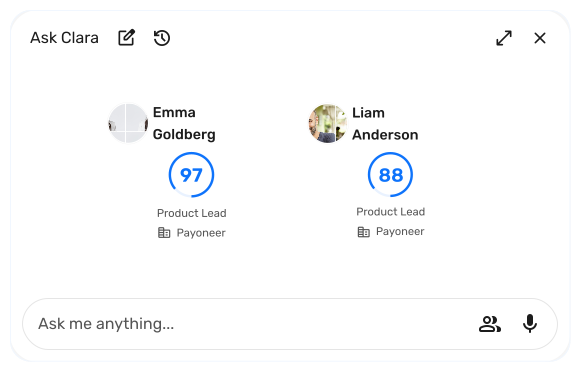
Ask Clara, your recruiting assistant, anything about any candidate in your hiring pipeline.
Candidate assessments
Validate cognitive ability, behavioural fit, and job-specific skills.