AI Candidate Screening: A Complete Guide for Recruiters
August 2026 / 11 min read / Written by our editorial team
If you’re spending more time reading candidate resumes than interviewing strong potential, AI candidate screening might be able to assist.
AI candidate screening automates repetitive tasks, such as AI resume screening, assessments, interviewing, and candidate ranking. In fact, 88% of companies already use AI tools to streamline their workflow.
In this guide, we'll explain what AI screening is, how it works, and where AI adds the most value, and how to choose the right tool for your recruiting needs.
Key takeaways
- AI candidate screening is more than resume screening.
- Use AI to screen, assess, interview, and rank candidates.
- AI improves speed, consistency, and hiring quality.
- The best AI tools supports recruiters, it doesn’t replace them
What Is AI Candidate Screening?
AI candidate screening is the use of artificial intelligence to evaluate, score, rank, and shortlist job applicants during the early stages of the hiring process. Rather than relying solely on manual hiring practices, AI tools use machine learning and natural language processing (NLP) to help recruiters identify the strongest candidates and move them through the hiring funnel more quickly.
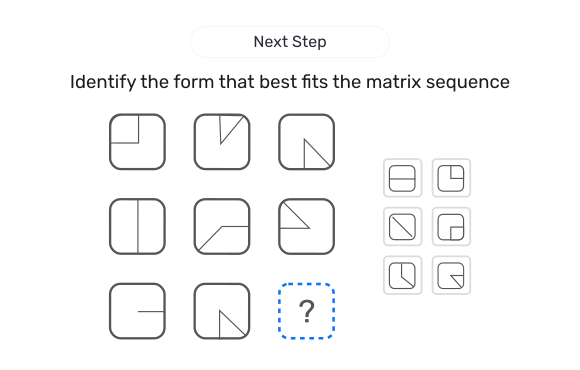
Despite the name, AI candidate screening is not just AI resume screening, although many platforms use these terms interchangeably. Resume analysis is only one part of a much broader screening process. In fact, AI candidate screening acts as an umbrella term for a range of AI-powered recruitment technologies, including:
- AI resume screening
- Pre-employment assessments
- AI and asynchronous video interviews
- Automated candidate screening, ranking, and shortlisting
- Conversational AI
Instead of evaluating candidates based on a single screening method, modern AI screening platforms combine multiple data points to build a more complete picture of each applicant. This allows recruiters to make more informed hiring decisions while reducing manual effort and improving hiring quality.
How Does AI Candidate Screening Work?
While every platform works a little differently, the overall AI candidate screening process is surprisingly straightforward.
1. Set your hiring criteria
Start by defining the role, the ideal candidate profile, and the criteria against which you want applicants evaluated. Depending on the platform, you can integrate AI screening with your existing applicant tracking system (ATS) or use an all-in-one solution with its own built-in ATS. You can also choose how much of the process you want to automate while keeping as much recruiter oversight as you need.
2. Candidates complete the screening process
Once candidates apply, they're automatically guided through the next stages. This may include resume screening, skills or personality assessments, AI or video interviews, or even conversational AI that asks follow-up questions to learn more about each applicant. This can all be done without any manual input, though many tools let you intervene or override functions if you prefer more control.
3. Review interviews on your schedule
As candidates complete each stage, the platform analyzes the results and generates scores, rankings, and shortlists based on your hiring criteria. The best AI candidate screening tools don't just provide a score; they also explain why candidates were ranked as they were, giving recruiters greater transparency and confidence in the results.
4. Move the best candidates forward
With a shortlist of qualified applicants already identified, recruiters can focus their time on interviewing the strongest candidates, making final hiring decisions, and delivering a faster, more efficient hiring experience for everyone involved.
How to Implement AI Candidate Screening in the Recruitment Workflow
Modern AI candidate screening combines technologies that evaluate candidates throughout the early hiring process. Depending on your recruiting needs, you can automate one stage or build an end-to-end workflow that screens, assesses, interviews, and ranks applicants before you ever schedule a live interview.
Your organization may need only one tool or a combination of a few, so choosing a platform depends on what it offers.
To decide, take a look at our in-depth review of the best AI candidate screening tools, which compares the top contenders on the market.
Resume Screening
- Best for: Reducing manual resume reviews and filtering high application volumes.
- Key benefit: Saves time while identifying strong candidates that simple keyword searches might overlook.
AI resume screening automatically reviews resumes against your hiring criteria to identify the strongest applicants.
Traditional screening solutions, including some of the biggest ATS', often focuses on keyword matching, while more advanced AI resume screening software, such as Hire-Match, evaluate transferable skills, career progression, relevant experience, qualifications, and evidence of problem-solving or leadership. Hire-Match combines resume analysis with assessments and AI interviews rather than relying on resume screening alone.
Pre-Employment Assessments
- Best for: Validating both technical ability, skills, and judgment.
- Key benefit: Looks beyond resumes to assess how candidates think, solve problems, and approach real workplace situations.
Pre-employment assessment software measure whether candidates have the skills and behaviors needed to succeed in the role.
These assessments may test cognitive ability, technical knowledge, behavioral traits, personality, or situational judgment. For example, a software developer may complete a coding challenge, while a manager could be asked how they would respond to an employee repeatedly arriving late. There isn't always a single "correct" answer, as some assessments are designed to evaluate decision-making, communication style, and workplace behaviors.
One-Way Video Interviews
- Best for: Evaluating preparation skills, communication, and cultural fit.
- Key benefit: Saves scheduling time while revealing qualities that can't be seen on a resume.
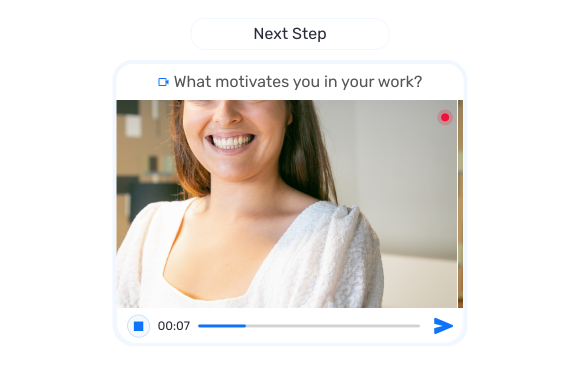
One-way video interviews ask candidates to record answers to a series of pre-set questions without a recruiter present.
Unlike regular interviews, candidates can usually complete the interview at their convenience and can often re-record their responses before submitting them. It can also make the interview process less stressful for those who aren’t as comfortable with public speaking but still have all the merits needed for the role. Asynchronous interviews give recruiters valuable insight into an applicant’s communication skills, confidence, and personality while removing the need to schedule dozens of first-round interviews.
AI Interviews
- Best for: Conducting fair, standardized first-round interviews.
- Key benefit: Creates consistency and provides recruiters with AI-powered insights alongside interview recordings.
AI interview software guides candidates through a structured interview process without a recruiter present.
Candidates will usually receive a link to complete the interview at a time that suits them, answering the same standardized questions as every other applicant. This creates a more consistent screening process while reducing scheduling delays and avoiding first impression bias. Many of the best AI interview platforms also generate summaries, interview highlights, and explanations for candidate evaluations, helping recruiters quickly understand each applicant before deciding who advances to the next stage.
Some tools even take this a step further with a virtual interviewer responding to the candidates' answers and adapting the interview in real time, more closely mirroring a real interview for a more personalized and natural experience.
Candidate Ranking
- Best for: Prioritizing the strongest candidates quickly.
- Key benefit: Produces more objective shortlists using data from the entire screening process rather than a single evaluation.
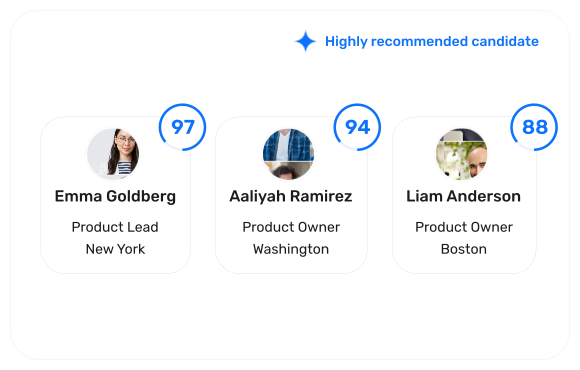
Candidate ranking software compares every applicant against your hiring criteria and automatically orders them from strongest to weakest match.
Unlike an assessment score, which reflects performance on a single test, candidate ranking considers multiple data points. This includes resumes, assessments, interviews, and other screening results, to predict overall suitability for the role. This creates a consistent, evidence-based shortlist while reducing the inconsistencies that can occur when recruiters manually compare large candidate pools under time pressure.
AI Chatbots and Conversational Screening
- Best for: High-volume recruiting and improving the candidate’s experience.
- Key benefit: Engages candidates instantly while reducing repetitive administrative tasks for recruiters.
AI chatbots use natural conversations to screen candidates before formal interviews begin. Candidates answer screening questions through text, messaging apps, voice calls, or web chat. These conversations typically take just a few minutes and can happen immediately after someone applies, regardless of the time of day. Many conversational AI tools can answer candidate questions, collect additional information, schedule interviews, and send automated follow-up messages.
Did you know: 64% of candidates say they would apply for a job via a chatbot if one were available.
How does AI Improve Candidate Screening?
If you've recruited recently, you'll know that screening applicants manually isn't getting any easier. Fortunately, automated candidate screening can handle repetitive tasks, evaluate candidates more consistently, and provide the insights you need to make better hiring decisions.
Save Hours of Manual Screening
Instead of spending hours reviewing resumes, scheduling interviews, and comparing candidates, AI automates repetitive tasks and highlights the strongest applicants. 61% of candidates accept the first job offer they receive, indicating that hiring speed is directly related to offer acceptance.
Evaluate Candidates More Thoroughly
The best AI candidate screening tools don't just analyze resumes. They combine resumes, assessments, interviews, and other screening methods to give you a more complete view of each candidate's skills, experience, and overall fit for the role. This can lead to hiring stronger candidates and reducing the risk of missing great potential through human error, bias, or fatigue.
Make Fairer Hiring Decisions
AI evaluates every applicant against the same predefined criteria, creating a more consistent screening process. Rather than relying on first impressions or who's the most confident in an interview, you'll have objective data to support your decisions. Most AI tools also anonymize candidates throughout the screening process, removing unconscious bias from the equation.
Stay in Control
AI should support your hiring decisions, not make them for you. Unlike blackbox hiring, platforms like Hire-Match explain why candidates have been shortlisted, allowing you to review the evidence, challenge recommendations, and make the final call. We recommend choosing a screening tool that lets you intervene at any stage of the hiring funnel.
Improve Hiring Quality
Research has found that AI has a stronger impact on improving the quality of hire, thanks to its ability to evaluate candidates using multiple data points rather than resumes alone. The result is a stronger shortlist and better-informed hiring decisions.
Like any hiring technology, AI candidate screening isn't without its challenges. Understanding these limitations will help you choose the right platform and use it effectively.
Are There Any Drawbacks to AI Candidate Screening?
While automated candidate screening offers significant advantages, there are a few considerations to keep in mind.
AI Screening AI?
As more candidates use AI to write resumes, employers are increasingly using AI to evaluate them. It may sound like fighting fire with fire, but the best AI screening tools look far beyond resumes by incorporating assessments, interviews, and other data points. Rather than simply matching keywords or job fit, these tools surface the candidate’s story behind the CV and discover long-term potential that may otherwise have been missed.
Is It Less Personal?
Some candidates worry that AI removes the human touch from hiring. In reality, AI often handles repetitive tasks behind the scenes, giving you more time to build meaningful relationships with the candidates who progress through the process.
Does It Cost A Lot?
AI candidate screening software can be expensive, especially for larger hiring teams. However, many organizations offset the cost through reduced administrative work, faster hiring, and better-quality shortlists.
Does AI Candidate Screening Replace Recruiters?
Growing skepticism about AI often stems from the fear that it will replace human jobs. However, the best hiring decisions still combine AI-powered insights with human judgment to ensure every candidate is evaluated fairly and accurately. In fact, most recruiters welcome AI to reduce manual workload and ease pressure, thereby improving their own work performance.
How to Use AI Candidate Screening for Job Applications
The best AI candidate screening tools don't replace recruiters; they make them more effective. Follow these best practices to get the most from your AI-powered hiring process.
Keep Recruiters in the Loop
AI should support your hiring decisions, not make them. Always review shortlists and use human judgment before progressing or rejecting candidates.
Look Beyond Keywords
Choose tools like Hire-Match that evaluate skills, career progression, assessment results, and interview performance rather than relying solely on keyword matching, which has often proved to be an unreliable AI tool.
Set Clear Screening Criteria
AI is only as good as the criteria you provide, and if you make mistakes, the AI will likely make them too. Effective AI tools like Hire-Match help you define your ideal candidate and job criteria carefully to generate stronger shortlists.
Prioritize Transparency
Use AI platforms that explain why candidates have been scored or ranked in a certain way, so both your hiring team and candidates understand how decisions are made.
Protect Candidate Data
Make sure your AI screening software complies with data privacy regulations and handles candidate information securely throughout the recruitment process.
Build a Multi-Stage Screening Process
Don't rely on resumes alone. Combining resume screening, assessments, interviews, and candidate ranking will give you a more accurate picture of each applicant and lead to better hiring decisions.
If possible, choose a platform that supports multiple screening methods in one ATS, instead of requiring separate tools for resumes, assessments, interviews, and ranking.
Why Choose a Unified AI Candidate Screening Platform?
By now, it's clear that effective AI candidate screening is much more than reviewing resumes. The best hiring decisions come from evaluating candidates across multiple touchpoints, not just what they've written on paper.
That's where Hire-Match stands apart.
Rather than focusing on a single stage of recruitment, Hire-Match brings the entire screening process together on a single platform, allowing you to build a more complete picture of every applicant.
With Hire-Match, you can:
- Screen resumes using AI that goes beyond keyword matching.
- Assess candidates with validated cognitive, behavioral, personality, integrity, and job-specific reasoning tests.
- Conduct structured AI interviews that evaluate problem-solving, confidence, emotional regulation, and decision-making under pressure.
- Rank candidates using data from every stage of the screening process, not just a single assessment or resume.
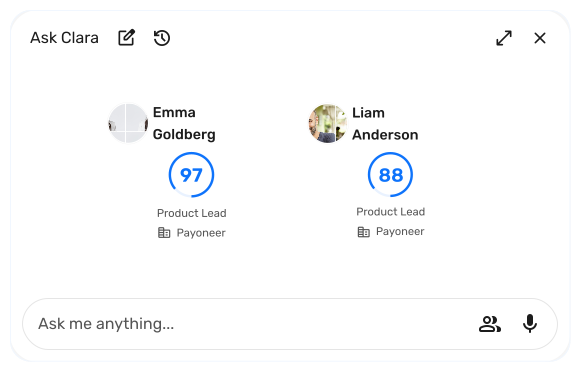
- Get guidance throughout the hiring process by simply asking Clara, an AI recruiting assistant that explains candidate results, answers questions, and supports hiring decisions.
Instead of asking, "Who has the best resume?", Hire-Match helps you answer the more important question: "Who is most likely to succeed in this role?".
By combining AI with human expertise, Hire-Match helps you spend less time managing the recruitment process and more time connecting with candidates with the best potential.
The Bottom Line
AI candidate screening is much more than screening resumes. From assessments and AI interviews to candidate ranking and conversational screening, today's platforms evaluate applicants from multiple angles to help you identify the best fit for the role.
By choosing a platform that supports the entire screening process rather than a single hiring stage, you can make faster, fairer, and more informed hiring decisions while creating a better experience for both your hiring team and your candidates.
FAQs
AI candidate screening can help reduce human bias by evaluating every applicant against the same criteria and using anonymization throughout the screening to remove unconscious bias or pre-conceived ideas about age, gender, or race.
AI candidate screening is most valuable when you're hiring at scale, reviewing large numbers of applications, or looking to improve consistency and efficiency. It can benefit businesses of any size by automating repetitive screening tasks and helping identify stronger candidates.
Traditional phone screening relies on a recruiter's availability and subjective assessment, whereas AI candidate screening can evaluate resumes, assessments, interviews, and candidate responses automatically before a recruiter gets involved.
Pricing varies depending on the platform, features, and hiring volume. Some tools charge per user or per job opening, while other platforms offer custom pricing based on your organization's recruitment needs.
Most AI candidate screening platforms can screen hundreds or even thousands of candidates simultaneously, making them well-suited to high-volume recruitment without increasing your team's workload. Some platforms, like Hire-Match, even allow you to upload resumes from your existing client pool.
All our recruitment solutions
Resume screening software
Turn a pile of resumes into a ranked shortlist, backed by clear hiring evidence.
Interview software
Screen candidates with structured video, audio, and conversational interviews.
AI recruiter
Ask Clara, your recruiting assistant, anything about any candidate in your hiring pipeline.
Candidate assessments
Validate cognitive ability, behavioural fit, and job-specific skills.