October 2026 / 15 min read / Written by our editorial team
Saving time and improving hires are essential to hiring. But with 60% of candidates reporting a poor experience, it’s time that recruiters turned their attention to the other side of the hiring funnel.
Luckily, many hiring platforms now include features for a smoother, more engaging candidate journey, from automated communication and flexible interviews to satisfaction surveys and analytics. These tools help organizations understand and improve the candidate experience, ensuring applicants feel valued even if they don't get the job.
In this guide, we compare the best candidate experience tools for 2026 and explore how they help organizations put candidates first.
Our Top Picks
- Hire-Match: Best for explainable candidate evaluation
- Survale: Best for identifying candidate experience friction points
- Goodtime: Best for interview scheduling and coordination
- Phenom: Best for personalized enterprise candidate journeys
- Sapia: Best for conversational AI interviewing
- Paradox: Best for high-volume candidate communication
- Teamtailor: Best for branded career sites & all-in-one candidate experience
- Starred: Best for candidate satisfaction analytics and benchmarking
Short on time? Jump straight to the reviews.
How We Evaluated the Best Candidate Experience Tools
We evaluated each platform based on how its features improve the candidate journey, from the insights it provides to its ability to help organizations identify and address areas for improvement.
- Candidate benefit: What specific improvements does the platform offer applicants, such as greater convenience, flexibility, transparency, or fairness?
- Hiring stage: Which parts of the candidate journey does it support, from job discovery and applications to interviews, offers, and onboarding?
- Communication and engagement: Does it help employers keep candidates informed through timely updates, personalized messages, or self-service features?
- Accessibility and flexibility: Can candidates participate conveniently, regardless of their location, schedule, or preferred communication method?
- Candidate satisfaction measurement: Does it support candidate satisfaction surveys, Candidate Net Promoter Score (cNPS), or other direct feedback methods?
- Candidate experience analytics: Can recruiters track completion rates, response times, candidate drop-offs, and other metrics to identify friction points?
- Actionable insights: Does the platform help recruiters understand feedback and identify specific improvements rather than simply reporting data?
- Limitations: Which aspects of candidate experience does the platform not address, and does it require additional tools to provide a complete solution?
Disclosure: Although Hire-Match is included in this comparison, every platform was evaluated against the same criteria to ensure a consistent and transparent review process.
The Best Candidate Experience Tools Compared
The table below dives into our top candidate experience tools, comparing their candidate-facing features, communication abilities, and how they measure data for a better candidate experience.
The best candidate experience tools support different stages of recruitment while keeping candidates engaged.
The 8 Best Candidate Experience Tools Reviewed
We’ve reviewed recruiting tools that have taken deliberate measures to provide the best experience for candidates below.
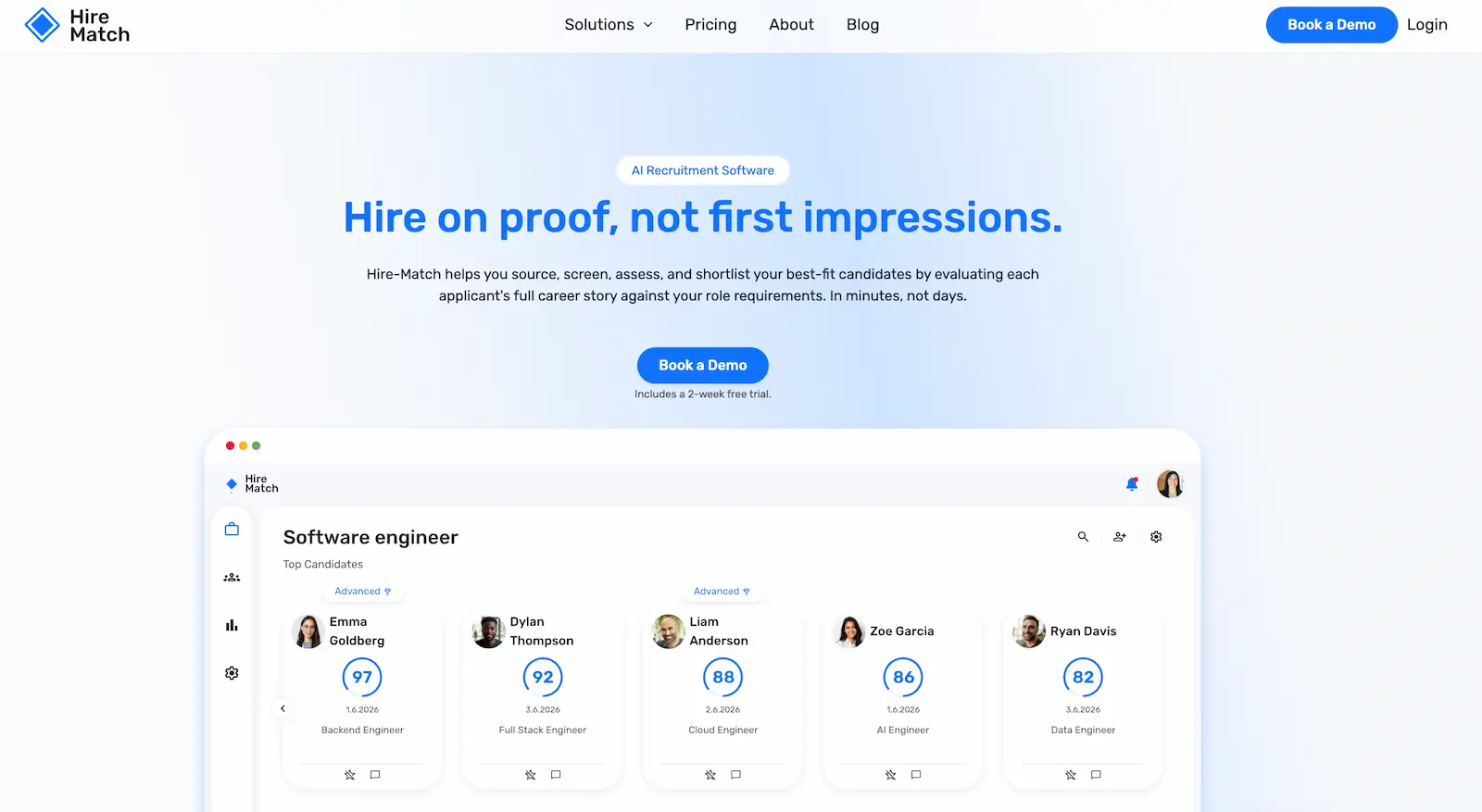
1. Hire-Match
Best for: Organizations looking to combine skills-focused screening, automated candidate communication, and flexible interviews on one platform.
Key Features
- Skills-based AI screening and evaluation.
- Guided AI-chat applications with progress indicators.
- Automated candidate emails and personalized reminders.
- Flexible interviews and self-scheduling.
- Post-application satisfaction ratings and written feedback.
- Candidate progress tracking and recruitment analytics.
Why We Chose Hire-Match
Hire-Match combines candidate-friendly workflows with structured, skills-based evaluation. Applicants follow a seamless screening experience guided by Clara AI recruiter, with clear progress indicators and expectations.
Candidates stay informed through automated emails and personalized reminders during the hiring stage, while flexible interview options give them more control over when and how they participate. The platform also collects direct candidate feedback, helping employers understand how applicants perceive the experience so that they can work on making improvements throughout the process. Hire-Match also provides broader recruitment analytics and tracks candidate progress.
| Pros | Cons |
|
Combines screening, interviewing, and candidate engagement. Guided application experience with clear progress indicators. Automated, personalized communication and follow-ups. Flexible interview formats and candidate self-scheduling. Built-in post-application satisfaction survey. |
No dedicated candidate experience analytics dashboard. No packaged feedback-trend or withdrawal-rate reporting. Interview self-scheduling relies on the employer's scheduling link. |
Pricing
Based on the number of active job openings. Includes a 2-week free trial.
2. Survale
Best for: Organizations looking to measure candidate satisfaction, find recruitment bottlenecks, and improve the hiring experience using real-time feedback.
Key Features
- Automated candidate surveys at every hiring stage.
- Candidate Net Promoter Score (cNPS) and satisfaction tracking.
- AI-powered sentiment analysis and feedback recommendations.
- Candidate experience analytics by job, recruiter, location, and hiring stage.
- Internal and industry benchmarking through CandE research.
- Real-time dashboards, alerts, and customizable reports.
Why We Chose Survale
Survale is dedicated to measuring and improving candidate experience. Rather than managing interviews or screening candidates, it integrates with existing recruitment systems to automatically collect feedback after key interactions, including applications, interviews, and offers. This helps employers understand how candidates feel about their hiring process rather than relying on recruitment performance metrics.
Its biggest advantage is turning feedback into actionable improvements. Survale combines candidate NPS, satisfaction scores, and written comments with operational data to identify where problems occur and what may be causing them. For example, recruiters can investigate whether poor interview feedback relates to scheduling delays, slow communication, or particular hiring stages. AI-powered sentiment analysis highlights recurring concerns, while benchmarking and trend reporting help organizations measure whether changes are improving candidate experience over time.
| Pros | Cons |
|
Collects candidate feedback throughout the hiring journey. Combines satisfaction metrics with operational data to pinpoint problems. AI analysis identifies recurring issues and recommends improvements. Industry benchmarking helps measure performance against peers. |
Focuses on feedback and analytics rather than directly managing screening, interviewing, or scheduling. Requires integration with recruitment systems to offer contextual insights. Effective measurement depends on candidates responding to surveys. |
Pricing
Survale offers custom pricing, with organizations required to request a demo and quote.
3. GoodTime
Best for: Those looking to simplify interview scheduling and give candidates more control over their interview experience.
Key Features
- AI-powered scheduling for individual, panel, and multi-day interviews.
- Candidate self-scheduling and rescheduling.
- Branded candidate portal with interview details and resources.
- Automated reminders and updates via email, SMS, and WhatsApp.
- Anonymous candidate feedback surveys through Candidate Pulse.
- Scheduling analytics, bottleneck detection, and AI recommendations.
Why We Chose GoodTime
GoodTime addresses one of the most frustrating parts of the candidate journey: interview coordination. Rather than exchanging multiple emails to arrange a suitable time, candidates can schedule and reschedule interviews themselves, including complex, multi-stage interviews. Its branded candidate portal brings together interview details, hiring team profiles, and preparation resources. Automated communications also help candidates stay informed and prepared throughout the process.
GoodTime also stands out for combining scheduling efficiency with candidate experience measurement. Its Candidate Pulse feature collects anonymous, role-specific feedback, giving employers direct insight into candidates' experiences. Meanwhile, analytics track metrics such as time-to-schedule, turnaround time, cancellations, and rescheduling. These measures help identify delays, while candidate surveys provide feedback to understand how those delays affect applicants.
| Pros | Cons |
|
Flexible self-scheduling reduces back-and-forth communication and time delays. Candidate portal centralizes interview information and preparation resources. Automated messaging keeps candidates informed across multiple channels. Combines candidate feedback with scheduling analytics to find improvements. |
Primarily focused on interview coordination rather than the entire recruitment journey. Candidate experience analytics focus heavily on the interviewing stage. |
Pricing
GoodTime offers custom pricing based on annual candidate volume rather than the number of users.
4. Phenom
Best for: Large organizations that want personalized, connected candidate experiences across the hiring process.
Key Features
- AI-powered career sites recommend relevant jobs and content based on candidate skills, interests, and location.
- Personalized email, SMS, and chat campaigns keep candidates engaged with relevant opportunities.
- AI screening offers candidates flexible, 24/7 access to structured conversations.
- Self-service interview scheduling allows candidates to book appointments through chatbots, career sites, or text messages.
- Automated interview reminders and updates reduce interview uncertainty throughout the hiring process.
- Recruitment analytics track candidate drop-off, campaign conversions, and hiring bottlenecks.
Why We Chose Phenom
Phenom stands out for its ability to personalize the candidate journey from the first career-site visit through screening and interviews. Its Intelligent Career Site recommends opportunities to potential candidates based on their individual skills, interests, and location. Candidates can also receive personalized communications, complete AI-powered screening at convenient times, and schedule interviews without back-and-forth email exchanges.
Phenom also helps recruiters understand where candidates drop out of the hiring process, highlighting areas that may need improvement. Talent CRM provides visibility into stage-to-stage drop-off and campaign performance, while recruitment analytics help identify delays and other bottlenecks. This allows employers to improve the journey based on candidate behavior.
| Pros | Cons |
|
Personalized career sites help candidates discover relevant opportunities. Connected communication, screening, and scheduling reduce friction between stages. Flexible screening and self-scheduling are more convenient. Conversion and drop-off analytics help |
Its focus on enterprise teams may be unsuitable for small teams or startups. Candidate NPS and CSAT survey capabilities are not confirmed. |
Pricing
Phenom uses custom, quote-based pricing, with costs depending on the products and capabilities needed.
5. Sapia.ai
Best for: Teams looking to offer candidates a flexible, inclusive interview experience while measuring satisfaction and engagement.
Key Features
- Text-based AI interviews assess job-relevant competencies.
- Untimed interviews let candidates respond at their convenience.
- Structured questions provide consistent evaluation criteria.
- Personalized interview feedback for every candidate.
- Multilingual interviews support diverse applicants.
- Candidate sentiment, completion rates, and drop-off analytics.
Why We Chose Sapia
Sapia takes a different approach from some other platforms on our list by focusing on inclusive and fair hiring. Its conversational AI interviews allow candidates to show their skills through written responses rather than relying on resumes or video interviews. The untimed, text-first format removes the pressure of performing on camera, while structured, competency-based questions give applicants a chance to show their suitability without worrying about interview anxiety. Candidates also receive personalized feedback, helping them gain something valuable from the process regardless of the outcome.
Sapia.ai also provides tools to measure and improve the interview experience. Its Discover Insights dashboard tracks candidate sentiment, feedback patterns, completion rates, and drop-offs, helping employers understand both how candidates feel and where they disengage.
| Pros | Cons |
|
Candidate satisfaction score of 9.1/10, Flexible, untimed interviews reduce scheduling pressures. Text-based assessments avoid reliance on appearance or voice cues. Personalized feedback provides value to unsuccessful candidates. Candidate sentiment and funnel analytics support ongoing improvements. |
Text-based interviewing may not suit every candidate or role. Primarily focused on interviewing rather than multiple hiring stages. Candidate NPS and configurable CSAT surveys are not confirmed. |
Pricing
Sapia.ai offers custom pricing and the possibility to request a demo and quote.
6. Paradox
Best for: Recruiters dealing with high-volume applications, wanting to automate candidate communication, and provide faster support.
Key Features
- Olivia AI Assistant answers candidate questions 24/7.
- Mobile-first applications through SMS, WhatsApp, and chat.
- Automated interview scheduling, reminders, and updates.
- Multilingual candidate support in 30+ languages.
- Candidate satisfaction surveys and customizable feedback prompts.
- Real-time dashboards track satisfaction, response rates, and conversions.
Why We Chose Paradox
Paradox is unique in how it makes high-volume recruitment more conversational and accessible. Its AI assistant, Olivia, allows candidates to discover jobs, apply, check their application status, and schedule interviews through familiar messaging channels. Unlike traditional methods of filling out lengthy forms or waiting for recruiter responses, applicants can receive instant answers and updates throughout the process.
Paradox also provides tools to measure candidate satisfaction throughout the hiring journey. Olivia can automatically request feedback after applications, interviews, and other interactions using customizable questions and ratings. Recruiters can then check satisfaction scores and survey response rates through reporting dashboards. Combined with application conversion and engagement analytics, this helps employers identify where candidates experience issues and assess whether changes are improving their experience.
| Pros | Cons |
|
Always-on communication reduces candidate uncertainty. Mobile-first applications simplify high-volume hiring. Automated scheduling and reminders reduce delays. Candidate surveys and satisfaction reporting support ongoing improvements. |
Many fairness claims are vendor-reported External audit scope and findings require further verification Predictive models may use incumbent data Assessment-heavy approach may be excessive for smaller teams |
Pricing
Paradox offers custom pricing, with a demo and quote available on request.
7. Teamtailor
Best for: Teams looking to create an engaging candidate journey while measuring satisfaction on one platform.
Key Features
- Customizable, mobile-friendly career sites.
- Quick applications without lengthy forms or logins.
- Candidate chat and automated email and SMS updates.
- Personalized job alerts and talent nurturing through Connect.
- Candidate NPS surveys and satisfaction tracking.
- Recruitment analytics covering conversions and candidate drop-offs.
Why We Chose Teamtailor
Teamtailor is one of the best ATS tools with strong candidate experience we’ve discovered. Its customizable career sites allow employers to highlight their culture, benefits, and employees, while mobile-friendly applications make it easier for candidates to apply. The Connect feature also lets job seekers express interest without applying for a specific vacancy, receive relevant job alerts, and maintain a relationship with the company.
Teamtailor also helps organizations support engagement and measure satisfaction throughout recruitment. Automated communications, candidate chat, and interview scheduling help keep applicants informed, while built-in NPS surveys collect direct feedback on their experience. Its analytics dashboard also tracks application rates, funnel conversions, and candidate drop-offs, allowing recruiters to identify friction points and evaluate improvements without relying on a separate feedback platform.
| Pros | Cons |
|
Combines career sites, ATS, CRM, and candidate experience tools. Mobile-friendly applications reduce unnecessary barriers. Automated communication supports consistent candidate engagement. Built-in NPS surveys and funnel analytics measure experience. |
Less specialized in candidate feedback analysis than dedicated platforms such as Survale.. Organizations with an established ATS may not need another all-in-one platform. |
Pricing
Teamtailor offers custom pricing and a demo on request.
8. Starred
Best for: Recruiters looking to measure candidate satisfaction, benchmark their hiring experience, and identify improvements using detailed feedback analytics.
Key Features
- Automated, customizable candidate surveys at every hiring stage.
- Candidate Net Promoter Score (cNPS) tracking and reporting.
- AI-powered sentiment and comment analysis.
- Priority Matrix identifies the improvements likely to have the biggest impact.
- Industry benchmarking by sector, region, and company size.
- Feedback analytics for withdrawn, rejected, and hired candidates.
Why We Chose Starred
Starred specializes in turning candidate feedback into measurable improvements. Its customizable surveys collect feedback throughout the recruitment journey, from career-site visits and applications to interviews, offers, and onboarding. Candidate NPS provides a consistent measure of satisfaction, while dedicated surveys for withdrawn and rejected applicants help employers understand experiences that might otherwise go unnoticed.
What makes Starred particularly special is its focus on prioritizing improvements rather than simply reporting scores. Its AI-powered comment analysis identifies recurring themes and sentiment, while the Priority Matrix highlights which issues have the biggest impact on candidate experience. Teams can compare their results against industry benchmarks and evaluate performance across recruiters, hiring managers, and interviewers. This helps talent acquisition teams identify specific problems, establish accountability, and measure progress over time.
| Pros | Cons |
|
Collects feedback across the entire candidate journey. Dedicated cNPS tracking and industry benchmarking. AI analysis finds recurring concerns and prioritizes improvements. Measures candidate experience across individual recruiters and hiring teams. |
Focuses on feedback and analytics rather than directly managing recruitment workflows. Requires ATS integration for automated, stage-specific surveys. Insights depend on candidates responding to feedback requests. |
Pricing
Starred offers custom pricing depending on an organization's hiring scale and a free demo.
How to Choose the Best Candidate Experience Tools for Recruiters
Choosing the best candidate experience software is about addressing genuine problems in the hiring process that can make the process easier, clearer, and more engaging for prospective candidates.
1. Identify Gaps in Your Current Candidate Experience
Before you even begin looking at different platforms, you should understand where candidates experience the most friction in the hiring process.
Review recurring themes in candidate feedback and identify if there is a pattern when candidates typically withdraw during the hiring process.
Different tools address different challenges, so match your priorities to the right capabilities:
- Communication tools: Reduce uncertainty through updates and candidate support.
- Scheduling tools: Simplify interview booking and rescheduling.
- Screening and interviewing tools: Offer more flexible, consistent evaluation experiences.
- Feedback and analytics tools: Identify dissatisfaction and reveal opportunities for improvement.
It’s important to put yourself in the candidate's perspective and identify which areas have the most impact on their experience.
2. Evaluate Candidate Communication Capabilities
Communication with candidates is about more than sending notifications. Candidates should feel engaged, informed, and have opportunities to ask questions that don’t take weeks for a response.
Look for features that support communication throughout the hiring journey:
- Application confirmations: Acknowledge applications and explain the next steps.
- Interview communication: Share invitations, reminders, preparation materials, and scheduling changes.
- Status updates: Inform candidates about their progress, delays, and expected timelines.
- Two-way messaging: Allow applicants to ask questions or request assistance with hiring teams or AI recruiters.
- Post-interview communication: Provide decision timelines, feedback where appropriate, and rejection notifications.
Consider which channels the platform supports, including email, SMS, candidate portals, and recruitment chatbots.
3. Look for Candidate NPS and Satisfaction Surveys
Recruitment metrics can tell you how quickly candidates progress, but they don't typically tell you how candidates feel about the experience.
Look for platforms that collect direct feedback through measures such as:
- Candidate Net Promoter Score (cNPS): Measures how likely candidates are to recommend the recruitment experience, using a 0–10 rating.
- Candidate Satisfaction (CSAT): Measures satisfaction with a particular interaction or hiring stage, often using a 1–5 scale.
- Stage-specific surveys: Gather feedback following applications, assessments, interviews, and hiring decisions.
- Qualitative feedback: Allow candidates to explain their ratings in their own words.
We don’t recommend hassling candidates with surveys at every hiring stage, but an automated notification to candidates at the end of the hiring process can be a simple and easy way of collecting feedback. Even candidates who aren’t successful may still have a positive experience of the overall process.
4. Examine Candidate Journey and Conversion Analytics
Candidate feedback provides valuable insights, but recruitment data can also reveal problems that applicants don't directly report, such as abandoned applications and lengthy waiting times.
Look for platforms that track relevant candidate journey metrics:
Behavioral data identifies where problems might exist, not necessarily why, but when combined with candidate feedback, can uncover potential causes.
5. Prioritize Accessibility, Convenience, and Candidate Control
Automating several stages of recruitment can make tasks easier for recruiters, but this doesn’t mean it will be the same for candidates.
Evaluate how much flexibility and control candidates have throughout the process:
- Mobile-friendly applications and communication.
- Interview self-scheduling and rescheduling.
- Flexible interview and assessment formats.
- Clear instructions and realistic time commitments.
- Accessibility features and accommodation request processes.
- Candidate portals with schedules, preparation resources, and progress information.
Did you know: 83% of candidates expect a fully mobile-optimized application process?
Ask platforms to experience the process as a candidate to get a better understanding of whether it is easy to apply, schedule an interview, and communicate concerns.
6. Assess Transparency and Fairness in Candidate Evaluation
Bias in hiring can appear through manual or AI recruiting. Applicants should also understand what they're being assessed on and feel that the evaluation process is consistent and fair.
Consider whether the platform supports:
- Clear evaluation criteria: Candidates understand which skills matter.
- AI transparency: Applicants receive meaningful information about when and how AI contributes to evaluation.
- Job-relevant assessments: Questions and tests reflect the actual requirements of the role.
- Human oversight: Recruiters can review, question, and override AI-generated recommendations.
- Candidate support: Applicants can request accommodations, raise concerns, or seek clarification.
- Consistent evaluation: Candidates are assessed against structured criteria, with safeguards against discriminatory outcomes.
Our article on the best platforms for fair and impartial hiring can take you through our top recommendations.
7. Check Whether Feedback Leads to Actionable Improvements
Collecting candidate feedback is only valuable if recruiters can use it to improve the hiring experience.
Useful capabilities include:
- Sentiment analysis: Finds recurring concerns in written feedback.
- Automated alerts: Flags declining satisfaction, communication delays, or other potential problems.
- Benchmarking: Compares candidate experience against previous results or relevant industry standards.
- Root-cause analysis: Helps identify which hiring stages or practices contribute to dissatisfaction.
- Trend reporting: Measures whether changes improve the experience over time.
For example, if candidate satisfaction decreases after the second round of interviews, this could show applications are waiting too long for updates. A fix as simple as an automated notification can keep candidates informed and improve communication.
Our Verdict
Candidate experience can be difficult to measure when recruiters only see one side of the hiring process. Fortunately, many recruitment platforms now offer satisfaction surveys, feedback analytics, and candidate journey tracking to reveal where improvements are needed.
The best candidate experience tools for recruiters help create a smoother hiring journey through clear communication, flexible interviews, and convenient candidate-facing features. The right platform depends on the bottlenecks and gaps in your current recruitment process.
Improve Candidate Experience with Hire-Match
Hire-Match combines AI-powered resume screening software, video interview software, and candidate assessments to create a more consistent, accessible candidate experience. Clara AI Recruiter also provides candidate guidance and support throughout evaluation.
Book a Hire-Match demo to explore how it can improve your hiring process.
Frequently asked questions
Candidate experience tools are designed to improve how applicants interact with an organization throughout the hiring process. They can include automated communication, interview scheduling, candidate portals, flexible assessments, and feedback surveys. Some platforms focus on improving specific hiring stages, while others help recruiters measure satisfaction and identify areas for improvement.
The best candidate experience software depends on your hiring needs. Hire-Match supports guided applications and skills-based evaluations, GoodTime simplifies interview scheduling, and Paradox automates candidate communication. For organizations focused on measuring satisfaction, Survale and Starred offer dedicated feedback and analytics capabilities. Prioritize tools that address the biggest gaps in your current recruitment process.
Recruiters can measure candidate experience using Candidate Net Promoter Score (cNPS), satisfaction surveys, and written feedback. They can also monitor application abandonment, assessment completion, candidate withdrawal rates, and time between hiring stages. Combining direct feedback with recruitment analytics helps organizations understand both how candidates feel and where they encounter difficulties.
AI can improve candidate experience by automating communication, answering common questions, simplifying interview scheduling, and offering more flexible screening options. AI-powered tools can also analyze candidate feedback to identify recurring problems.
Companies can improve candidate experience by simplifying applications, communicating regularly, offering flexible interview options, and providing clear expectations throughout recruitment. Collecting feedback from successful, unsuccessful, and withdrawn candidates can also reveal areas for improvement. The most effective approach is to identify existing problems, introduce changes, and measure their impact over time.
Our recruitment solutions.
Resume screening software
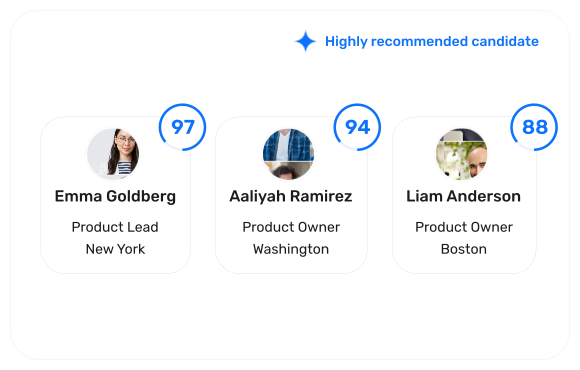
Turn a pile of resumes into a ranked shortlist, backed by clear hiring evidence.
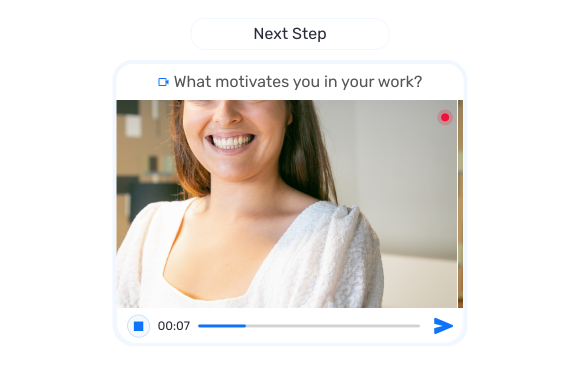
Interview software
Screen candidates with structured video, audio, and conversational interviews.
AI recruiter
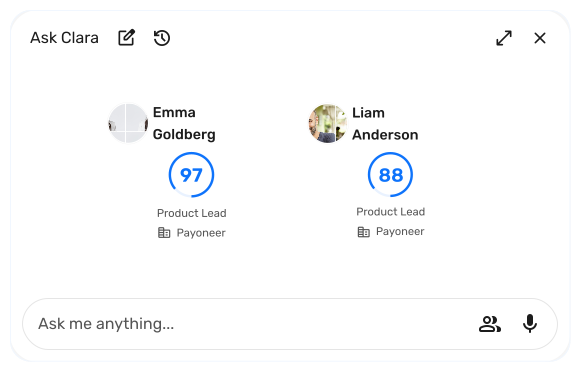
Ask Clara, your recruiting assistant, anything about any candidate in your hiring pipeline.
Candidate assessments
Validate cognitive ability, behavioural fit, and job-specific skills.