September 2026 / 9 min read / Written by our editorial team
Around 40% of employers using AI in recruitment use chatbots to communicate with candidates, and they have become an essential asset in the hiring process. But they aren't designed to replace recruiters entirely. Chatbots for recruitment manage time-consuming tasks such as answering questions, collecting information, scheduling interviews, and guiding candidates through the hiring process.
This guide explains how recruitment chatbots work, where they can help, and the challenges to consider before using one.
Key Takeaways
- Chatbots for recruitment automate candidate communication.
- Conversational AI recruiting tools can understand natural language, context, and follow-up questions.
- Recruitment chatbots can improve candidate experience by providing faster, 24/7 support throughout the hiring process.
- Automating repetitive interactions can reduce recruiter workload and help candidates move through the hiring process faster.
- More advanced chatbots can work alongside resume screening, assessments, interviews, and other recruiting technology.
- Chatbots should not replace recruiters, with human interaction available when candidates need it.
- When choosing a chatbot, consider its AI capabilities, integrations, candidate experience, privacy, security, and ease of implementation.
What Are Chatbots for Recruitment?
Chatbots for recruitment are tools that allow candidates to interact with an AI through a conversational interface. Candidates can ask questions, learn about roles, provide information, receive updates, and move through parts of the recruitment process without waiting for a recruiter to respond manually.
They can help with:
- Answering questions about roles, requirements, and the hiring process
- Providing 24/7 candidate support
- Recommending relevant job openings
- Collecting candidate information
- Conducting conversational pre-screening
- Sending reminders and application updates
- Scheduling or rescheduling interviews based on calendar availability
- Guiding candidates through different recruitment stages
Chatbots for recruitment are useful for both candidate engagement and reducing recruiters' repetitive workload, and they go far beyond simple FAQ bots.
Traditional Chatbots vs. Conversational AI
Not all chatbots for recruitment are the same. While traditional chatbots rely on predefined rules and responses, conversational AI can interpret natural language and adapt to interactions based on context.
| Traditional chatbot | Conversational AI | |
| How it works | Follows predefined scripts, rules, or decision trees | Uses AI to interpret natural language and conversation context |
| Candidate input | Buttons, keywords, or simple questions | Free-form, natural-language responses |
| Responses | Predetermined responses | Context-aware, more dynamic responses |
| Follow-up questions | Follow predefined paths | Can adapt based on what the candidate says |
| Recruiting capabilities | FAQs, basic information collection, simple process guidance | Candidate Q&A, screening conversations, personalized guidance, and recruiting workflow actions |
| Best suited for | Straightforward, repetitive interactions where candidate needs are predictable | More complex or varied candidate conversations that require understanding and adaptability |
A traditional recruiting chatbot can be useful when conversations are predictable. However, conversational AI recruiting goes further by interpreting what candidates mean rather than simply matching their input to a predefined response. This allows conversational AI in HR to handle follow-up questions, maintain context, and support more complex recruiting interactions.
Note: The capabilities of an AI recruiting chatbot vary considerably between platforms. Using AI does not automatically mean a chatbot can understand complex conversations, act autonomously, or perform every recruiting task.
Benefits of Chatbots for Recruitment
The biggest benefits of chatbots for recruitment come from making communication faster and reducing the repetitive work that can slow recruiters and candidates down.
Enhanced candidate experience
Candidates don't always apply for a role during recruiter working hours. Luckily, chatbots can provide immediate, 24/7 access to answers, application information, and next steps rather than making candidates wait until traditional workday hours for a response. Some chatbots extend beyond a careers site to SMS, WhatsApp, and Facebook messenger, making the hiring process more accessible for candidates.
Recruiters can collect more candidate information
A recruiting chatbot can ask candidates questions and collect information conversationally rather than relying solely on application forms. More advanced systems can also ask initial qualification questions or follow up on previous answers more similarly to a human recruiter. This can give recruiters useful information earlier in the process while making it easier for candidates to provide it.
Reduced time-to-hire
Chatbots for recruitment can keep candidates moving along the hiring funnel instead of waiting for recruiters to manually coordinate every next step.
They can:
- Schedule or reschedule interviews
- Send reminders and follow-ups
- Provide application updates
- Guide candidates toward the next hiring stage
For example, A case study on Sodexo reported a 60% reduction in time-to-hire after introducing Paradox's conversational AI recruiting chatbot.
Less manual work for recruiters
Recruiters are constantly swamped with repetitive jobs, and reports suggest a significant portion of their time is taken up with admin-related tasks.
Automating these repetitive interactions gives recruiters more time to interview promising candidates, build relationships, evaluate applicants, and make informed hiring decisions. This is where conversational AI recruiting can complement recruiters rather than replace them.
Lower recruiting costs
Adding an AI recruiting chatbot requires an initial investment, but reducing administrative work and shortening hiring processes can potentially lower costs over time. For example, Neighborly reported a 54% decrease in cost per hire after introducing conversational AI to automate administrative recruiting tasks.
What Are the Challenges of AI Recruiting Chatbots?
Chatbots don’t come without their pitfalls and poorly chosen or implemented technology can create more problems for recruiters. We’ll unpack some of these below.
They can feel impersonal
Some candidates simply prefer human interaction, and even the best AI chatbot won’t convince them otherwise. Be transparent about when candidates are interacting with AI and make it easy to reach a recruiter when human support is needed.
Conversational AI in recruiting isn’t about removing human interaction from recruitment. Instead, chatbots can fill the gaps where humans aren’t needed. By providing quick, accessible support while recruiters focus their attention where human judgment and interaction matter most.
They can frustrate candidates
A poorly implemented chatbot can become another obstacle. Candidates may become frustrated if they misunderstand questions, provide generic or inaccurate answers, or trap them in a conversation with no clear access to a human recruiter.
This makes choosing the right technology important. A basic FAQ bot may be sufficient for simple questions, but more complex candidate interactions require a conversational AI recruiting platform that can understand natural language and context.
Privacy and security require careful consideration
Recruitment chatbots may process personal candidate data, including contact details, resumes, employment history, and other information collected during applications or screening.
Therefore, it's important to understand how candidate data is collected, processed, stored, and protected, and to ensure that the use of AI complies with applicable privacy and employment regulations.
Integration can be complex
Not all chatbots have smooth ATS integration capabilities, and the process differs from platform to platform. Poor integration can create duplicate work, fragmented candidate data, and having to switch between different platforms.
Choose a solution that is compatible with your existing recruitment systems and has a clear implementation process. Ideally, the chatbot should simplify the recruiter's workflow rather than introduce another disconnected tool to manage.
How Can Chatbots for Recruitment Support Your Workflow?
Chatbots for recruitment act as the conversational interface between candidates, recruiters, and the wider hiring technology behind them. The chatbot handles the conversation, while a broader AI candidate screening software may review resumes, send assessments, or even interview candidates.
Pre-screen candidate applications
Chatbots can handle the first conversation with applicants, asking role-specific questions about qualifications, experience, availability, location, or other essential requirements to weed out applicants that aren’t relevant to the role. It also helps identify which candidates are ready to progress, without manually reviewing and contacting every applicant individually.
Schedule interviews
Some chatbots for recruitment can connect with Google or Microsoft calendars, compare candidate and recruiter availability, and schedule or reschedule interviews automatically. Instead of exchanging multiple emails over a period of days or weeks to find a suitable time, candidates can arrange the next step directly through the conversation.
Answer candidate questions
A chatbot can provide 24/7 answers to common questions about the role, application, requirements, or next steps. This also gives candidates an easy way to ask smaller questions they may hesitate to send to a busy recruiter. A conversational AI recruiting assistant can go further by understanding follow-up questions and maintaining context throughout the conversation.
Support recruiters
Chatbots aren't only candidate-facing. An AI recruiting chatbot can also give recruiters an interface for accessing information and navigating the hiring process.
Depending on the platform, recruiters may be able to ask questions about candidates, clarify insights, compare applicants, or decide what needs their attention next. This turns the chatbot into an assistant for both sides of the hiring process.
Work alongside other candidate screening tools
A chatbot becomes particularly useful when connected with other recruiting technology rather than working in isolation.
- Ask for information missing during AI resume screening
- Guide candidates toward pre-employment assessments
- Schedule an asynchronous video interview after screening
- Answer questions before or after an assessment
- Send reminders and follow-ups between hiring stages
- Help recruiters access information collected by other tools
In this way, chatbots for recruitment can connect different stages of the hiring process, keeping candidates informed while helping recruiters manage the wider workflow.
Examples of Recruitment Chatbots
We’ll take you through some of our favorite examples of AI recruiting chatbots, so you can see exactly how they work.
Clara by Hire-Match
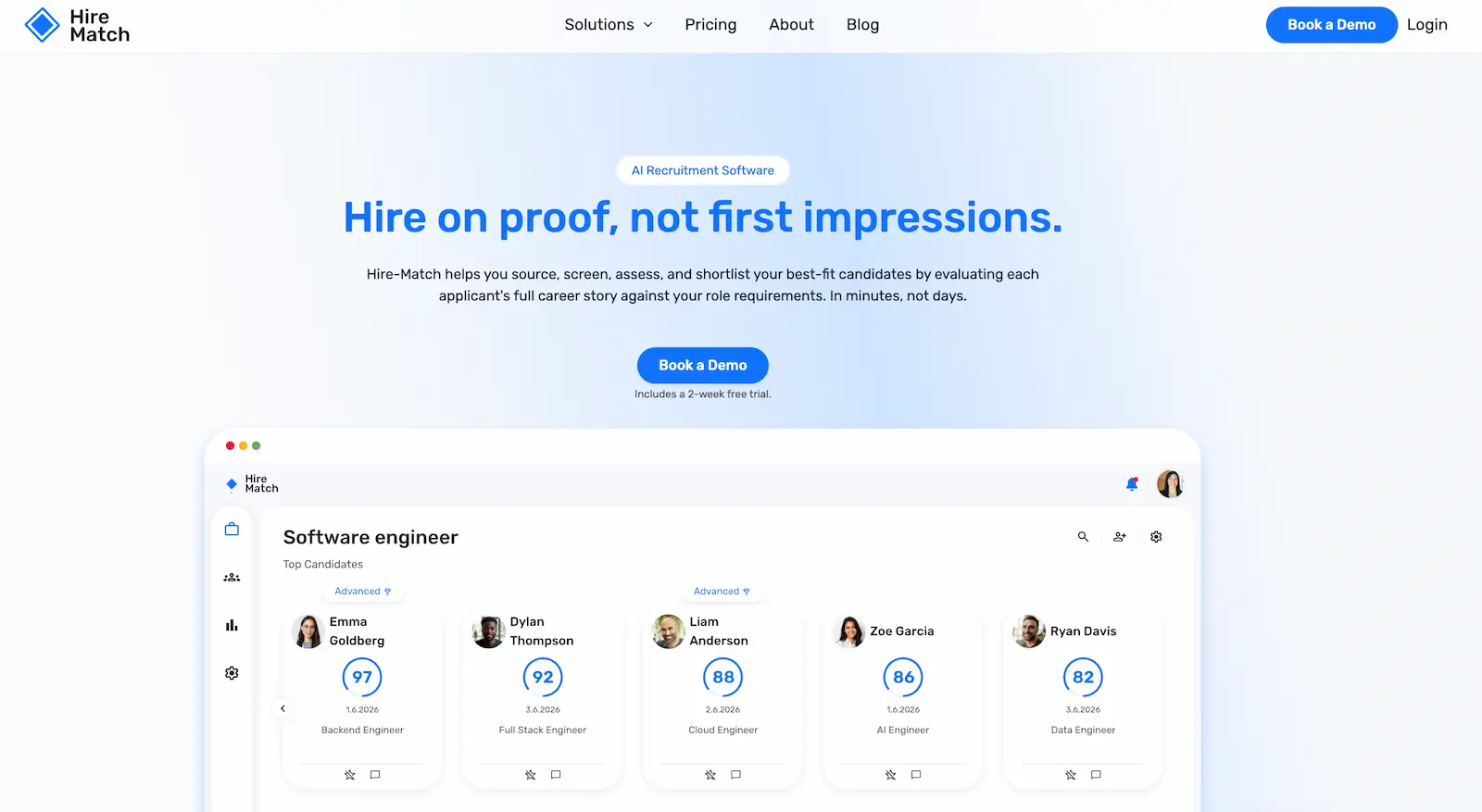
Best for: Conversational Interviewing and Recruiter Support
Key features:
- Conversational, video, and audio interviews
- Adaptive interview follow-up questions
- Deep resume and career analysis
- Recruiter-facing conversational assistant
- Candidate comparisons and explainable insights
- Next-step recommendations
- Candidate ranking and shortlisting
- Optional talent assessment insights
- Human confirmation for sensitive or bulk actions
How Does Clara Work?
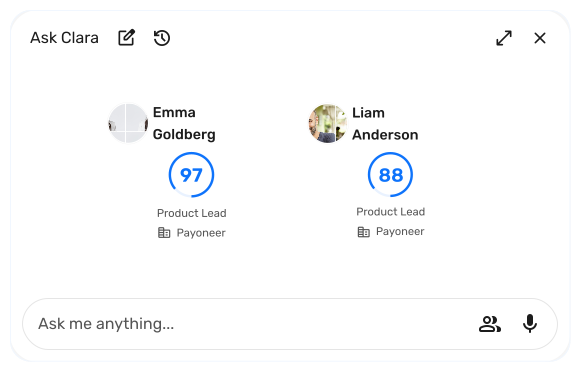
Clara conducts conversational interviews to uncover information beyond the resume, while also giving recruiters an AI assistant to interact with throughout the hiring process.
Recruiters can ask Clara why a candidate ranked highly, compare applicants, investigate potential concerns, or determine what to assess next. What makes Clara particularly special is this focus on explainable hiring intelligence: resume analysis, career history, interviews, and optional assessments can contribute to a ranked shortlist, while recruiters can explore the evidence behind Clara's recommendations rather than simply accepting an AI-generated decision.
Olivia by Paradox
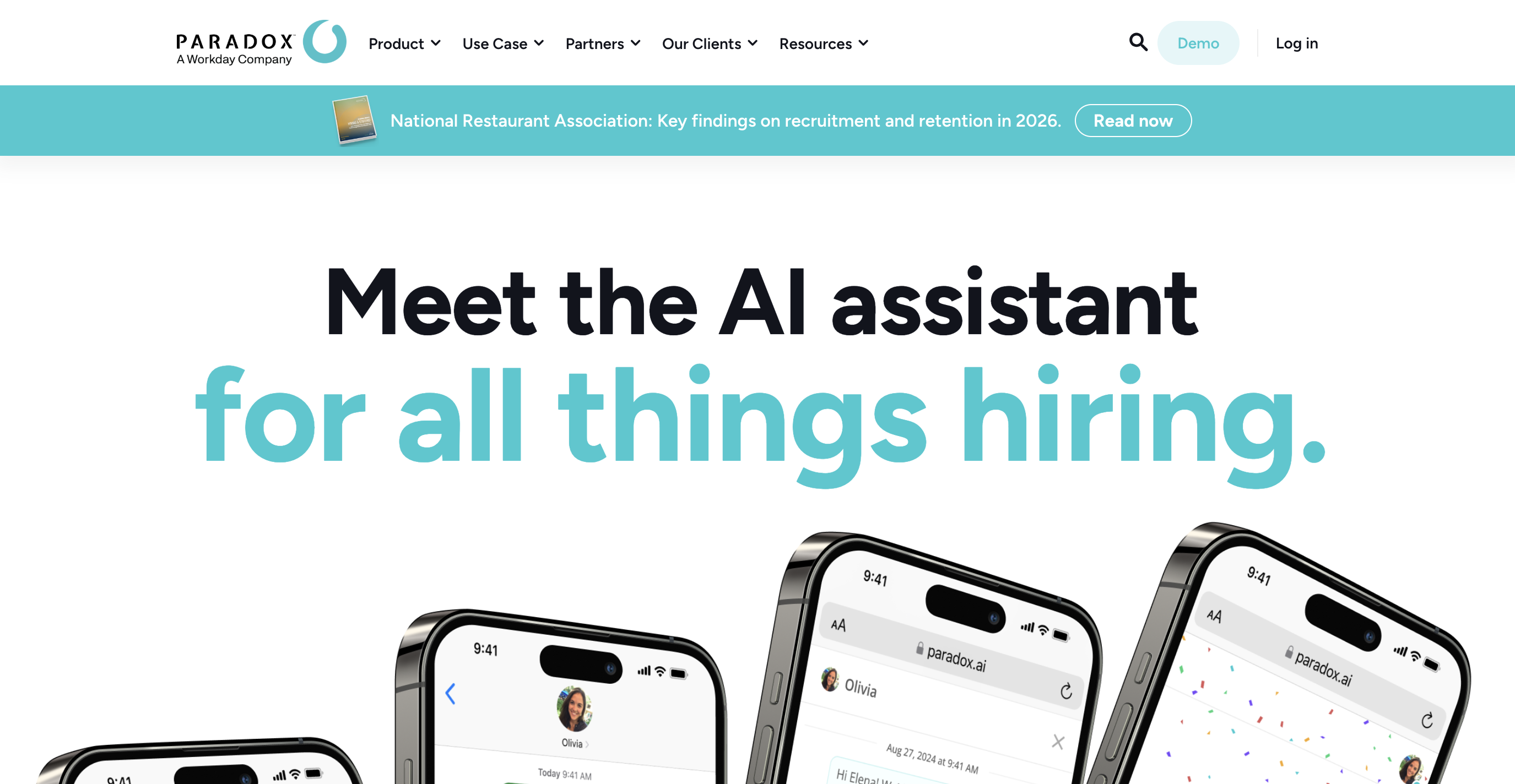
Best for: Mobile-first candidate engagement
Key features
- Conversational Apply via SMS, WhatsApp, and chat
- Candidate screening and qualification questions
- 24/7 candidate Q&A
- Automated interview scheduling, reminders, and rescheduling
- Multilingual applications
- Talent community and candidate pipeline management
- Automated offers and onboarding tasks
- Recruiter-to-candidate texting and chat
- Personalized job recommendations
How Does Olivia Work?
Olivia is a conversational recruiting assistant designed by Paradox to keep candidates moving through the hiring process directly from their smartphones. Candidates can search for jobs, apply conversationally without creating an account, answer screening questions, schedule interviews, and receive updates through channels such as SMS and WhatsApp.
What makes Olivia particularly unique is the breadth of the candidate journey it can support. Rather than limiting its recruiting chatbot to answering FAQs, Paradox uses conversation as an interface for everything from initial job discovery and applications to interview scheduling and onboarding. Recruiters can also step into conversations when human support is needed.
Winston by SmartRecruiters
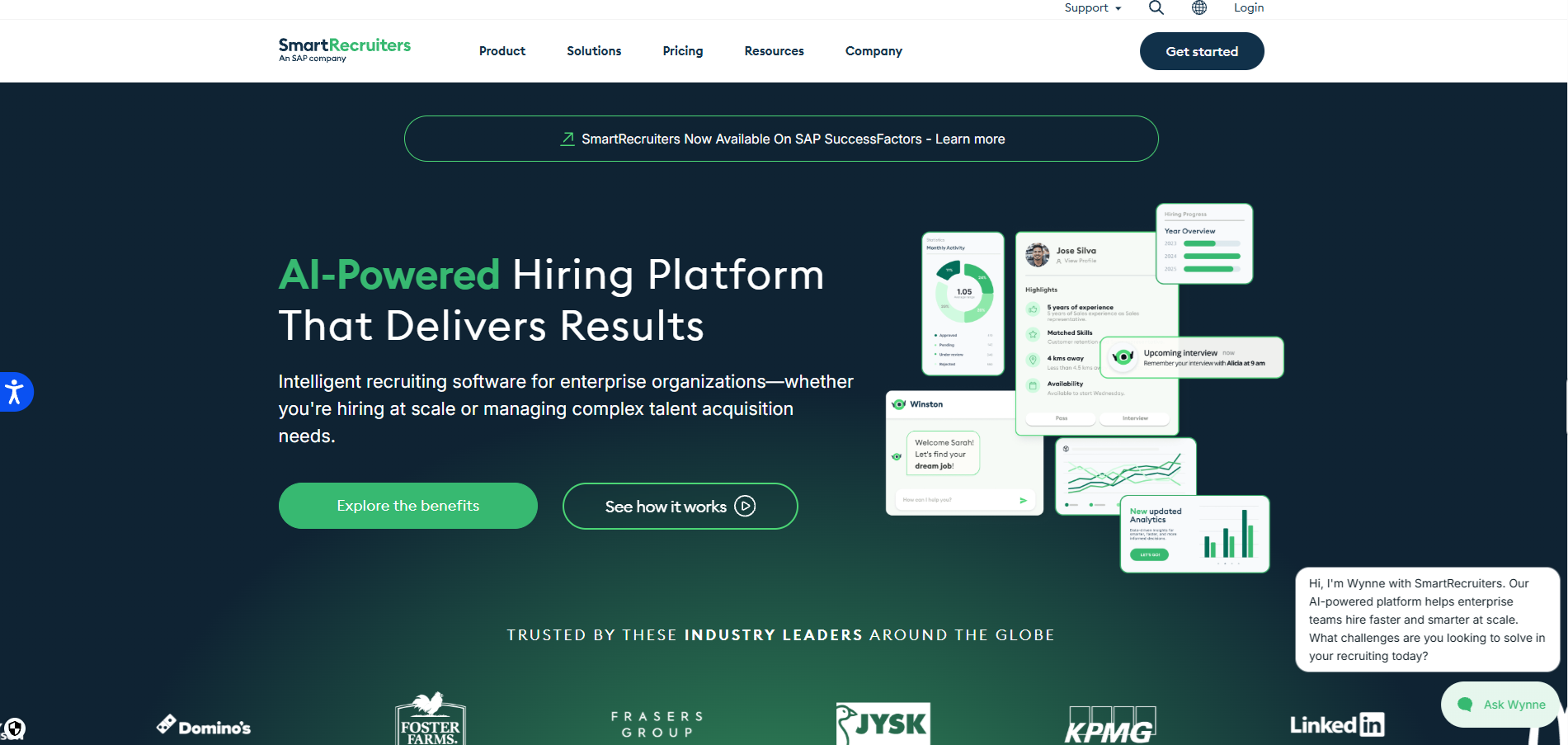
Best for: Personalized candidate engagement
Key features:
- Generative AI-powered candidate conversations
- Personalized job recommendations
- Conversational applications and screening
- Automated interview scheduling
- Real-time application support and updates
- SMS, WhatsApp, and web communication
- Multilingual candidate support
- Career site and knowledge base integration
How Does Winston Work?
Winston Chat is SmartRecruiters' AI recruiting chatbot, supporting candidates from job discovery and applications through screening and interview scheduling. It can recommend relevant vacancies, answer questions, provide updates, and guide candidates through the process across the web, SMS, and WhatsApp.
What stands out is Winston's use of generative AI. Rather than selecting answers from a limited predefined library, it can dynamically generate responses using information from an employer's career site and knowledge base. This creates a more flexible and personalized conversation while allowing employers to provide candidate support at scale.
In a Nutshell
Chatbots for recruitment can make hiring more responsive and efficient by answering candidate questions, collecting information, scheduling interviews, and keeping applicants moving through the process. More advanced conversational AI can go further, supporting recruiters and connecting conversations with screening, assessments, interviews, and other hiring stages.
If you're looking for more than a standalone recruiting chatbot, Hire-Match combines Clara, its AI recruiting assistant, with resume screening, candidate assessments, AI interviews, and predictive candidate insights. This gives recruiters one connected system for engaging, evaluating, and comparing candidates while keeping human decision-making at the center of the hiring process.
FAQs
Chatbots for recruitment are conversational tools that help candidates and recruiters complete hiring tasks. Depending on their capabilities, they can answer questions, recommend jobs, collect candidate information, conduct initial screening, schedule interviews, send updates, and support candidates throughout the hiring process.
One report suggests that around 40% of employers already using AI in recruitment use chatbots for candidate communication. Adoption varies by organization and use case, with recruitment chatbots particularly useful for employers that need to manage large volumes of candidate interactions.
Enterprise recruitment chatbots are available through dedicated AI recruiting platforms and some larger talent acquisition suites. Look for tools that integrate with your ATS, support your required communication channels, meet your security and compliance requirements, and can scale with your hiring volume.
The best chatbots for recruitment depend on what you need them to do. Clara from Hire-Match is a strong choice for combining conversational support with wider candidate evaluation, while Paradox’s Olivia focuses heavily on mobile-first candidate engagement, and Winston by SmartRecruiters provides generative AI-powered candidate conversations.
Not always. Traditional recruitment chatbots may use predefined responses, rules, and decision trees. More advanced AI recruiting chatbot platforms can use generative AI to understand natural language and create context-aware responses. Check how a particular platform works rather than assuming every AI chatbot uses generative AI.
Yes, some recruitment chatbots can ask pre-screening questions and collect information from candidates. More advanced systems may connect these conversations with other AI candidate screening software.
However, the level of screening varies considerably between platforms.
Yes. Some chatbots for recruitment integrate with recruiter calendars to identify available times and allow candidates to schedule or reschedule interviews conversationally. They may also automate confirmations and reminders.
Recruitment chatbots are better suited to supporting recruiters than replacing them. They can automate repetitive communication and administrative tasks, while recruiters are still responsible for areas where human interaction, judgment, and hiring decisions are more valuable.
All our recruitment solutions
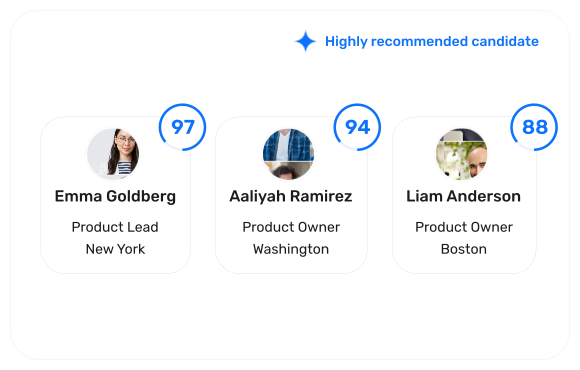
Resume screening software
Turn a pile of resumes into a ranked shortlist, backed by clear hiring evidence.
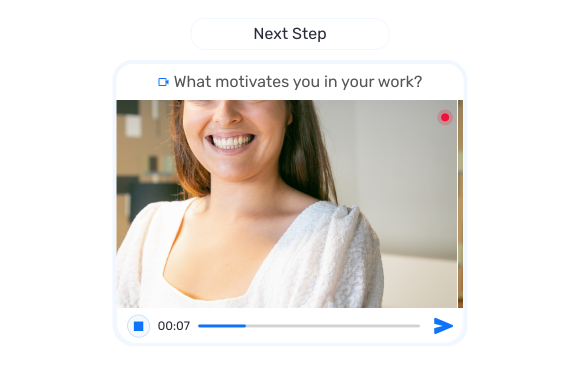
Interview software
Screen candidates with structured video, audio, and conversational interviews.
AI recruiter
Ask Clara, your recruiting assistant, anything about any candidate in your hiring pipeline.
Candidate assessments
Validate cognitive ability, behavioural fit, and job-specific skills.