October 2026 / 15 min read / Written by our editorial team
AI doesn't rely on gut feelings. But does that automatically make it a fairer hiring tool?
AI hiring platforms can still introduce bias towards candidates, and not every platform takes preventing it as seriously as others. The ones that do are transparent about how their AI works, reveal the safeguards they use to mitigate bias, and allow recruiters to remain in control of hiring decisions.
We've found the best AI platforms for fair and impartial hiring and compared what makes them stand out below.
Key Takeaways
1. Hire-Match: Evidence-based candidate evaluation
2. HireVue: Best for validated multi-method assessments
3. Eightfold: Best for independently audited talent intelligence
4. Harver: Best for fairness-validated assessments/adverse-impact monitoring
5. Sapia: Best for explainable, skills-based AI interviewing
6. BrightHire: Best for human-in-the-loop AI interviewing
7. Applied: Best for anonymized, skills-based hiring
Short on time? Jump straight to the reviews.
How We Chose the Best AI Platforms for Fair and Impartial Hiring
We evaluated how each tool approaches bias prevention, consistent candidate evaluation, transparency, and human oversight.
We considered:
- Fair and job-relevant screening: Does the platform assess candidates against consistent criteria based on the skills and competencies required for the role?
- Bias mitigation: What safeguards are in place to identify, prevent, or reduce potential bias in candidate evaluation?
- Explainability: Can recruiters understand why an AI system assigned a particular score or made a recommendation?
- Human oversight: Can recruiters review, question, and override AI recommendations while retaining control over hiring decisions?
- Fairness testing and auditing: Does the platform conduct bias testing or undergo independent audits?
- AI transparency: Does the platform clearly explain how its AI works, what information it uses, and how candidates are evaluated?
- Outcome monitoring: Can employers track candidate progression, identify potential disparities, and evaluate hiring outcomes over time?
- Multiple sources of evidence: Does the platform consider different types of job-relevant candidate evidence rather than relying on a single score or signal?
- Independent validation: Are fairness claims supported by independent audits, certifications, or recognized standards?
Disclosure: Although Hire-Match is included in this comparison, every platform was evaluated against the same criteria to ensure a consistent and transparent review process.
The Best AI Platforms for Fair and Impartial Hiring Compared
The table below compares our recommended platforms based on how they confront fairness and reduce bias in hiring.
|
Platform |
Bias mitigation |
AI transparency |
Fairness auditing |
Human oversight |
Certifications / validation |
|
Hire-Match |
Excludes protected characteristic, job-description checks |
Clara explains rankings and candidate evidence |
Regular internal fairness checks reported |
Recruiters retain final decisions |
JobTestPrep assessment expertise, independent AI validation |
|
HireVue |
Structured assessments, AI fairness testing and adjustments |
Evidence-linked AI interview scoring |
Adverse-impact testing; external audits |
Recruiters make final decisions |
Published assessment research, independent audits |
|
Eightfold AI |
Model-update bias testing, demographic perturbation tests |
Explainable, role-specific matching |
Published independent BABL AI audits |
Human-controlled progression decisions |
ISO/IEC 42001, NYC LL144 audits |
|
Sapia.ai |
Blind, text-first interviews, predefined competencies |
Recommendations linked to interview evidence |
Reported ongoing fairness monitoring |
Recruiters control progression |
ISO/IEC 42001, published research |
|
BrightHire |
Structured interviews, consistent scoring rubrics |
AI outputs traceable to interview evidence |
Reports annual BABL AI audits |
AI doesn't recommend candidates or make hiring decisions |
Independent auditing reported, audit details to verify |
|
Harver |
Fairness-tested assessments; disparate-impact analysis |
Explainable assessment recommendations |
Internal testing, reported independent audits |
AI supports human decisions |
Assessment validation, NYC LL144 audits |
|
Applied |
Anonymization, randomized review, independent scoring |
Skills-based scoring criteria, limited AI-score detail |
Internal validation, limited public external audit evidence |
Human CV review and configurable screening |
Cyber Essentials Plus (security, not fairness) |
Note: Fairness measures and auditing practices vary by product and model. Certifications, internal testing, and independent audits provide different forms of assurance, and none guarantees bias-free hiring. Where independent evidence is unavailable, the comparison reflects vendor-reported practices.
The 7 Best AI Platforms for Fair and Impartial Hiring
Let's take a closer look at what each platform offers and how it supports fairer hiring decisions.
1. Hire-Match
Best for: Evidence-based candidate evaluation
Key fairness features
- Skills-first candidate ranking
- Doesn't infer protected characteristics
- Bias-aware job description validation
- Consistent, role-specific evaluation
- Explainable AI recommendations
- Regular fairness audits
Why We Chose Hire-Match
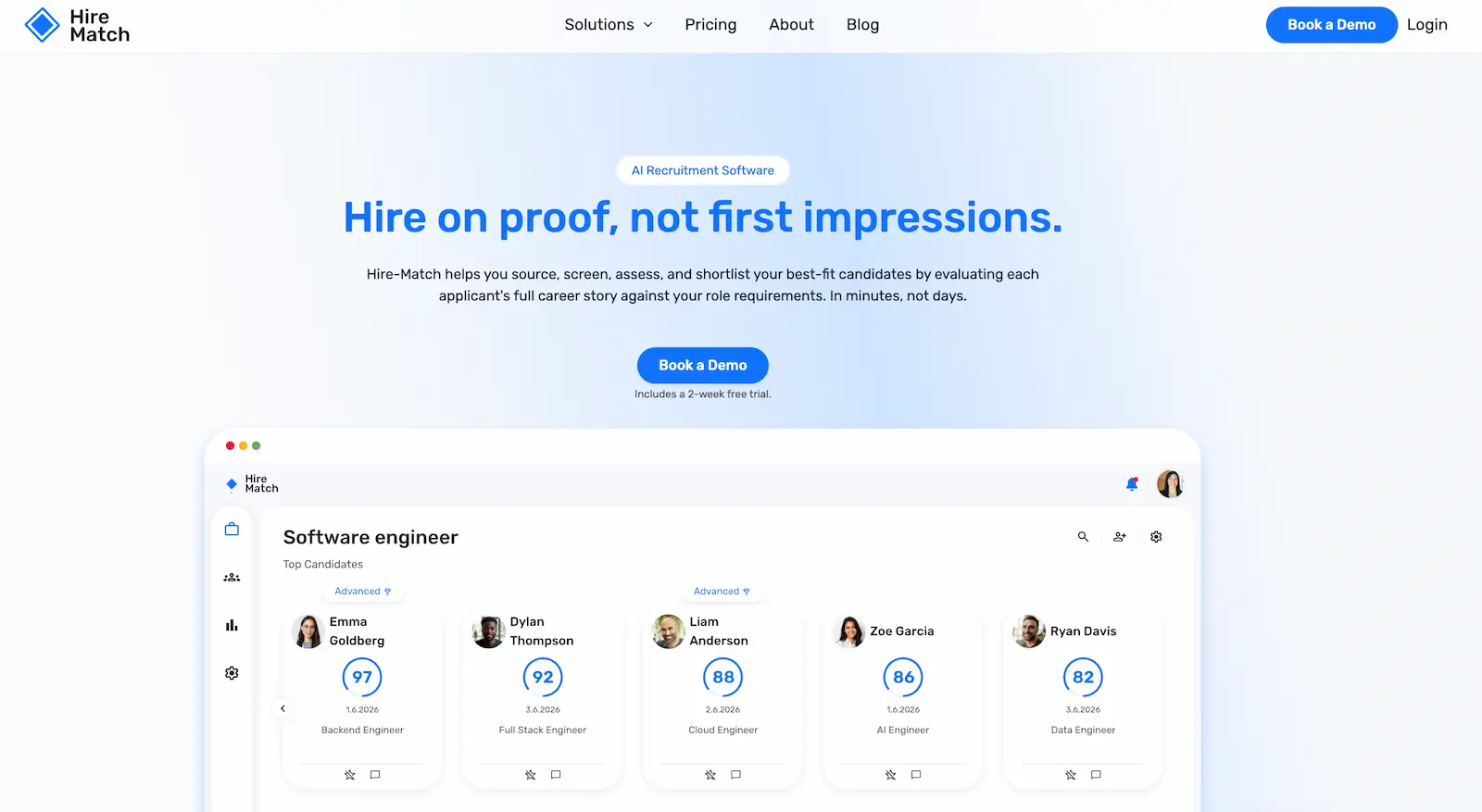
Hire-Match takes a preventative approach to some common sources of hiring bias. Its AI is designed not to collect, score, or infer protected characteristics such as gender, ethnicity, or age, instead ranking candidates using job-relevant evidence such as skills, experience, career history, and potential. Job descriptions are also checked for potentially discriminatory language before candidates enter the hiring process.
Candidate evaluation can then combine career evidence from resume screening software with video interview data and optional cognitive, behavioral, and role-specific candidate assessments. Clara AI recruiter supports the recruiter by discussing strengths, concerns, and evidence behind recommendations rather than relying solely on an unexplained ranking. Hire-Match also conducts regular fairness checks designed to prevent historical hiring patterns from influencing recommendations, while recruiters remain responsible for final hiring decisions
| Pros | Cons |
|
Protected characteristics excluded from AI evaluation Broad range of job-relevant candidate evidence Explainable recommendations through Clara Consistent role-specific evaluation Human-controlled final decisions Regular fairness checks to prevent bias |
Fairness audit methodology isn't publicly detailed Doesn't currently track post-hire performance or retention |
Pricing
Hire-Match is priced on the number of simultaneously active roles with budget-friendly tiers and custom pricing for enterprise needs.
2. HireVue
Best for: Scientifically validated, multi-method candidate assessment
Key fairness features
- Structured, job-specific assessments
- Standardized interview scoring
- Multi-method candidate evidence
- Adverse-impact testing and monitoring
- Multi-Penalty Optimization for bias mitigation
- Human-reviewed AI recommendations
Why We Chose HireVue
HireVue is unique in the depth of science behind its candidate evaluation tools. Its I-O psychologists develop and validate job-specific assessments and structured interviews, while standardized scoring helps reduce reliance on inconsistent interviewer judgment. HireVue reports more than 1,300 validation studies, 2,000 model-maintenance studies for fairness, and 75 peer-reviewed publications.
It also has more concrete bias controls than some other platforms. Models undergo adverse-impact testing and ongoing monitoring, while its Multi-Penalty Optimization methodology is specifically designed to balance predictive validity with subgroup differences. AI Interviewer scores are tied to role-specific criteria and supporting interview evidence, with recruiters retaining responsibility for final hiring decisions.
| Pros | Cons |
|
Extensive validation and fairness research Broad range of job-relevant candidate evidence Strong I-O psychology foundation Independent external auditing Human oversight of hiring decisions |
Many headline fairness statistics are HireVue-reported Fair outcomes still depend on how assessments and AI recommendations are implemented |
Pricing
HireVue offers custom pricing based on the products and hiring requirements of each organization.
3. Eightfold
Best for: Independently audited talent intelligence
Key fairness features
- Independent annual bias audits
- Impact-ratio and perturbation testing
- Explainable, role-specific match scores
- Human-controlled hiring decisions
- ISO/IEC 42001 AI governance
- Ongoing model fairness testing
Why We Chose Eightfold
Eightfold makes its responsible AI practices more transparent than most other platforms we’ve researched. Its matching models are tested for bias with every model update, including impact-ratio analysis and perturbation testing that examines whether changing sensitive candidate characteristics affects match scores. Its AI is also designed for decision support: match scores are role-specific, candidates can see the skills and experience behind their match, and recruiters retain control over hiring decisions.
Independent scrutiny strengthens these measures. Eightfold publishes third-party bias audits under NYC Local Law 144 and is certified to ISO/IEC 42001 for AI management. Its 2026 AI Interviewer audit, conducted by BABL AI, passed its disparate-impact, governance, and risk-assessment sections. However, some race/ethnicity and intersectional testing relied on simulated candidate profiles rather than real-world candidate data, which is an important limitation to consider.
| Pros | Cons |
|
Independent annual bias audits Transparent fairness-testing methodology Strong candidate and recruiter explainability Clear human decision-making boundaries ISO/IEC 42001 certified |
Some audit testing relies on simulated candidate data Limited evidence of post-hire outcome validation Audit findings shouldn't be generalized to every Eightfold AI feature |
Pricing
Eightfold provides custom enterprise pricing based on an organization's products and requirements.
4. Sapia.ai
Best for: Explainable, skills-based AI interviewing
Key fairness features
- Structured, competency-based interviews
- Blind, text-first assessment
- Traceable AI recommendations
- Adverse-impact monitoring
- Human-controlled hiring decisions
- ISO/IEC 42001 AI governance
Why We Chose Sapia.ai
Sapia.ai takes a structured approach to AI interviewing. Employers define relevant competencies before screening, while candidates answer consistent, job-relevant questions against predefined criteria. Its text-first Chat Interview focuses on what candidates say rather than analyzing their appearance or voice, helping remove some potentially irrelevant signals from the initial assessment.
Explainability and monitoring are also central to its approach. Recruiters can trace recommendations back to candidate interview evidence, while Discover Insights provides visibility into representation, candidate progression, score distributions, and AI recommendations across the hiring funnel. Sapia also states that it monitors adverse impact and validates scores against real outcomes over time, although more detail on the specific post-hire outcomes would strengthen this evidence.
| Pros | Cons |
|
Strong recruiter-facing explainability Built-in fairness and diversity monitoring Avoids visual and voice-based assessment Human oversight of hiring decisions ISO/IEC 42001 certified |
Relies heavily on text-based interview evidence Some fairness claims require further independent verification Limited detail on post-hire validation outcomes |
Pricing
Sapia.ai provides custom pricing based on an organization's hiring requirements and platform usage.
5. BrightHire
Best for: Human-in-the-loop AI interviewing
Key fairness features
- Human-controlled hiring decisions
- Structured, competency-based interviews
- Employer-defined scoring criteria
- Traceable AI-generated insights
- Independent bias auditing
- Candidate consent and opt-out
Why We Chose BrightHire
BrightHire places clear boundaries around AI's role in hiring. Its AI doesn't make hiring decisions or recommend candidates. Instead, employers define the competencies, questions, and scoring criteria, while BrightHire helps structure interview evidence against those requirements. AI-generated notes and scorecards remain reviewable by interviewers before being submitted.
Transparency is another strength. AI-generated insights can be traced back to the underlying interview evidence, giving recruiters the opportunity to check how conclusions were reached rather than relying on an unexplained output. BrightHire also states that its AI undergoes annual independent bias audits by BABL AI and provides candidates with disclosure, consent, and opt-out mechanisms.
| Pros | Cons |
|
Clear human-in-the-loop approach AI outputs traceable to interview evidence Employer-controlled scoring criteria Independent third-party bias auditing Candidate AI disclosure and opt-out |
Candidate evidence is primarily interview-focused Limited evidence of demographic outcome monitoring Limited evidence of post-hire outcome validation |
Pricing
BrightHire offers custom pricing based on an organization's requirements and selected products.
6. Harver
Best for: Fairness-validated candidate assessments
Key fairness features
- Job-relevant, validated assessments
- Disparate-impact testing
- Post-deployment bias monitoring
- Multi-method candidate evidence
- Human-controlled hiring decisions
- Fairness and outcome analytics
Why We Chose Harver
Harver embeds fairness testing throughout its assessment process. It’s I-O psychologists and data scientists develop job-relevant assessments, analyze questions for potential group differences, and test algorithms for disparate impact. Harver also uses multiple forms of candidate evidence, including skills, cognitive, behavioral, language, and realistic job assessments, helping employers evaluate candidates on evidence directly related to the role.
Fairness monitoring continues after assessment deployment. Harver provides analytics covering fairness, attrition, retention, and performance and describes an ongoing process of analyzing results and adjusting models. AI remains decision support rather than the final decisionmaker, while its video interviewing tools use standardized questions without facial or micro-expression analysis for automated scoring.
| Pros | Cons |
|
Extensive assessment and I-O psychology expertise Strong adverse-impact testing processes Broad range of job-relevant evidence Ongoing fairness and outcome monitoring Human oversight of hiring decisions |
Many fairness claims are vendor-reported External audit scope and findings require further verification Predictive models may use incumbent data Assessment-heavy approach may be excessive for smaller teams |
Pricing
Harver provides custom pricing based on an organization's hiring needs and selected solutions.
7. Applied
Best for: Anonymized, skills-based hiring
Key fairness features
- Anonymized candidate evaluation
- Skills-based screening
- Randomized, chunked review
- Independent human scoring
- PII excluded from AI scoring
- EDI reporting
Why We Chose Applied
Applied takes a behavioral-science approach to reducing opportunities for bias during screening. Candidate responses can be anonymized, randomized, and reviewed one skill at a time, helping prevent identifying information, application order, or first impressions from influencing evaluations. Multiple reviewers can also score responses independently before their scores are aggregated.
Applied carries similar principles into its AI Screener, which evaluates skills-based responses without using personally identifiable information in scoring. Notably, Applied doesn't use AI to score CVs; identifying information is concealed, and human reviewers evaluate candidates against relevant skills instead. EDI reporting then gives employers greater visibility into candidate progression and demographic patterns across the hiring process.
| Pros | Cons |
|
Strong candidate anonymization Concrete behavioral-science bias controls Skills emphasized over credentials PII excluded from AI scoring Built-in EDI reporting |
Limited independent fairness auditing AI Screener explainability could be stronger Limited evidence of post-hire validation Candidate-facing AI transparency is less clear |
Pricing
Applied offers tiered pricing based on organization size and hiring requirements.
How to Choose AI Interview Software for Fair Hiring
Hiring platforms have more responsibility than just claiming a tool has “bias-free AI”. As we explore in our guide to bias in AI hiring, fairness in AI hiring requires consistency, ongoing monitoring and testing, transparency from AI, and constant human oversight.
Bias Mitigation
Look for platforms with specific safeguards designed to prevent, identify, and reduce bias throughout candidate evaluation. These might include:
- Anonymized screening
- Job-description checks
- Adverse-impact testing
- Hiding protected characteristics
Ask the vendor: What specific safeguards prevent protected characteristics or their proxies from unfairly influencing candidate evaluations?
Job-Relevant Evidence and Assessment Validity
Candidate evaluations should focus on skills and competencies that matter for the role. Validated assessments and multiple sources of candidate evidence can provide a more complete picture than relying on a single score or signal.
Ask the vendor: How do you validate that your assessments measure job-relevant skills and predict hiring outcomes?
Consistency
Consistent AI resume screening, standardized pre-employment assessments, structured and asynchronous interviews, and predefined scoring criteria can help reduce subjective differences between candidate evaluations. However, those criteria must also be appropriate for the role.
Ask the vendor: Does the platform apply the same job-relevant criteria to every candidate, and can recruiters review or adjust those criteria?
Explainability and Transparency
Recruiters should be able to understand why an AI tool scored, ranked, or recommended a particular candidate. Look for explanations linked to job requirements, candidate responses, assessment results, or other relevant evidence.
Ask the vendor: Can recruiters see which evidence influenced each recommendation, and do candidates know how AI is used?
Human Oversight
AI should support recruiters rather than replace their judgment. Look for platforms that allow users to review evidence, challenge recommendations, correct errors, and override automated scores or rankings.
Ask the vendor: Can recruiters meaningfully review and override AI recommendations, and does the platform automatically reject or advance candidates?
Fairness Testing and Ongoing Monitoring
Bias mitigation measures are only useful if employers can verify that they're working. Look for platforms that regularly test for adverse impact, examine differences in outcomes between demographic groups, and monitor whether fairness changes over time.
Ask the vendor: How frequently is fairness tested, which demographic groups are covered, and what happens when disparities are identified?
Compliance, Data Security, and Independent Validation
Check how the platform addresses relevant hiring laws, privacy, and AI regulations. Independent audits published validation studies, and relevant certifications can provide additional assurance, but security certifications alone don't demonstrate hiring fairness.
Ask the vendor: What independent evidence supports your fairness claims, and which specific products, models, and candidate groups does it cover?
Our Verdict
Choosing new hiring software involves balancing capabilities, scalability, ATS integrations, and cost, while fairness is often an afterthought. But even the best AI recruiting tools offer little value if the platform unfairly disadvantages qualified candidates. To ensure you choose the best AI platforms for fair and impartial hiring, you need to go beyond believing a claim about “bias-free AI”. Consider platforms that explain how AI is used throughout the process, if it is consistent and transparent, how bias is monitored, and whether this is backed up actual evidence.
If you're looking for a practical example of this approach, book a demo with Hire-Match to explore how skills-first evaluations, explainable AI recommendations, and human oversight work together to support fairer hiring decisions.
Frequently asked questions
The best platform depends on your hiring needs. HireVue and Harver emphasize validated assessments, Applied focuses on anonymized skills-based evaluation, and BrightHire prioritizes human oversight during interviews. Meanwhile, Hire-Match combines skills-first candidate evaluation with explainable AI recommendations and bias safeguards.
No AI hiring platform can guarantee completely bias-free decisions. Bias can enter through training data, evaluation criteria, or correlations between candidate information and protected characteristics. However, structured assessments, bias testing, and ongoing monitoring can help identify and reduce these risks.
Prioritize job-relevant evaluation criteria, explainable AI recommendations, documented bias mitigation measures, and meaningful human oversight. It's also worth asking vendors about independent fairness audits, candidate accessibility, data protection, and whether employers can monitor hiring outcomes across different demographic groups.
Requirements depend on the jurisdiction and how the technology is used. For example, New York City's Local Law 144 requires covered automated employment decision tools to undergo an independent bias audit before use and at least annually thereafter, alongside specific notice and disclosure requirements. Employers should check which regulations apply to their hiring activities.
AI is generally better used to support rather than replace human decision-making. Recruiters should be able to examine the evidence behind recommendations, identify potential errors, and override AI-generated rankings or scores. Human involvement should be meaningful rather than simply approving automated decisions.
Ask providers for evidence of fairness testing, adverse-impact monitoring, independent audits, and validation studies. Review which demographic groups and hiring stages have been tested, how recently testing occurred, and whether the results apply to the specific features you intend to use. Fairness is something employers should continue monitoring, not simply assume at the point of purchase.
Our recruitment solutions.
Resume screening software
Turn a pile of resumes into a ranked shortlist, backed by clear hiring evidence.
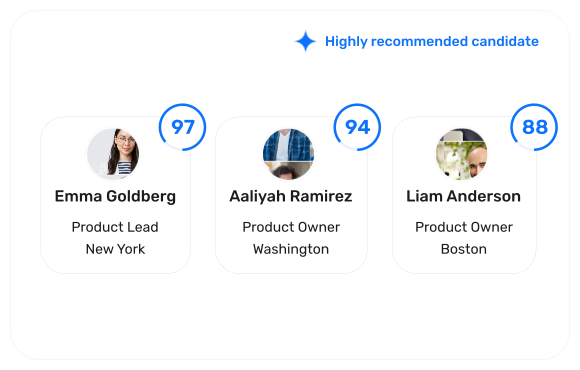
Interview software
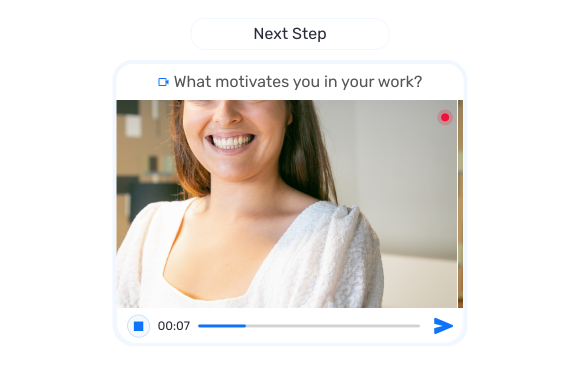
Screen candidates with structured video, audio, and conversational interviews.
AI recruiter
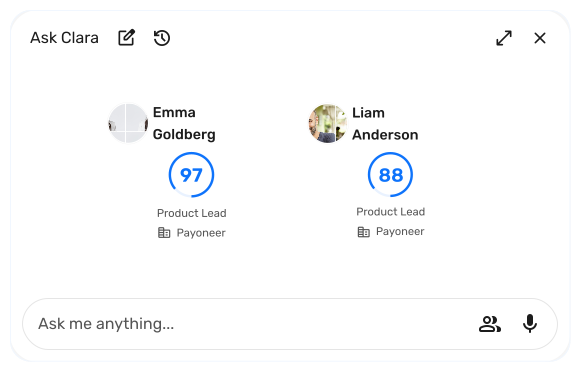
Ask Clara, your recruiting assistant, anything about any candidate in your hiring pipeline.
Candidate assessments
Validate cognitive ability, behavioural fit, and job-specific skills.