September 2026 / 10 min read / Written by our editorial team
When you’re buying a house, you don’t just start viewing every property for sale. You decide what matters first, your budget, location, space, and must-haves, then narrow down the options. Shortlisting candidates works the same way. By comparing candidates against clear criteria, recruiters can find out who shows the strongest potential to progress, saving you time and helping to make more efficient hiring decisions.
This guide explains how to shortlist candidates effectively, including how AI can help build and refine a more evidence-based shortlist.
Key Takeaways
- Define must-have and nice-to-have criteria before reviewing candidates.
- Gather job-relevant evidence from resumes, assessments, screening questions, or interviews.
- Use a shortlisting scorecard to evaluate candidates against the same criteria and document your reasoning.
- Avoid relying too heavily on keywords, exact job titles, rigid requirements, or gut feeling.
- AI shortlisting can help analyze, match, and rank candidates at scale, but progression decisions should retain human oversight.
- A shortlist can evolve as new evidence emerges rather than being based solely on the initial resume review.
What is Candidate Shortlisting?
Candidate shortlisting is when you identify which applicants should progress to the next stage of hiring using predefined, job-relevant criteria. It helps recruiters narrow a larger candidate pool into a smaller group of applicants who show the strongest potential for the role.
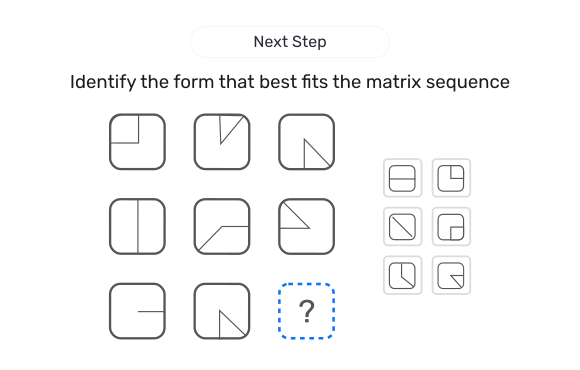
Shortlisting typically starts with resume screening, but it can continue as you gather more evidence through screening questions, pre-employment assessments, or interviews. The goal is to make progression decisions based on consistent criteria for a fairer and more accurate hiring process.
Why Should You Shortlist Candidates?
Shortlisting provides more structure when deciding who should progress, rather than sending every applicant through each stage of the hiring process and wasting time for both the candidate and the recruiter.
In fact, research suggests that adding more structure to candidate selection can help decision-makers identify job-relevant criteria, select more qualified applicants, and reduce discrimination compared with relying on impression-based judgments.
An effective shortlisting process can:
- Save time and resources: Focus on interviews and further assessments on candidates who show the strongest potential for the role.
- Improve consistency: Compare candidates against the same job-related criteria rather than changing expectations from one applicant to another.
- Support fairer decisions: Structured criteria can reduce gut feeling, assumptions, and inconsistent judgments.
- Improve candidate experience: Faster progression decisions can reduce unnecessary delays and keep candidates more informed.
- Make large applicant pools manageable: Narrow hundreds or thousands of applications into a realistic number of candidates for closer evaluation.
Ultimately, shortlisting candidates helps recruiters focus their time and resources on the candidates with the strongest evidence of job fit while creating a more consistent process for deciding who progresses.
How to Shortlist Candidates for a Job Role in 3 Steps
Knowing how to shortlist candidates for a job starts before you review the first application. Setting your criteria, deciding what evidence you need, and creating a consistent evaluation process makes the final decision much easier.
1. Define your job criteria
Setting job criteria can be tricky. Too few criteria can leave you with an unmanageable shortlist, while too many can eliminate promising candidates. The aim is to identify what someone genuinely needs to succeed in the role.
Start by separating your requirements into must-haves and nice-to-haves:
| Must-have | Nice-to-have | |
| Meaning |
Essential for performing the role | Valuable, but not essential |
| Ask yourself | Would lacking this prevent someone from doing the job? | Could someone succeed without this? |
| Examples | Legally required qualification, essential technical skill, required availability | Experience with a preferred tool, additional certification, industry experience |
You should be selective with must-haves. If something is an absolute requirement for a role, you should be prepared to apply it consistently to every candidate.
Example:
Imagine you’re shortlisting a candidate for a mid-level software engineer role. Your list might look something like this:
- Must-have: Strong programming and problem-solving skills, proficiency in Python, experience developing and maintaining production software
- Nice-to-have: Computer science degree, experience with TypeScript, experience with cloud platforms
Avoid criteria that are unnecessarily rigid, such as requiring an exact previous job title when candidates could have gained the relevant skills elsewhere. Strong initial criteria provide the foundation for everything that follows.
2. Create a scorecard
Next, decide what evidence you need to determine whether candidates meet those criteria. Depending on the role and hiring stage, this could include:
- Resumes and application forms
- Screening-question responses
- Work samples or portfolios
- Skills or cognitive assessments
- Video, audio, or phone screening
- Structured interview responses
Gather comparable evidence wherever possible. For example, candidates completing the same hiring stage should receive the same core assessment or structured questions under comparable conditions.
Create a candidate shortlisting scorecard before reviewing the results. Rather than relying entirely on yes/no judgments, you could rate evidence as weak, moderate, or strong, with space for notes explaining the rating.
It might look something like this:
| Criteria | Priority | Score | Weighted score | Notes |
| Python experience | Must-have (x2) | 3 | 6 | 4 years using Python to build and maintain backend applications |
| Developing software | Must-have (x2) | 3 | 6 | 3 years developing and maintaining production software |
| Programming & problem-solving | Must-have (x2) | 3 | 6 | Strong technical assessment results and clear examples of solving complex problems |
| Computer science degree | Nice-to-have | 0 | 0 | No degree |
| TypeScript experience | Nice-to-have | 1 | 1 | No experience with TypeScript, but previous development work with a similar tool |
| Cloud experience | Nice-to-have | 2 | 2 | 2 years using Azure; no direct AWS experience |
| Overall score | / | / | 21/27 | Strong evidence across all must-haves despite gaps in preferred criteria. Suitable for progression. |
Scoring:
0 = no evidence 1 = weak evidence 2 = moderate evidence 3 = strong evidence
Must-haves = score x 2
You would then score the applicant based on the criteria set in your scorecard. Don't rely on the total score alone. A candidate who scores highly on several nice-to-haves but fails a genuine must-have may still be unsuitable. You should always review the results rather than relying on the score alone.
Tip: Before scoring, decide how many candidates you intend to progress. This gives you a clear target rather than continually expanding the shortlist whenever another promising candidate appears.
3. Gather & review the evidence
Now you can evaluate each candidate against the criteria established in Step 1.
- Score candidates individually first: Assess each person against the job criteria before comparing candidates with one another. This way, a particularly strong applicant will not subconsciously raise the standard for everyone who follows.
- Apply the same criteria consistently: Avoid changing requirements or weighting because of individual candidates. Always stick to your initial criteria and scorecard.
- Focus on job-relevant evidence: Where practical, removing unnecessary identifying information can help limit opportunities for irrelevant characteristics to influence initial evaluations.
- Document your reasoning: In your scorecard's notes, explain why each candidate got their ratings, particularly where evidence is less clear-cut. This will make it easier when you review the results, rather than having to go back through a candidate's resume or interview notes.
- Stick to your planned shortlist: Avoid expanding it without a job-related reason simply because several candidates appear promising.
- Review the final results: Compare the completed scorecards and identify which candidates have provided the strongest evidence against your predefined requirements.
- Create your shortlist: Move the strongest candidates into your shortlist, depending on how many you initially decided to move forward at this stage.
Your shortlist doesn't have to be final. If there isn't enough evidence to confidently determine who to shortlist for an interview, an additional screening question or assessment can help decide between closely matched candidates before you move forward.
How to Shortlist Candidates With AI
AI shortlisting can help recruiters apply the same process at scale. Instead of manually reviewing every application, AI can analyze candidate information against predefined job criteria and help prioritize who should progress.
Depending on the platform, AI-based candidate shortlisting can:
- Analyze CVs and applications quickly: Identify relevant skills, experience, qualifications, and other job-related evidence across large applicant pools.
- Match candidates to role requirements: AI candidate matching can assess how closely a candidate's skills, experience, and other evidence align with the requirements of a particular role.
- Rank and prioritize candidates: AI can use candidate evidence and predefined criteria to help recruiters identify which applicants show the strongest potential to progress.
- Standardize evaluation: Apply the same scoring framework across candidates to support more consistent comparisons.
- Reduce manual work: Automate repetitive review and ranking tasks so recruiters can spend more time interviewing and engaging candidates.
- Consider evidence beyond the CV: More advanced tools can incorporate assessments, screening responses, and interviews when refining candidate rankings.
CV shortlisting AI can make initial resume review faster, but a resume doesn't necessarily provide enough evidence to determine who should ultimately progress.
How to Shortlist Candidates with Hire-Match
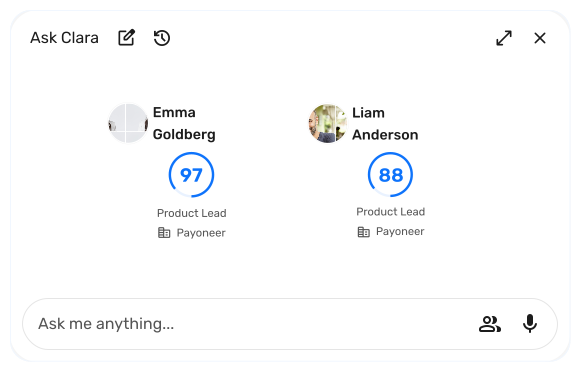
Hire-Match takes a broader approach than other AI shortlisting tools. It uses resume screening software to evaluate job fit and career history, then gathers additional evidence through AI interview software and talent assessments. Clara AI recruiter also helps to engage candidates and uncover more meaningful hiring evidence. This evidence contributes to the overall candidate evaluation, helping recruiters refine their shortlist as they learn more about each applicant.
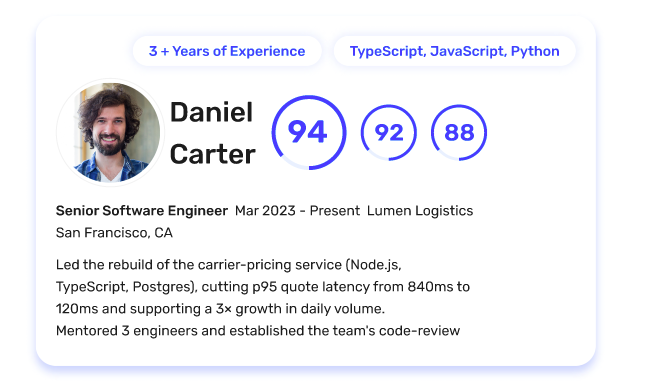
The aim isn’t just to speed up the hiring process. It's about removing unconscious bias, creating more consistency, and giving recruiters more relevant evidence to support their decision about who progresses.
Common Mistakes when Shortlisting Candidates
Even with clear set criteria, some habits can lead recruiters to overlook strong candidates. Watch out for these common mistakes when shortlisting candidates.
Relying Too Heavily on Keywords and Job Titles
Exact keywords and previous job titles don't always tell you whether someone can perform the role. Different candidates may describe similar skills in different ways, while transferable experience may come from another position or industry.
- For manual shortlisting: Review resumes and other candidate evidence in context, instead of looking for exact terms. Observe what candidates actually did, the skills they demonstrate through their career history, and how that relates to your criteria.
- For AI shortlisting: Choose technology (like Hire-Match) that supports semantic or contextual matching instead of relying on exact keywords. This can help identify related skills, terminology, and experience even when a candidate hasn't used the same wording as the job description.
And don’t just base the evidence on resumes alone; assessments, interviews, and additional screening questions can all contribute to making a stronger shortlist.
Making the Requirements Too Rigid
Some requirements are non-negotiable. But others may simply describe the recruiter's idea of the “ideal” candidate.
Being too restrictive can eliminate candidates who could perform well but take a different route to develop the required skills. Revisit your criteria and ask whether each must-have is genuinely essential or whether relevant transferable skills and experience could provide sufficient evidence.
Rushing the Shortlisting Process
When you have a large applicant pool, it can be tempting to skim applications or make fast judgements without clearly reviewing the evidence using your initial plan.
However, rushing shortlisting can just shift the workload into the later stages of hiring. A predefined scorecard and consistent review process can help you work efficiently while ensuring that only suitable candidates progress to more resource-intensive assessments and interviews.
Overlooking Existing Talent
The right candidate could already be in your talent pool. Before focusing entirely on new applicants, consider previous candidates, silver medalists, and other existing talent who could meet the requirements of the new role.
You can review existing candidates using the same preset shortlist criteria for consistency. Alternatively, AI can make talent rediscovery easier by searching for existing candidate data and identifying potentially relevant matches.
Letting First Impressions Influence the Shortlist
Confidence, personality, shared interests, or the fact that “they had good energy” should not be used as criteria to shortlist candidates. Making a strong first impression or discovering a shared hobby is great for building friendships but isn't necessarily evidence that someone will perform well in the role.
Return to your predefined criteria and ask: What job-relevant evidence supports this candidate's progress? This keeps the decision focused on what candidates have demonstrated rather than how positively you feel about them.
Applying Criteria Inconsistently
Bias doesn't always involve consciously favoring one candidate. Decisions can also become less objective when recruiters ask different questions, overlook a missing requirement for one person but not another, or adjust expectations after meeting an impressive candidate. Structured criteria, standardized questions, and steady scoring can support more consistent comparisons.
Build a Stronger Candidate Shortlist
Effective shortlisting isn't just about reducing a large applicant pool. It's about identifying which candidates have provided the strongest evidence that they could succeed in the role.
Start with clear job criteria, gather the evidence you need from multiple screening methods, and evaluate every candidate in the exact same way before deciding who progresses.
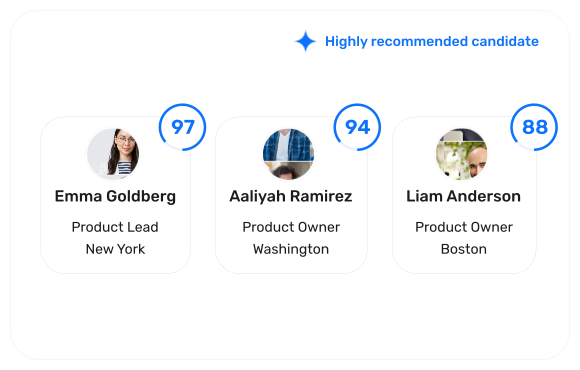
Hire-Match can support this process by using AI to evaluate candidate evidence across different screening methods and using it to rank and shortlist candidates based on their potential fit for the role.
FAQs
Shortlisting candidates is the process of deciding which applicants should progress to the next stage of hiring. Recruiters compare candidates against predefined, job-related criteria and use the available evidence to identify those who demonstrate the strongest potential for the role.
To determine how to shortlist candidates for interviews, first establish the must-haves and nice-to-haves for the role. Gather relevant evidence from resumes, applications, screening questions, or assessments and consider additional questions to obtain any missing evidence. Write a list of interview questions that can be applied to all candidates so that you can be consistent when you review the data and shortlist candidates.
Candidate screening is the broader process of collecting and evaluating information to determine candidate suitability. Shortlisting uses that information to decide who progresses. Like shortlisting, candidate screening can be done manually or using AI candidate screening software.
In short, yes. AI can remove personal information from applications and help recruiters apply predefined criteria and score more consistently, which may reduce opportunities for subjective judgments to influence decisions. However, AI systems have been known to reproduce or introduce bias depending on how they are used.
When looking for AI-based candidate shortlisting tools, check for bias safeguards and explainable evaluations.
Shortlisting criteria should relate directly to what someone needs to perform the job. Separate must-have requirements, such as essential skills or legally required qualifications, from nice-to-haves, such as preferred industry experience or familiarity with a particular tool.
Avoid requirements that don't provide meaningful evidence of whether someone could succeed in the role.
Not necessarily. A resume provides useful information about someone's career history, skills, and experience, but it may not provide all the evidence needed to make a confident progression decision.
Screening questions, skills assessments, work samples, and structured interviews can provide additional evidence. Recruiters can use this information to refine their shortlist as they learn more about each candidate.
Our article on the best AI candidate screening tools recommends platforms that include a variety of different screening stages.
There is no universal number, as it depends on the role, applicant pool, hiring resources, and next selection stage.
The University of Cambridge recommends shortlisting around three to six candidates, noting that interviewing more than six can become resource-intensive. Taking the time to create a focused shortlist can therefore save time later without compromising the quality of your initial evaluation.
Rather than aiming for an arbitrary number, establish your approximate shortlist size beforehand and focus on candidates who meet the requirements for progression.
All our recruitment solutions
Resume screening software
Turn a pile of resumes into a ranked shortlist, backed by clear hiring evidence.
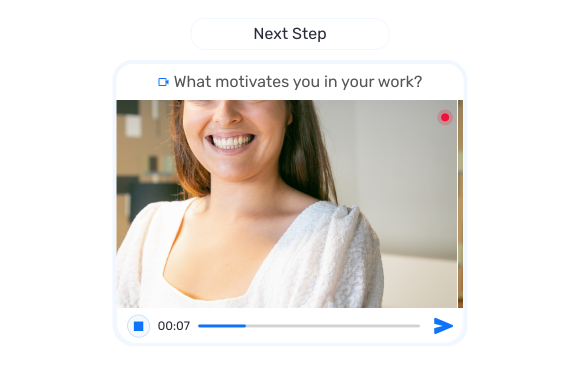
Interview software
Screen candidates with structured video, audio, and conversational interviews.
AI recruiter
Ask Clara, your recruiting assistant, anything about any candidate in your hiring pipeline.
Candidate assessments
Validate cognitive ability, behavioural fit, and job-specific skills.