October 2026 / 9 min read / Written by our editorial team
Recruiting across languages isn’t easy, especially when you rely on translators before moving forward with a candidate. This can mean losing strong applicants to competitors with faster hiring processes.
Fortunately, multilingual recruitment software does more than just translate messages. Multilingual recruitment platforms use advanced AI language tools to communicate naturally with candidates, screen resumes, conduct interviews, and evaluate skills, helping recruiters move candidates through the hiring process quickly and efficiently.
In this guide, we compare the best multilingual recruitment software to help you find a platform that removes language barriers without compromising hiring quality.
Top Picks
- Hire-Match: Best for bilingual AI candidate screening and evaluation
- TalkPush: Best for high-volume multilingual AI interviewing
- Paradox: Best for Multilingual Candidate Engagement and Recruitment Automation
- Sapia: Best for multilingual AI interviews and written-language assessment
- HireVue: Best for Multilingual Recruitment Workflows and Candidate Assessments
Short on time? Jump straight to the reviews.
Tools for Multilingual Automated Recruitment Compared
The best multilingual recruitment automation software depends on which parts of your hiring process need to support different languages.
Here's how our top picks compare.
A tool that has the most languages isn’t necessarily the best option as support for different functions varies. For example, just because a tool advertises 100 languages, only some may support AI interviewing or assessments.
We’ll go into more detail about what each tool offers in our detailed reviews.
How We Evaluated Multilingual Recruitment Software
We evaluated each platform based on how effectively it supports recruitment across different languages.
Our comparison focused on:
- Language coverage: How many languages are supported and whether coverage varies across different features.
- Candidate communication: Multilingual communication through text, voice, video interviews, and other channels.
- Recruitment automation: Which stages of the hiring process can be completed and automated in different languages, from applications and screening to scheduling and updates.
- Candidate assessments: Support for multilingual interviews, skills assessments, and language proficiency testing.
- Accuracy and fairness: Evidence of translation accuracy, assessment validation, and consistent candidate evaluation across languages.
We also considered each platform's broader recruitment capabilities, limitations, and suitability for different hiring needs.
What Is Multilingual Recruitment Software?
Multilingual recruitment software helps organizations hire candidates in different languages. This means recruiters and candidates can communicate and complete recruitment tasks in their preferred language, removing potential language barriers from the hiring process.
Depending on the platform, this can include translated job applications, automated candidate communication, AI-powered screening, interviews, and assessments.
Some tools also evaluate language proficiency, although this is different from simply supporting recruitment in multiple languages.
Who Needs Multilingual Recruitment Software?
Multilingual recruitment software is particularly useful for:
- Multinational companies: Recruiting employees for offices and teams across different countries.
- Franchises and multi-location businesses: Managing hiring across regions with different language requirements.
- Employers with diverse workforces: Supporting applicants in industries such as hospitality, manufacturing, logistics, and agriculture.
- International recruitment agencies: Screening and interviewing candidates across different markets.
- Businesses hiring for multilingual roles: Recruiting for positions requiring multiple languages, such as customer support or international sales.
Multilingual software can make hiring more accessible, but candidates must still meet the language requirements needed to perform their roles effectively and safely.
The Best Multilingual Recruitment Software in 2026
Below, our reviews explain how our chosen recruitment tools support different languages.
1. Hire-Match
Best for: Organizations recruiting in English and Hebrew that want to automate candidate screening, interviewing, and evaluation.
Key features
- Full platform functionality in English and Hebrew
- Bilingual recruiter and candidate experiences
- AI-powered resume screening and candidate matching
- Video, audio, and conversational interviews
- AI-assisted candidate evaluation and ranking
- Built-in bias-mitigation safeguards
Why We Chose Hire-Match
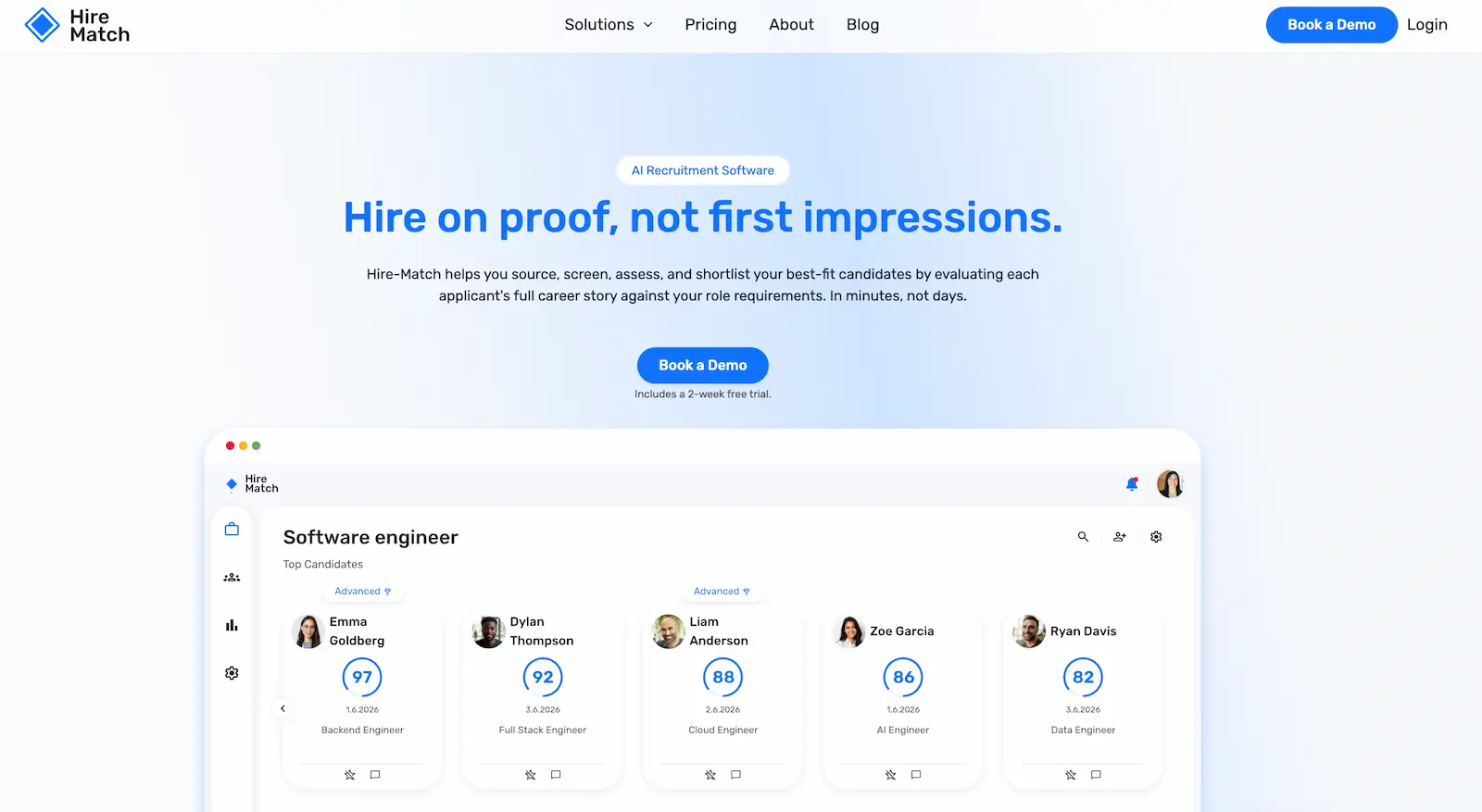
Hire-Match offers complete bilingual recruitment functionality in English and Hebrew. Both recruiters and candidates can use the platform in either language, including its screening, interviewing, and evaluation features. Unlike platforms that limit language support to certain communications or stages, Hire-Match supports both languages throughout the hiring process. However, it may be less suitable for organizations recruiting across a wider range of languages.
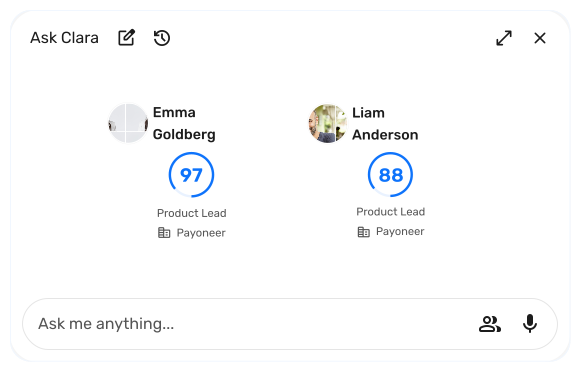
Hire-Match combines AI-powered resume screening software, video interviews, and candidate assessments to build evidence-based shortlists. Its AI recruiter, Clara, supports recruiters in exploring candidate strengths, identifying concerns, comparing applicants, and explaining the reasoning behind recommendations.
| Pros | Cons |
|
Full bilingual functionality across the platform in English and Hebrew AI-powered screening, interviewing, and shortlisting Multiple candidate interview formats Explainable candidate recommendations Built-in bias-mitigation safeguards Standalone platform or ATS integration |
Only supports two languages
No AI-based language proficiency measurement |
Pricing
Hire-Match pricing is based on active job openings with unlimited recruiter seats and a 2-week free trial. Optional talent assessments are available at an additional cost.
2. Talkpush
Best for: Organizations conducting high-volume recruitment across multiple languages, particularly those needing to assess spoken communication skills.
Key features
- AI interviews and assessments in 50+ languages
- Mid-interview language switching
- CEFR-aligned language proficiency scoring
- Multilingual AI voice and chat agents
- Automated candidate screening and scheduling
Why We Chose Talkpush
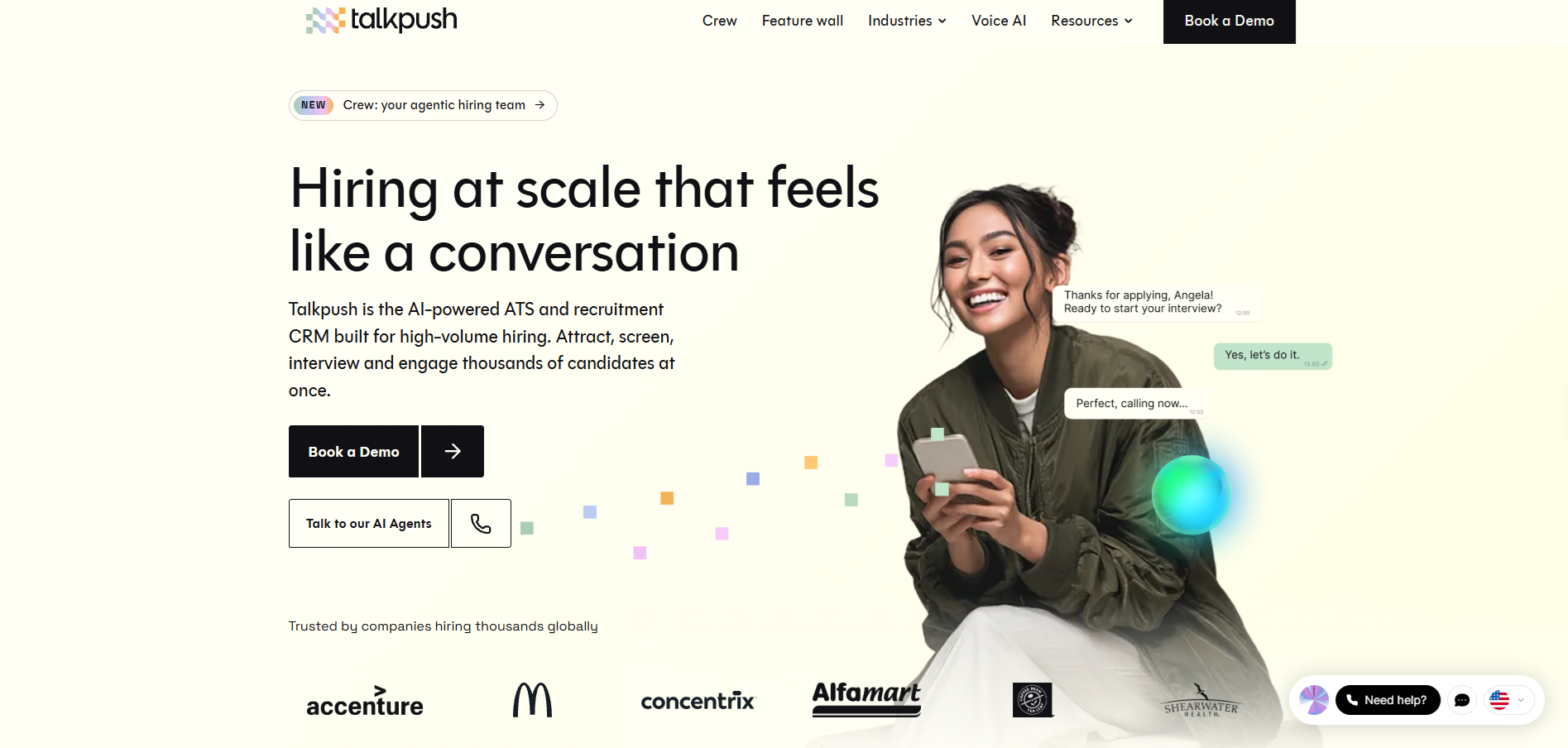
Talkpush conducts AI interviews and assesses language proficiency in over 50 languages, making it a great choice for international and high-volume recruitment. Its TalkScore technology evaluates candidates through structured voice interviews, assessing communication skills such as pronunciation, grammar, fluency, vocabulary, and comprehension. Results align with the Common European Framework of Reference for Languages (CEFR), letting recruiters assess language proficiency alongside cognitive ability, situational judgment, and role-specific skills.
Another standout feature is the ability to switch languages during an interview without interrupting the conversation. Talkpush also uses multilingual AI agents to automate candidate screening, interview scheduling, reminders, and onboarding communications. Recruiters can review interview recordings, transcripts, and competency scores to inform hiring decisions.
| Pros | Cons |
|
Extensive multilingual interviewing capabilities Built-in language proficiency assessment Flexible voice and chat-based candidate engagement End-to-end recruitment automation Recruiter access to interview evidence |
Limited publicly available cross-language validation evidence Primarily designed for high-volume recruitment No publicly listed pricing |
Pricing
Contact Talkpush for a custom quote or request a demo.
3. Paradox
Best for: Organizations looking to automate candidate communication, applications, and interview scheduling across multiple languages.
Key features
- Conversational AI candidate Q&A in 100+ languages
- Automated language detection and translation
- Multilingual applications and candidate screening
- Interview scheduling in 30+ languages
- Automatic recruiter inbox translation
- Candidate engagement through SMS, WhatsApp, and web chat
Why we chose Paradox
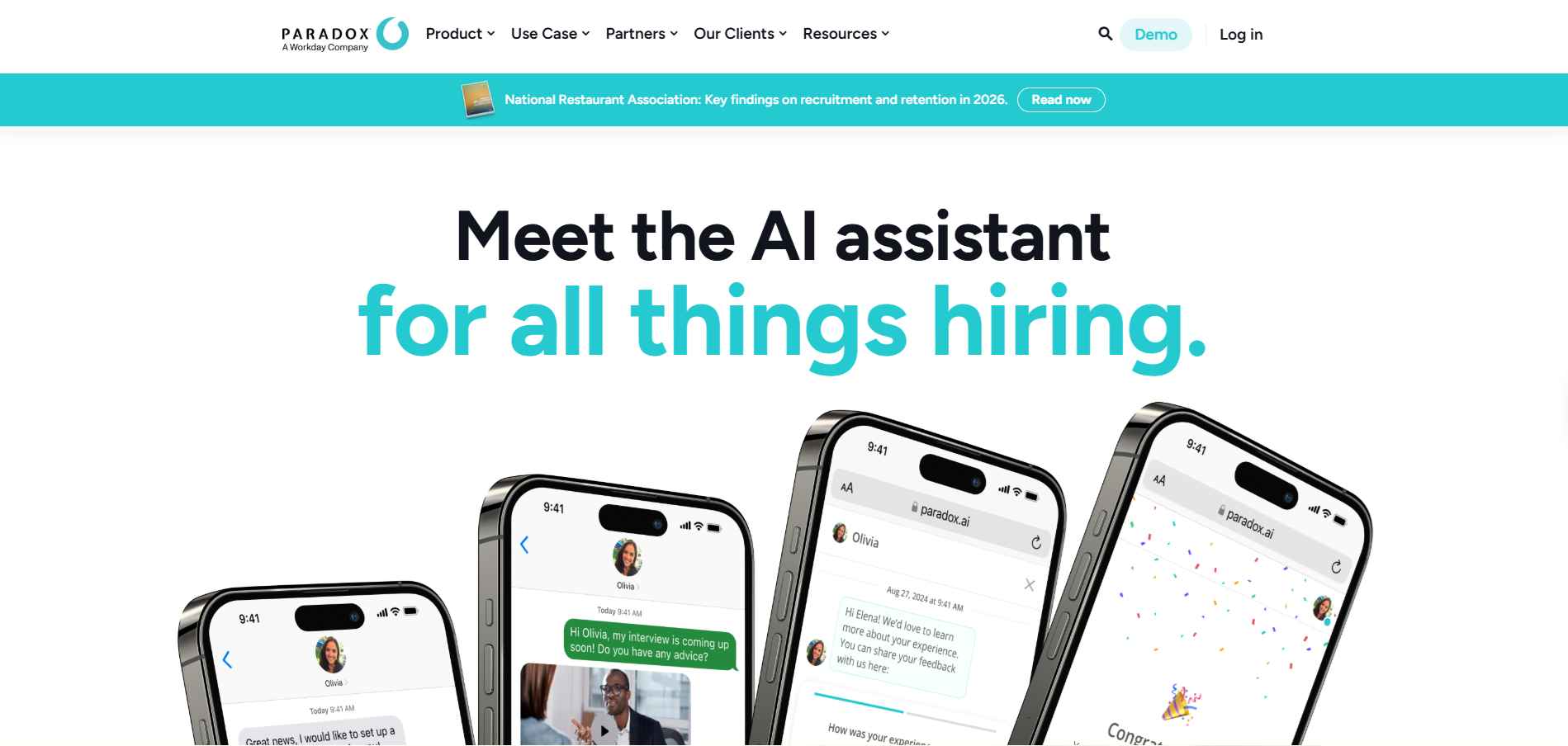
Paradox can automate candidate communication across many different languages. Its conversational AI assistant, Olivia, can answer candidate questions in over 100 languages, automatically detecting their language and translating responses. Employers can also use on-the-fly translation to answer questions using their existing knowledge base, without manually translating content into every supported language.
Paradox stands out for its conversational job applications, initial screening, and automated interview scheduling in multiple languages. Its scheduling tools offer localized experiences in 30+ languages, while recruiters can translate candidate messages into their preferred language. This makes Paradox useful for international recruitment teams managing applicants across regions.
Important note: Only seven English, French, and Spanish language variants are validated. Other available languages are described as 70% accurate but may need additional updates.
| Pros | Cons |
|
Extensive multilingual candidate communication Automatic language detection and translation Localized recruiter interface and inbox Automated applications, screening, and scheduling Multiple candidate communication channels |
Only seven language variants classified as validated, with others only 70% accurate Language coverage varies by recruitment function No confirmed language proficiency assessment No publicly listed pricing |
Pricing
Custom pricing. Contact Paradox for a quote or request a demo.
4. Sapia
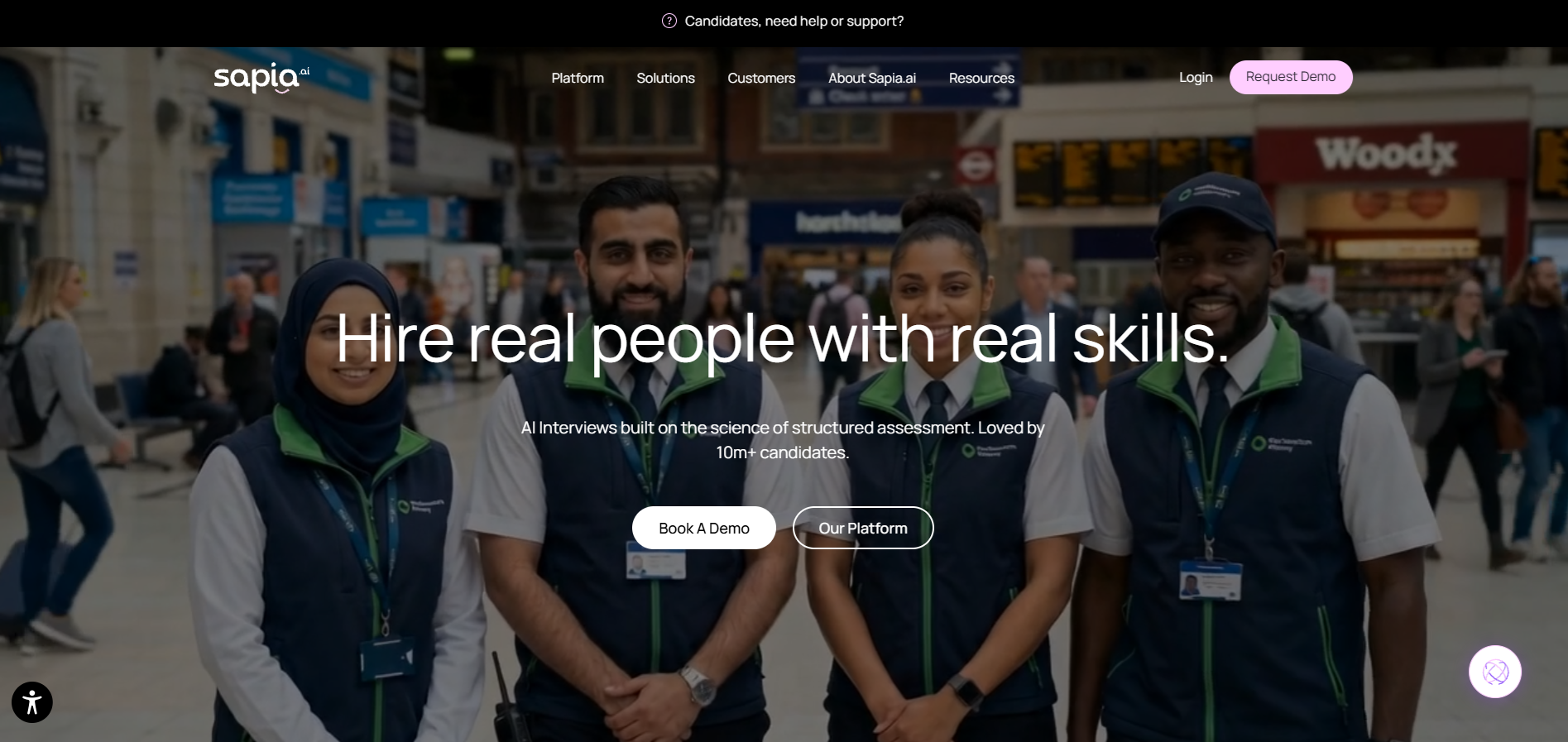
Best for: Organizations looking to assess candidates' written communication skills alongside behavioral competencies across multiple languages.
Key features
- AI-powered skills assessments advertised in 173 languages
- Structured, text-based AI interviews
- Built-in written-language fluency and complexity scoring
- CEFR-aligned written-language proficiency assessment
- Automated candidate scoring and personalized feedback
Why We Chose Sapia
Sapia.ai combines multilingual AI interviews with written-language assessment. Its structured, text-based Chat Interviews allow candidates to demonstrate their behavioral competencies in supported languages. While earlier documentation lists nine interview languages, Sapia.ai has more recently advertised skills assessment in 173 languages, but the exact capabilities available across these languages aren’t always clear.
Its Communication Score (CommScore) is particularly useful for roles requiring strong written communication. Rather than conducting a separate language test, Sapia.ai evaluates candidates' interview responses for fluency and complexity, considering factors such as grammar, vocabulary, organization, and coherence. It also provides CEFR-aligned written-language proficiency ratings, allowing recruiters to assess communication skills alongside behavioral competencies and other candidate insights.
| Pros | Cons |
|
Multilingual, structured AI interviews Written-language assessment built into interviews CEFR-aligned proficiency scoring Automated candidate ranking and feedback Vendor-published assessment validation research |
No confirmed spoken-language proficiency assessment Exact functionality across 173 languages unclear Cross-language assessment validation needs verification No publicly listed pricing |
Pricing
Contact Sapia.ai for a custom quote or request a demo.
5. HireVue
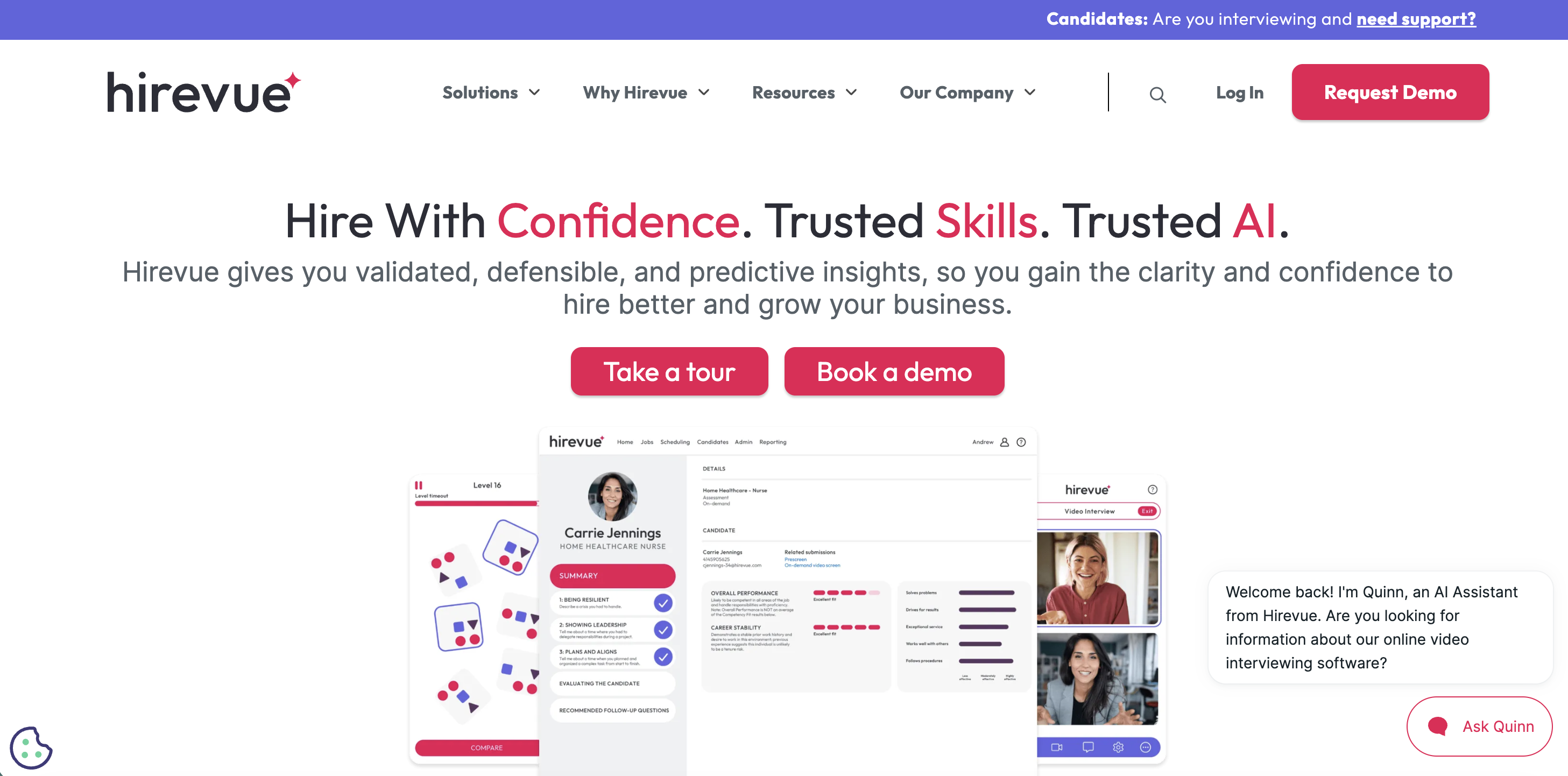
Best for: Enterprise organizations looking to deliver localized recruitment experiences alongside structured interviews and candidate assessments.
Key features
- Candidate-facing content localized into 35 languages and regional variants
- Multilingual application pages, emails, and SMS templates
- Automatic language selection based on browser settings
- Job-specific language settings for candidate communications
- Language proficiency assessments
- Live, on-demand, and AI-powered interviewing
Why We Chose HireVue
HireVue offers localized recruitment workflows and a broad range of candidate assessments. It supports 35 languages and regional variants across different functions, including application pages, email templates, and SMS communications. Application pages can automatically display in a candidate's browser language, while recruiters can configure job-specific language preferences to provide a more consistent experience across international hiring markets.
Its published language list primarily covers localized application elements and communications, instead of support for AI interviews or assessments. Some languages, including Catalan and Slovak, are limited to Virtual Job Tryout assessments.
| Pros | Cons |
|
Extensive recruitment workflow localization Multiple interviewing and assessment formats Dedicated language proficiency assessments Structured, research-backed candidate evaluation Broad ATS integration capabilities |
Multilingual support varies by feature AI interview language coverage is unclear Some language settings depend on licensing Complex platform for smaller hiring teams No publicly listed pricing |
Pricing
Contact HireVue for a custom quote or request a demo.
How to Choose Multilingual Recruitment Software
Choosing the right multilingual recruitment software is not just about finding a platform that supports the languages you need. You also need to consider what processes are supported by these languages throughout hiring.
Consider these factors when comparing platforms:
1. Language Coverage
A platform might advertise support for 100 languages, but that doesn't necessarily mean every feature is available in every language. For example, some tools offer multilingual chat and AI resume screening in these languages, but have more limited support for interviews or assessments.
Ask: Which languages are supported, and are they available across the entire recruitment process or only specific features?
2. Multilingual Screening and Interviewing
Candidates should be able to move through the hiring process in their preferred language for the best experience. Look for platforms that support multilingual screening questions, interviews, and pre-employment assessments.
Consider the interview formats available, too. For example, some platforms support text-based interviews in multiple languages, while others offer voice, video, or asynchronous interviews.
Ask: Can candidates complete screening and interviews in their preferred language, and can the software evaluate their responses?
3. Recruitment Automation
Multilingual recruitment can create additional administrative work, particularly when hiring across different countries. Recruitment automation can help manage candidate communication, screening, interview scheduling, reminders, and follow-ups without requiring recruiters to handle every interaction manually.
However, automation capabilities may differ between languages, so check whether the same workflows are available in each market.
Ask: Which recruitment tasks can be automated in our required languages, and where is manual intervention still needed?
4. Accuracy and Fairness
It’s important that translations are accurate. But ensuring how software interprets and evaluates candidate responses is equally vital. Different AI candidate screening processes may evaluate candidates differently depending on language, accent, dialect, or communication style.
Make sure that the platform has tested its multilingual capabilities, particularly where AI contributes to candidate scoring or ranking. If language proficiency is assessed, check whether the assessment uses a recognized framework, such as CEFR.
Ask: How does the platform test translation accuracy, account for language differences, and evaluate candidates consistently across languages?
5. International Hiring Requirements
Recruiting across countries often involves different candidate expectations, communication preferences, and legal requirements.
Check whether the software supports global communication channels, such as WhatsApp or SMS, and supports different ATS integrations. You should also consider regional data protection requirements, accessibility, and any restrictions on using AI in employment decisions.
Ask: Does the platform support our target markets, existing recruitment systems, and applicable regional requirements?
In A Nutshell
Recruiting across different languages means making the hiring process accessible to more candidates, without compromising the quality or consistency of their experience. The best multilingual recruitment software should support clear candidate communication, flexible screening and interviewing, automated workflows, and fair, evidence-based evaluation.
However, more languages don't necessarily mean better multilingual recruitment capabilities. A platform supporting 100 languages for candidate messaging may offer less flexibility than one supporting fewer languages across the entire hiring process.
Ultimately, the right choice depends on your recruitment needs. Consider which languages matter most to your organization, which hiring stages need multilingual support, and how reliably the software can evaluate candidates across those languages.
Book a demo with Hire-Match and discover how bilingual recruitment software works in practice.
Frequently asked questions
Multilingual or global recruitment software helps organizations manage hiring across different countries, regions, and languages. Depending on the platform, it may support multilingual applications, candidate communication, automated screening, interviews, and assessments. Some tools also offer international job board integrations, localized workflows, and features that help employers meet regional recruitment requirements.
Yes. Some AI recruitment platforms allow candidates to complete interviews in different languages through text, voice, or video. For example, Talkpush supports AI interviews in 50+ languages, while Sapia.ai offers multilingual text-based interviews.
However, language availability varies by platform and interview format. Employers should confirm whether the software can both conduct interviews and accurately evaluate responses in their required languages.
The best tools for multilingual automated recruitment depend on which hiring tasks you need to automate. Talkpush specializes in high-volume multilingual AI interviewing, while Paradox focuses on candidate communication and scheduling. Sapia.ai offers text-based interviews and written-language assessment, and HireVue combines localized recruitment workflows with interviewing and assessment capabilities.
Hire-Match is another option for organizations recruiting in English and Hebrew, offering bilingual AI screening, interviewing, and candidate evaluation across its platform.
For organizations hiring across multiple locations, particularly franchises and high-volume employers, platforms with automated candidate communication and scheduling can be especially useful.
Paradox is worth considering for its multilingual candidate engagement, screening, and interview scheduling capabilities. Talkpush is another option for employers that need to conduct large volumes of AI interviews across different languages.
The best choice depends on your hiring volume, needed languages, and whether you need localized communication, automated interviewing, or both.
It depends on the roles you're recruiting for and the skills you need to evaluate.
Voice-based tools can be useful for assessing spoken communication and conducting conversational interviews, particularly for customer-facing roles. Text-based tools offer candidates flexibility and can help evaluate written communication skills.
For example, Talkpush supports multilingual voice interviews, while Sapia.ai specializes in structured text-based interviews. Consider whether candidates need to prove speaking, listening, or writing skills, and check how accurately the platform evaluates responses in each language.
The best multilingual recruitment platforms offer more than a long list of supported languages. They should help candidates navigate the hiring process in their preferred language while giving recruiters reliable tools for screening, interviewing, and evaluation.
When comparing platforms, prioritize language coverage across recruitment stages, multilingual automation, candidate experience, and evidence of accurate and fair evaluation. The strongest choice is the one that supports your organization's actual hiring needs, rather than simply advertising the most languages.
Our recruitment solutions.
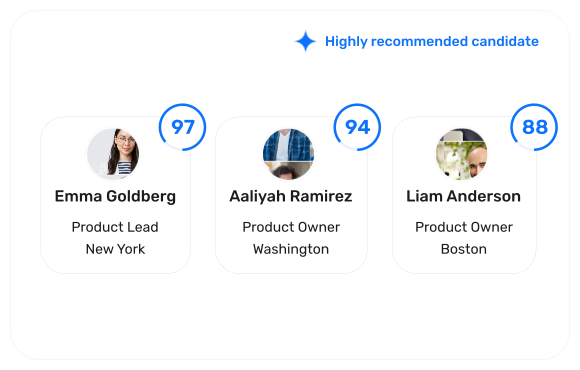
Resume screening software
Turn a pile of resumes into a ranked shortlist, backed by clear hiring evidence.
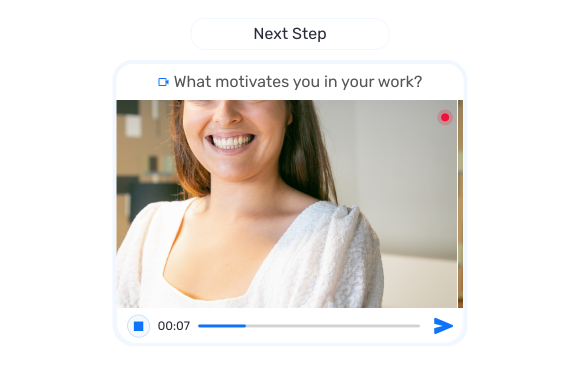
Interview software
Screen candidates with structured video, audio, and conversational interviews.
AI recruiter
Ask Clara, your recruiting assistant, anything about any candidate in your hiring pipeline.
Candidate assessments
Validate cognitive ability, behavioural fit, and job-specific skills.