September 2026 / 15 min read / Written by our editorial team
Every hire counts in a startup. But when you're recruiting with a small team, finding the right person can sometimes feel like a full-time job. AI recruiting tools for startups can shoulder more of the workload, helping you source, screen, assess, and interview candidates without adding more people to your recruiting team.
We compared 8 of the best AI recruiting tools for startups in 2026, focusing on cost, function, integrations, scalability, and the hiring problems each one solves.
Top Picks
- Hire-Match: Best overall AI recruiting platform
- Manatal: Best affordable all-in-one
- Ashby: Best for scaling startups
- Workable: Best for recruiting + HR
- BreezyHR: Best for small recruiting teams
- Pin: Best for AI sourcing
- TestGorilla: Best for skills assessments
- Willo: Best for flexible video interviewing
Short on time? Jump straight to the reviews.
How We Evaluated AI Recruiting Tools for Startups
Startups have different hiring priorities from larger organizations, so we focused on the factors that matter most to smaller, growing teams:
- Pricing: Startups often have tighter budgets, so we considered starting costs, pricing models, add-ons, and limitations.
- Ease of use: Smaller teams have less time and fewer IT resources, so we prioritized tools with a quick setup, intuitive interfaces, minimal training, and straightforward implementation.
- ATS compatibility: Startups may have an established ATS or no ATS at all, so we looked for ATS integrations, standalone functionality, and built-in applicant tracking.
- Scalability: Hiring needs can change quickly as startups grow, so we considered whether each platform can scale without introducing unnecessary enterprise costs or complexity.
- Coverage and specialization: Startups may need support in the entire hiring process, so we prioritized platforms with all-in-one solutions for sourcing, screening, assessments, and interviewing.
Disclosure: Although Hire-Match is included in this comparison, every platform was evaluated against the same criteria to ensure a consistent and transparent review process.
The Best AI Recruiting Tools for Startups Compared
The right platform depends on where your startup needs the most support. Some provide an entire recruiting system, while others specialize in sourcing, assessments, or interviewing. Here’s how our eight picks compare:
| Platform | Capabilities | ATS compatibility | Scalability | Free option | Pricing |
| Hire-Match | AI sourcing, resume screening, assessments, AI interviews, shortlisting. | Standalone or integrates with existing ATS | Pricing scales by active positions rather than users or applicants | 2-week free trial | From $499/month for 1–4 active positions |
| Manatal | ATS, AI sourcing, resume parsing, AI interviews, career pages, analytics. | Built-in ATS plus HR/recruiting integrations | Higher tiers add unlimited jobs, candidates, automation, and APIs | 14-day free trial | From $15/user/month billed annually |
| Ashby | ATS, CRM, sourcing, AI application review, scheduling, structured interviewing, analytics, automation. | Built-in ATS with 250+ integrations | Designed to scale from startup to enterprise | No permanent free plan | Foundations from $400/month for 11–25 employees |
| Wellfound | Job advertising, startup and tech talent marketplace, AI sourcing, candidate matching, filtering, outreach, screening questions, built-in ATS. | Built-in ATS plus integrations with major ATS platforms | Add Reach or Autopilot as sourcing needs increase | Free Jobs and Reach tiers | Jobs free; Reach from $135/seat/month |
| Breezy HR | ATS, AI applicant scoring, resume auditing, automation, job advertising, scheduling, video interviews. | Built-in ATS plus HR/recruiting integrations | Multiple tiers from free to Business and custom plans | Free-forever plan | Startup from $157/month billed annually |
| Pin | AI sourcing, candidate matching, talent rediscovery, outreach, recruiting agents, CRM, scheduling. | Recruiting CRM plus 120+ ATS integrations | Flexible, although paid plans are primarily per user | Free-forever plan | From $99/user/month billed annually |
| TestGorilla | Resume scoring, skills assessments, job simulations, AI interviews, video screening, talent sourcing. | ATS integrations and API available on Plus | Credit-based plans support different hiring volumes | Free plan | Core from £58/month billed annually |
| Willo | Async video/audio interviews, skills assessments, AI summaries, screening questions, candidate verification. | 7,000+ integrations and flexible API | Supports screening from small teams to high-volume hiring | No permanent free plan | Growth from $310/month |
Each tool in our list includes easy set-up for starters that don’t have time to wait weeks to start using their new tech.
The Best AI Recruiting Tools for Startups Reviewed
When budgets are limited, it's not easy to decide which tool is worth investing in.
Our detailed reviews help clarify that decision by explaining exactly why each tool on our list is worth considering for startups.
1. Hire-Match
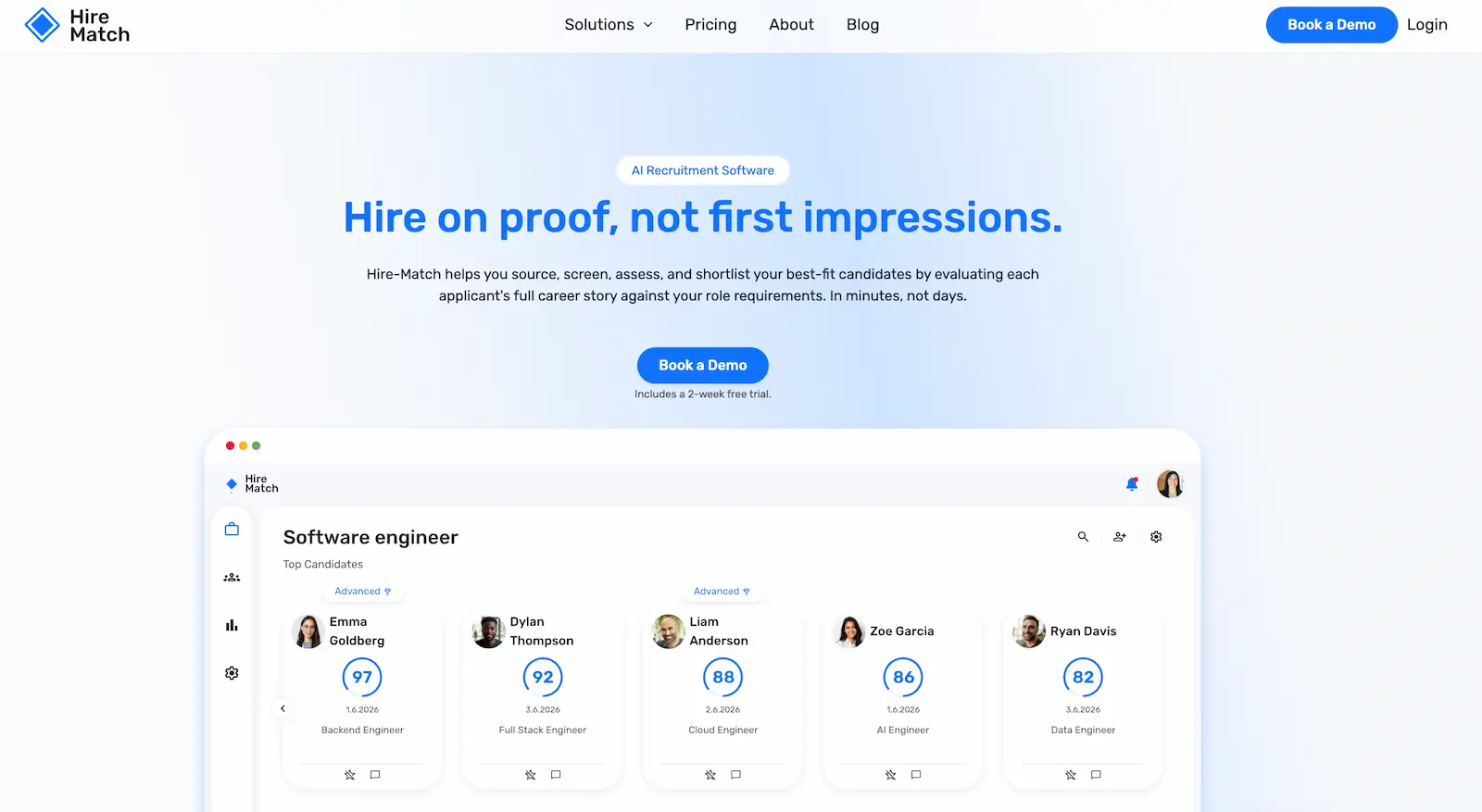
Best for: Startups that want support throughout the hiring process without paying for several disconnected recruiting tools.
Key Features
- AI candidate sourcing
- Resume screening software
- 100+ career intelligence data points
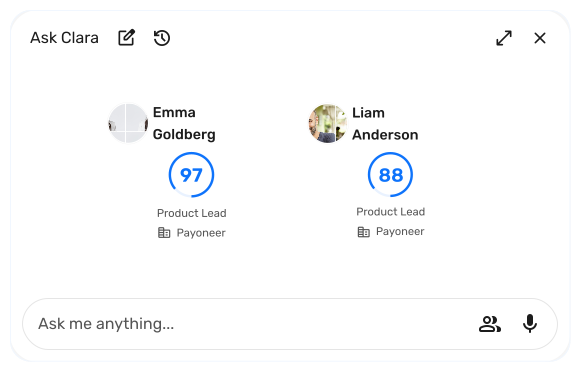
- Clara AI recruiting assistant
- AI interview software
- Talent assessment tool
- AI job description builder
- Configurable hiring pipelines
- ATS integrations
Why Hire-Match Earned Our Top Spot
Built by the creators of JobTestPrep, Hire-Match combines AI sourcing, AI resume screening, structured interviews, pre-employment assessments, and candidate evaluation within one platform. This breadth makes it particularly useful for small startup teams where recruiters may cover several stages of the hiring process themselves. Clara AI recruiter also shortlists the strongest candidates with explainable recommendations so you can see exactly how and why they were ranked.
Pricing is based on simultaneously active positions rather than application volume or recruiter seats, which can make costs more predictable when popular roles attract hundreds or thousands of applicants. There are no setup fees, and startups can use Hire-Match independently or integrate it with an ATS as their recruiting stack becomes more sophisticated.
| Pros | Cons |
|
Broad recruiting functionality in one platform Unlimited applications and recruiter seats No setup fees Scales with the number of active vacancies Works standalone or with an existing ATS Explainable AI recommendations 2-week free trial |
Starting price may be high for very early-stage startups hiring infrequently Talent assessments cost extra Integrations are handled through an API, which could be complex for startup teams (although Hire-Match take care of set-up) |
Pricing
Plans start at $499 per month for 1–4 active positions, with unlimited applications and recruiter seats and no setup fees. A two-week free trial with up to two active positions is available.
2. Manatal
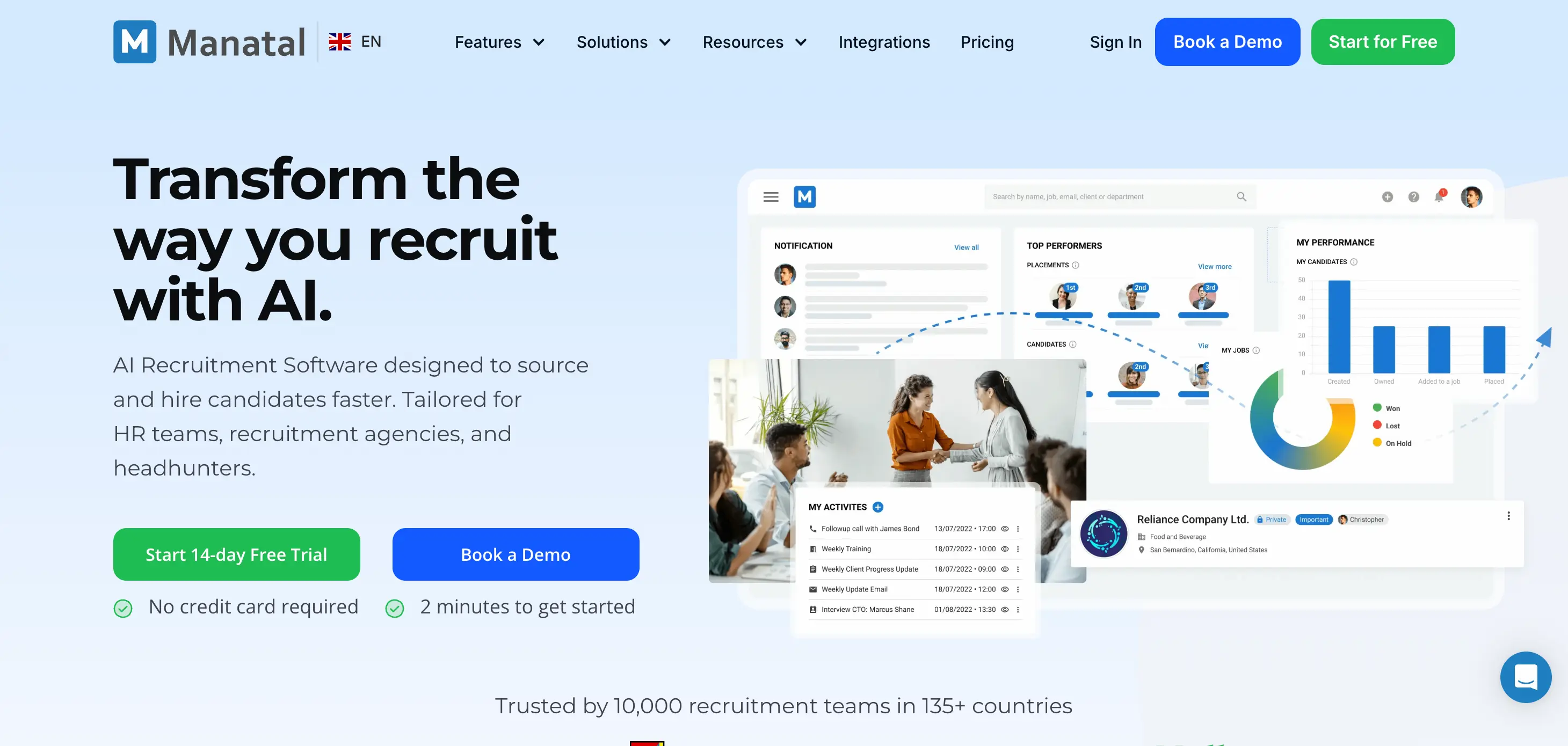
Best for: Budget-conscious startups that want an affordable ATS with AI recruiting, sourcing, candidate management, and collaboration tools built in.
Key Features
- Customizable applicant tracking system
- AI candidate scoring and matching
- AI Interviewer for automated screening
- 700+ million candidate sourcing database
- 2,500+ job board channels
- People-Match AI sourcing extension
- AI resume parsing and candidate enrichment
- Branded career pages
- Recruitment analytics and reporting
- Email, calendar, Zapier, and HR tech integrations
Why We Chose Manatal
Manatal offers affordable recruiting and ATS functionality for teams with small budgets. It combines an ATS with candidate sourcing, AI matching, resume parsing, automated screening interviews, career pages, and analytics, reducing the number of separate tools a small company may need. Its ‘Professional’ plan is specifically designed for individuals and small teams.
Manatal is also designed to be quick to adopt, which matters when a startup has limited IT resources. Manatal says teams can get started in around 2 minutes, while its drag-and-drop pipelines and no-code career pages keep setup relatively straightforward. Startups can then move to higher plans for unlimited jobs and candidates, workflow automation, APIs, and more advanced functionality as their hiring operation develops.
| Pros | Cons |
|
Low starting price ATS and AI recruiting capabilities in one platform Extensive sourcing options Quick setup with relatively little technical expertise required Professional plan supports unlimited hiring managers Higher plans provide room to scale 14-day free trial with no credit card required |
Pricing is per user, so costs increase as the recruiting team grows Professional plan is limited to 15 jobs and 10,000 candidates Some advanced integrations and functionality require higher-priced plans Less comprehensive candidate assessment functionality than specialist assessment platforms |
Pricing
The Professional plan starts at $15 per user/month when billed annually, supporting up to 15 jobs and 10,000 candidates, while Enterprise starts at $35 per user/month with unlimited jobs and candidates. A 14-day free trial is also available.
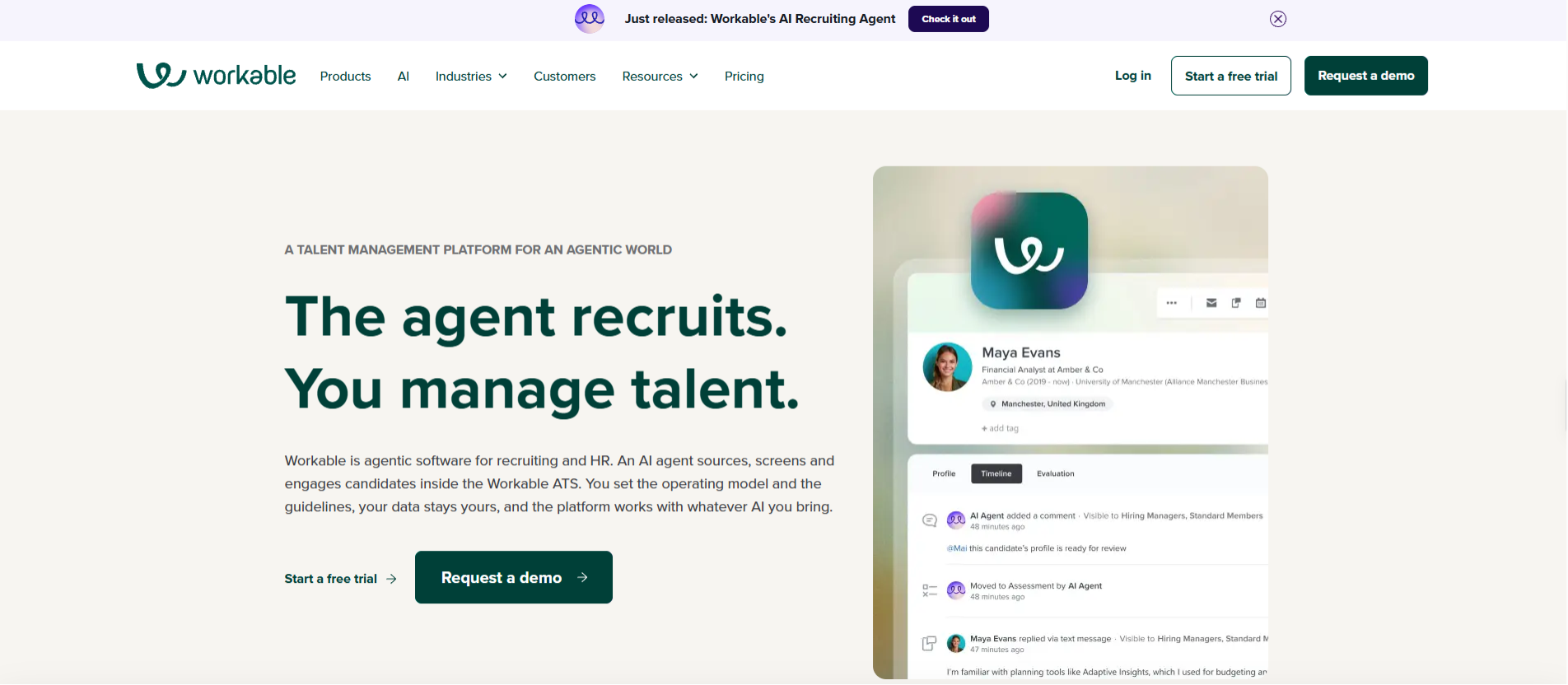
3. Workable
Best for: Tech startups looking for engineering, product, growth, and other startup-focused talent.
Key Features
- 10M+ opted-in startup candidates
- 500M+ enriched external profiles
- Unlimited free job postings
- Built-in ATS
- AI candidate matching and filtering
- Wellfound Reach AI sourcing agents
- Personalized automated outreach
- Startup-specific candidate and company-stage data
- Custom screening questions
- ATS integrations with Greenhouse, Lever, Ashby, and Workable
Why We Chose Workable
Wellfound is the best AI recruiting tool for tech startups because its talent marketplace is built specifically around startup hiring, with a candidate community that is primarily tech focused. Its 10M+ opted-in candidates have actively expressed an interest in startup roles, while recruiters can find talent across engineering, product, design, data, growth, and other common startup functions.
It also provides context that can matter when hiring for a tech startup, including candidates' tech-stack experience and the stage of companies they previously worked for. This can help recruiters look beyond job titles and identify people with experience relevant to early-stage or rapidly scaling environments.
| Pros | Cons |
|
Large network of candidates specifically interested in startups Particularly strong focus on tech, product, engineering, and growth roles Unlimited job postings and applicants available for free AI sourcing can be added as hiring needs increase Startup-specific candidate experience data Built-in ATS for teams without one Integrates with several popular startup ATS platforms No setup fees or long-term contracts |
Less comprehensive candidate assessment and interviewing functionality than all-in-one platforms Reach pricing is per seat, which can become more expensive as recruiting teams grow Autopilot adds a 10% placement fee when a candidate is hired |
Pricing
Wellfound Jobs is free for unlimited job listings and applicants, while Reach offers a free tier and paid plans starting at $135 per seat/month. Autopilot costs $500 per month per open role plus a 10% placement fee on successful hires.
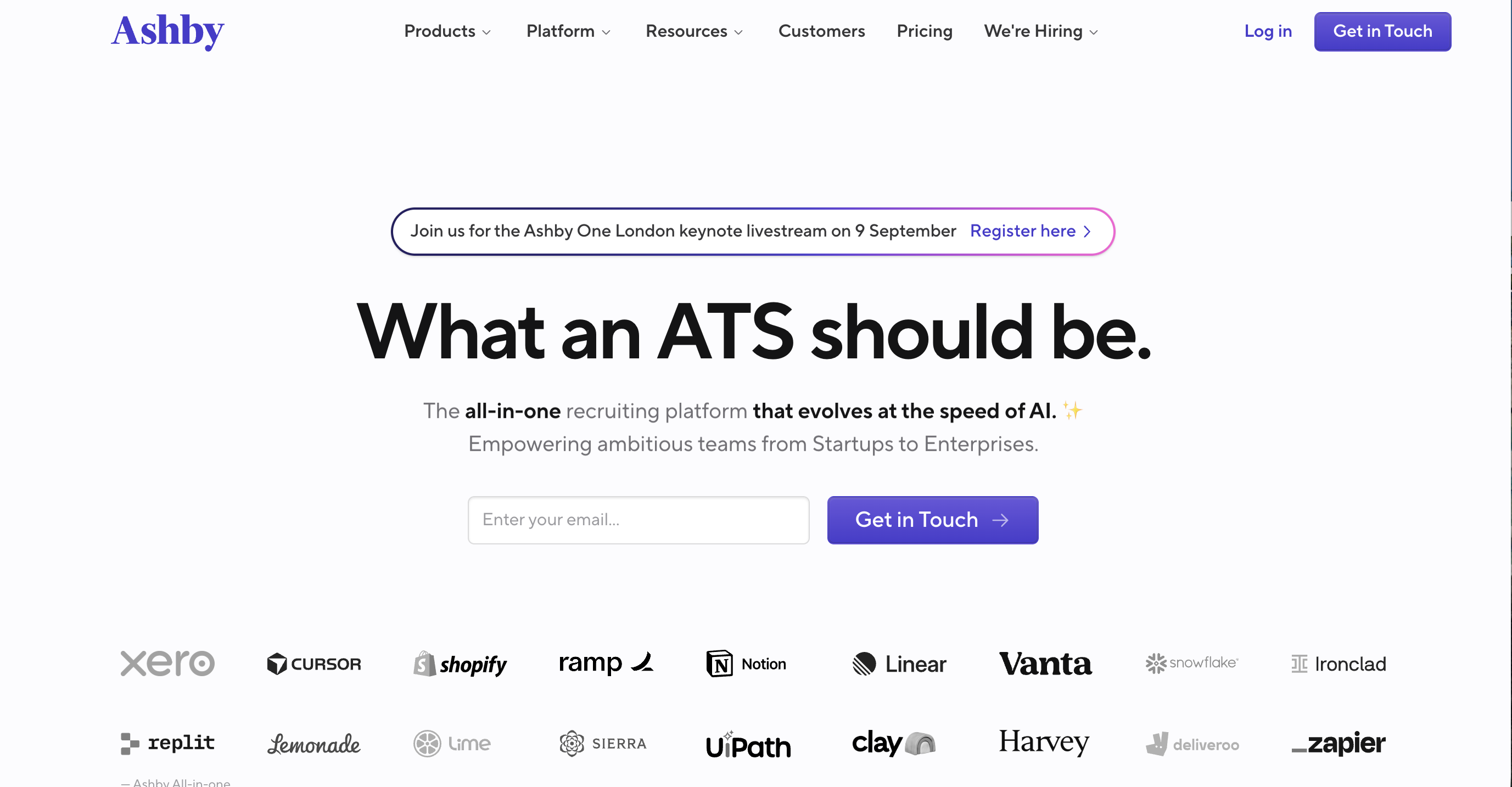
4. Ashby
Best for: Fast-growing startups that want an all-in-one recruiting platform they can continue using as their hiring volume, team, and processes become more complex.
Key Features
- Applicant tracking system
- Recruiting CRM and sourcing
- AI-assisted application review
- AI candidate search and talent rediscovery
- Automated interview scheduling
- AI Candidate Assistant
- Advanced recruiting analytics
- Automated workflows
- Structured interview plans
- 250+ integrations
Why We Chose Ashby
Ashby is built to support companies from their first hires through growth and enterprise-level recruiting. Its ‘Foundations’ plan gives startups an ATS, sourcing and CRM, scheduling, analytics, automation, and increasingly broad AI functionality in one system. This makes it particularly attractive for ambitious startups that would rather invest in a platform they can grow into than migrate to a more sophisticated ATS later.
Its depth becomes more valuable as hiring gets complicated. Startups can introduce structured interviews, automated scheduling, talent rediscovery, advanced reporting, headcount management, and more sophisticated workflows as their recruiting operation matures. However, that depth also means Ashby may be more platform than a very small startup with simple or infrequent hiring needs requires.
| Pros | Cons |
|
Designed specifically to scale from startup to enterprise Combines ATS, CRM, sourcing, scheduling, and analytics Strong AI and automation capabilities Particularly advanced recruiting analytics Supports structured, repeatable hiring processes Large integration marketplace Startup-specific ‘Foundations’ plan |
More expensive than basic startup ATS platforms Extensive functionality may be unnecessary for very small teams Some advanced capabilities require higher plans or paid add-ons Pricing increases as company size and requirements grow |
Pricing
Ashby Foundations starts at $400 per month for companies with 11–25 employees, with a 10% discount available for annual commitments. Pricing increases with company size, while growing companies move onto Ashby’s Plus plan.
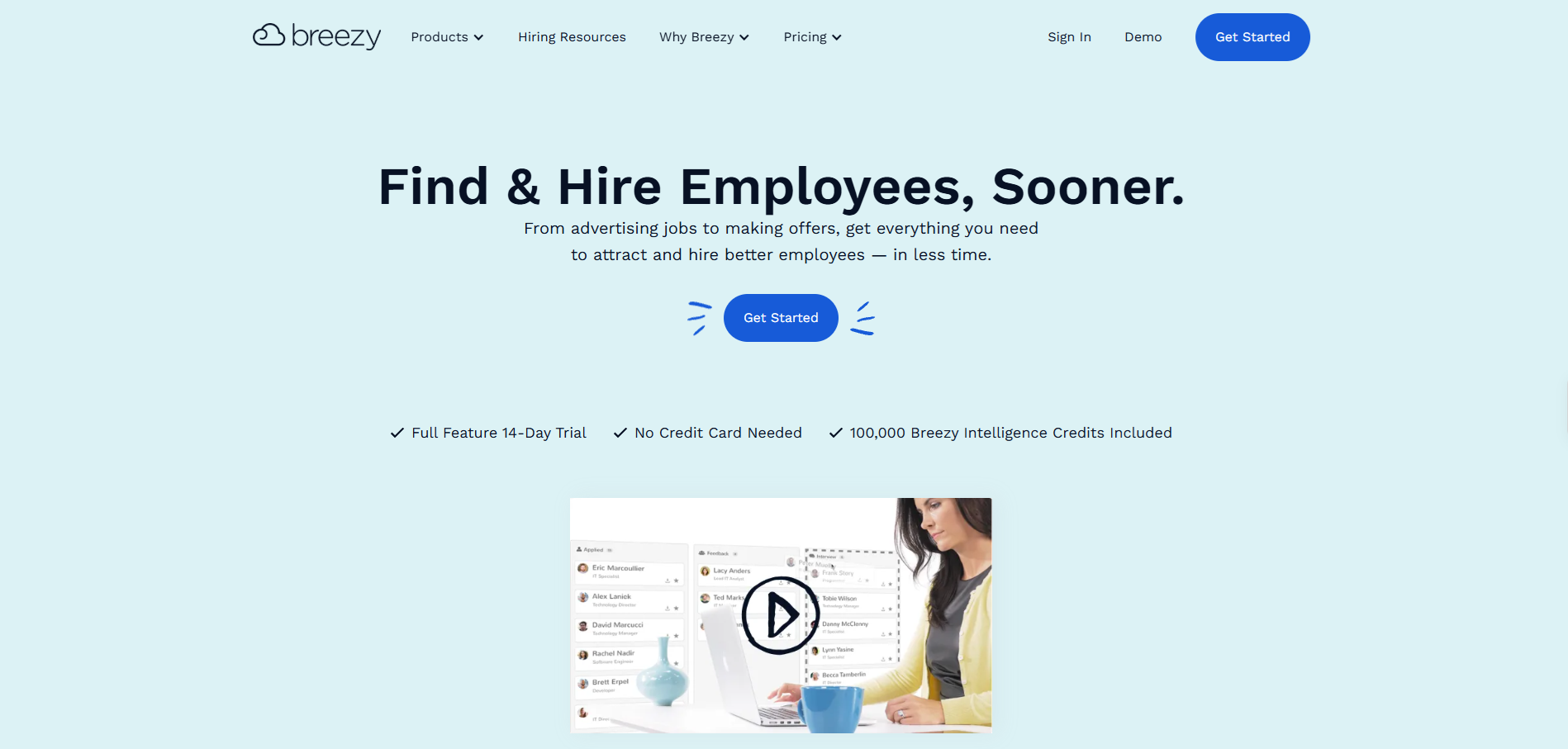
5. BreezyHR
Best for: Startups with small or decentralized hiring teams that want an easy-to-use ATS with automation, collaboration, and AI-assisted candidate screening.
Key Features
- AI-powered applicant scoring
- AI resume auditing
- Automated candidate activity summaries
- Customizable drag-and-drop pipelines
- Automated pre-screening and workflows
- One-way and live video interviewing
- Interview self-scheduling
- 50+ job board integrations
- Branded career sites
- Collaborative hiring tools
Why We Chose Breezy HR
Breezy HR combines a straightforward ATS with tools that can reduce the administrative workload for small recruiting teams. Automated workflows can handle tasks such as pre-screening, candidate communication, assessments, and interview scheduling, while Breezy Intelligence adds AI-powered applicant scoring, candidate summaries, and resume fraud detection.
Its pricing structure is also well-suited to collaborative startup hiring. Every plan includes unlimited users, so founders and hiring managers can participate without paying for additional seats. Startups can begin with the free plan for occasional hiring or move to the aptly named ‘Startup’ plan for unlimited positions, candidate automations, questionnaires, self-scheduling, and video interviewing.
| Pros | Cons |
|
Unlimited users on every plan Free plan available for occasional hiring Dedicated Startup plan Easy-to-use candidate pipelines Good range of workflow automations Built-in video interviewing and scheduling AI candidate screening available
|
Breezy Intelligence is a paid add-on Free plan supports only one active position or candidate pool Assessment integrations and offer management require the ‘Business’ plan Less advanced sourcing functionality than specialist AI sourcing tools |
Pricing
Breezy HR offers a free plan with unlimited users and candidates but only one active position or pool. Its Startup plan costs $157 per month when billed annually, with unlimited positions and users; Breezy Intelligence is available separately as an add-on.
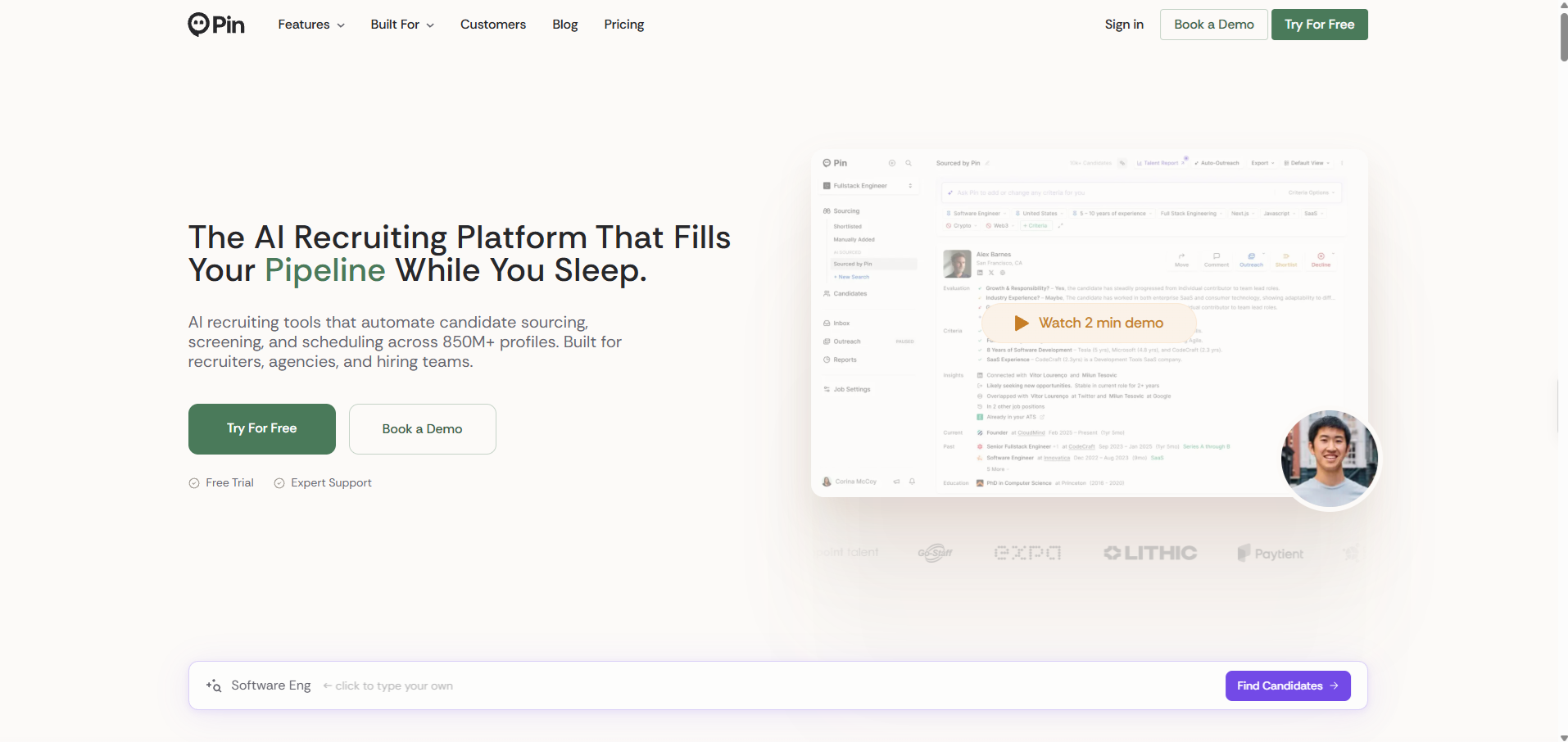
6. Pin
Best for: Startups that need to proactively find and engage specialized or hard-to-find candidates without a dedicated sourcing team.
Key Features
- AI sourcing across 850M+ candidate profiles
- Natural-language candidate search
- Skills-based AI candidate matching
- AI-ranked candidate shortlists
- Automated multi-channel outreach
- AI recruiting agents
- Talent rediscovery
- Automated interview scheduling
- Recruiting CRM and visual pipelines
- 120+ ATS integrations
Why We Chose Pin
Pin stands out for startups that cannot rely solely on inbound applicants. Its AI searches across multiple data sources, including professional profiles and technical communities, then ranks candidates based on skills, experience, and fit rather than relying solely on job titles or keyword matches. This can be particularly useful when hiring specialized technical talent.
It also extends beyond candidate discovery by automating personalized outreach, follow-ups, and interview scheduling. Startups can therefore automate much of the sourcing workflow without needing a recruiter dedicated to candidate sourcing, while the free plan provides a low-risk way to test the platform before committing.
| Pros | Cons |
|
Free plan available Searches across 850M+ profiles Strong natural-language and skills-based sourcing Useful for finding passive and specialized talent Automates sourcing, outreach, and scheduling 120+ ATS integrations Particularly relevant for technical hiring |
Paid plans are priced per user Contact lookup credits are limited on lower plans Primarily focused on sourcing and candidate engagement rather than assessments or interviewing Costs can increase as the recruiting team adds users |
Pricing
Pin offers a free-forever plan with one job position and five contact lookup credits per week. Paid plans start at $99 per user per month when billed annually, while the Professional plan starts at $135 per user per month.
7. TestGorilla
Best for: Startups that want to validate candidates’ technical, cognitive, and role-specific skills before committing time to interviews.
Key Features
- 350+ skills tests
- Coding challenges and job simulations
- AI fluency assessments
- Custom tests and questions
- AI interviews and video questions
- AI resume scoring
- Automated assessment scoring
- Candidate ID verification
- Qualifying questions
- Talent sourcing
Why We Chose TestGorilla
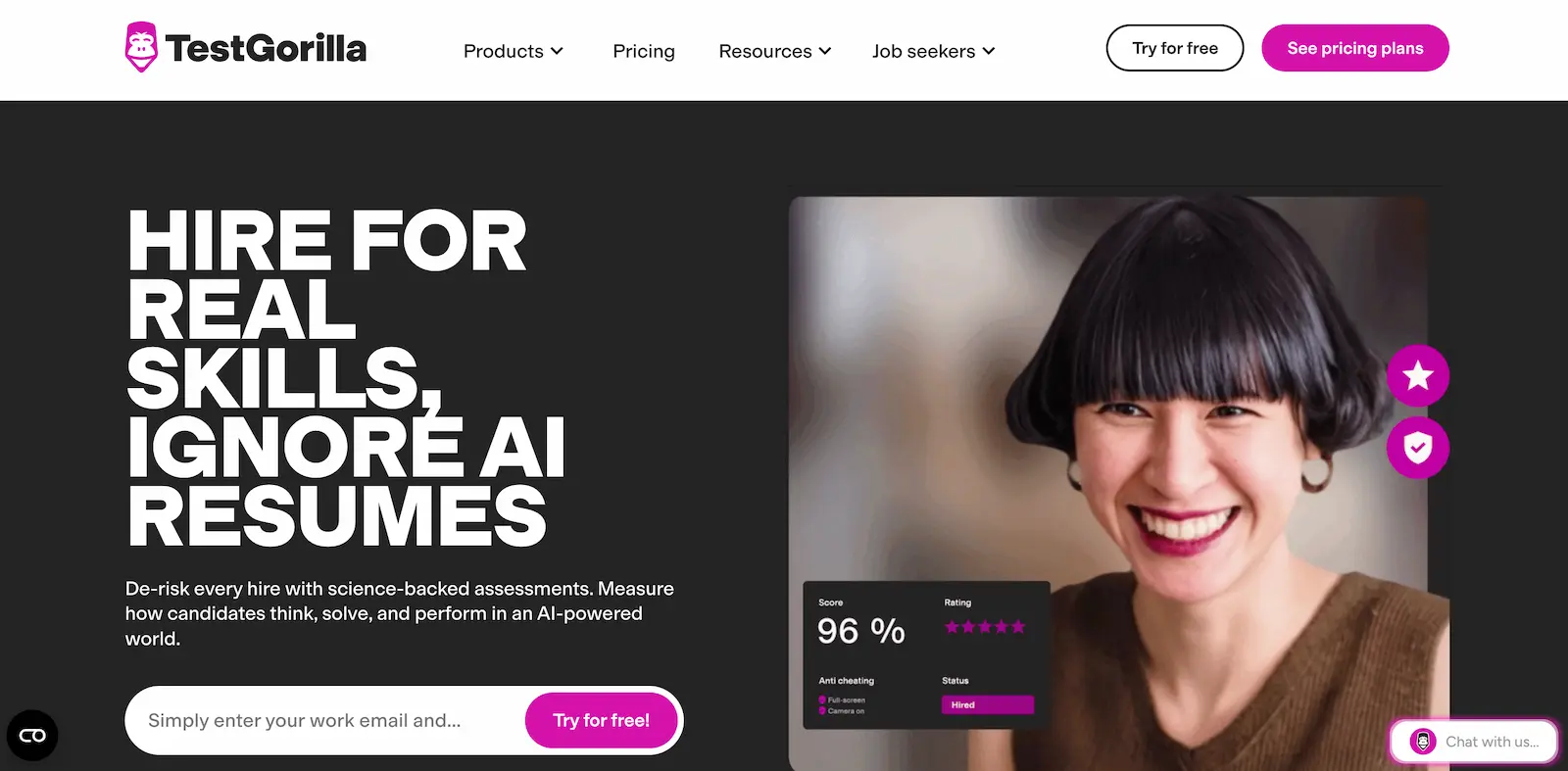
For startups making a small number of high-impact hires, TestGorilla provides more evidence of what candidates can actually do through assessments. Its 350+ test library covers technical, cognitive, language, software, and role-specific skills, while custom tests, coding challenges, and job simulations provide additional flexibility.
This makes it particularly useful for technical startups that need to validate specialist skills without building assessments internally. However, many of its more advanced capabilities, including fully customizable AI interviews, coding challenges, and ATS integrations, require the more expensive (but still affordable) ‘Plus’ plan.
| Pros | Cons |
|
Advanced assessment features require higher-priced plans Core plan has a limited annual credit allowance ATS integrations require the Plus plan Less suitable as a complete recruiting platform than broader ATS or all-in-one options skills tests Strong technical and role-specific assessment options Free plan available Coding challenges and job simulations AI interviews and video screening available Consistent scoring across candidates Useful for high-volume applicant screening |
Advanced assessment features require higher-priced plans Core plan has a limited annual credit allowance ATS integrations require the Plus plan Less suitable as a complete recruiting platform than broader ATS or all-in-one options |
Pricing
A free plan includes resume scoring, qualifying questions, limited video questions and AI interviews, and five essential skills tests. The ‘Core’ plan starts at £58 per month with an annual commitment, while ‘Plus’ starts at £300 per month.
8. Willo
Best for: Startups that want to replace time-consuming initial screening calls with flexible, asynchronous video, audio, and skills-based screening.
Key Features
- Asynchronous video and audio interviews
- AI-powered candidate matching and ranking
- AI interview transcripts and summaries
- Role-specific skills assessments
- AI-generated follow-up questions
- Customizable candidate scorecards
- Knockout screening questions
- Anti-cheating and AI-response detection
- 18-language support
- 7,000+ integrations and flexible API
Why We Chose Willo
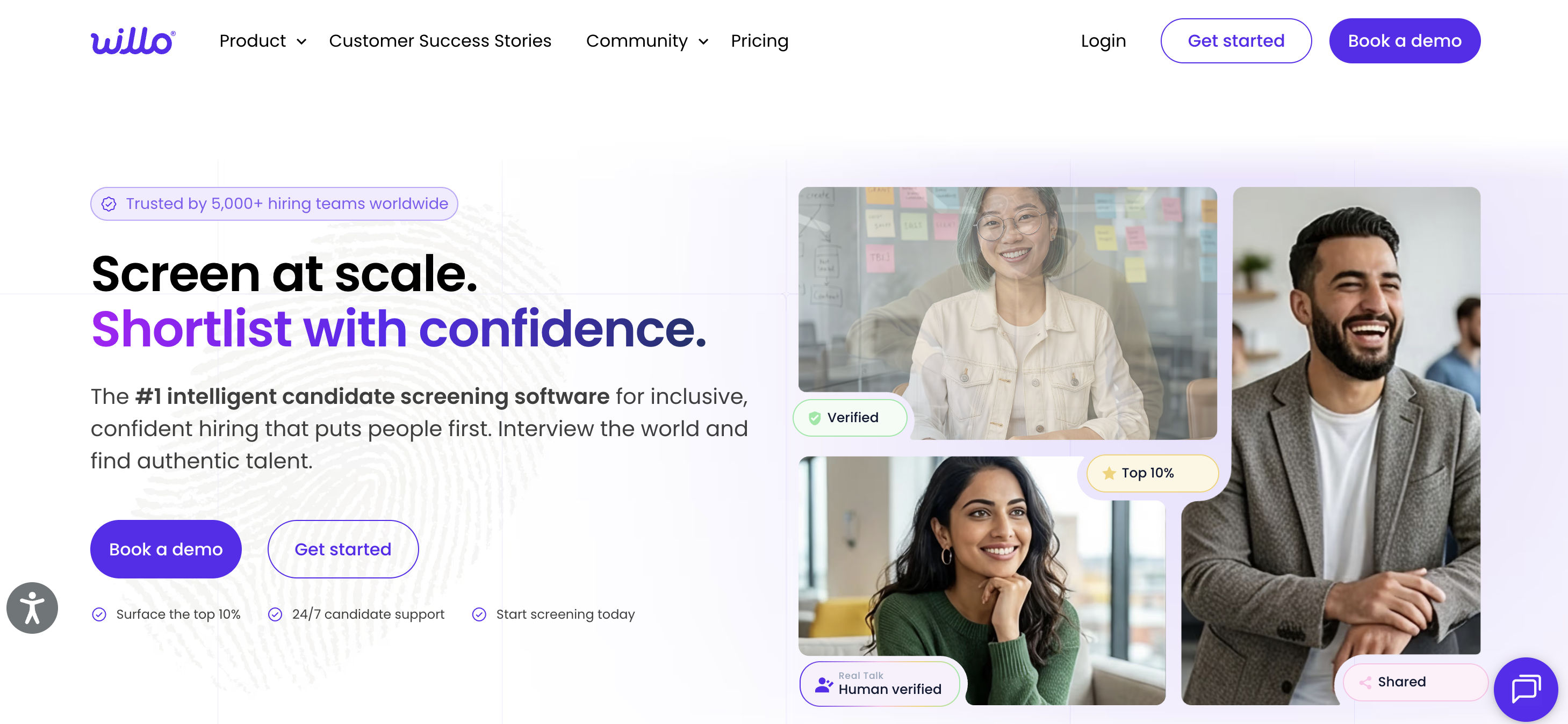
Willo can help small startup teams screen more candidates without filling their calendars with first-round calls that can waste valuable time for growing companies. Candidates’ complete interviews on their own time and device, while teams can combine video, audio, multiple-choice questions, task uploads, and knockout criteria within the same screening workflow.
Its flexibility also makes it easy to introduce without replacing an existing ATS. Willo integrates with thousands of tools and major recruiting platforms, while its browser-based, WCAG-compliant candidate experience supports remote and international hiring. AI-generated transcripts, summaries, match insights, and continuously updated shortlists can further reduce the time small teams spend reviewing applications.
| Pros | Cons |
|
Flexible asynchronous screening Supports video, audio, assessments, and task uploads No candidate app or account required WCAG-compliant and available in 18 languages AI-assisted candidate evaluation and summaries Anti-cheating and candidate verification features 7,000+ integrations Particularly useful for remote and international hiring |
Does not currently support live video interviews Primarily focused on screening rather than end-to-end recruiting Human review is still required for subjective video responses Less suitable for startups primarily looking for candidate sourcing |
Pricing
Willo’s Growth plan starts at $310 per month, while Scale costs $399 per month. Enterprise pricing is customized to the organization.
How to Choose the Best AI Recruiting Tools for Startups
The best platform for your startup depends on your hiring volume, budget, existing recruiting stack, and where your team currently spends the most time. Before comparing features, identify what you actually need AI to improve.
1. Identify Your Biggest Hiring Bottleneck
Start with your main recruiting problem rather than the software. Are you struggling to find specialist candidates, screen hundreds of applications, validate technical skills, or fit interviews around a small team's schedule?
You may only need a specialist tool for sourcing, assessments, or interviewing. If several stages are creating bottlenecks, a broader recruiting platform could reduce the number of separate tools you need.
2. Pricing & Plans
The cheapest advertised plan isn't necessarily the most affordable long-term. Check:
- Monthly vs. annual commitments
- Setup or implementation fees
- Minimum contracts
- Per-seat, per-position, applicant-based, or usage-based pricing
- Usage limits and paid add-ons
- How pricing changes as you grow
For startups, predictable pricing and minimal upfront costs can make budgeting easier. Also consider what is included: a more expensive platform may offer better overall value if it replaces several separate subscriptions.
3. Setup and Integration
A recruiting tool shouldn't require a major implementation project that can take weeks before you even get started. Look at how quickly initial setup is, whether technical support is required, and how easily the platform fits into your existing workflow.
If you already have an ATS, check whether the tool integrates with it and what information flows between the two systems. If you don't, consider whether the platform can operate independently or provide its own applicant tracking functionality.
4. Scalability
Today's 3 open positions could become 30 as your company grows. Consider whether the platform can accommodate more vacancies, candidates, recruiters, and increasingly complex hiring processes.
Scalability doesn't simply mean "enterprise ready". Look for software you can grow into without paying for unnecessary enterprise functionality from day one or facing a costly platform migration later.
5. Capabilities
An all-in-one platform combines sourcing, screening, assessments, interviewing, scheduling, and candidate management, potentially reducing the need to jump between systems and individual subscription costs.
But more functionality isn't automatically better. If sourcing is your only major bottleneck, for example, a specialist AI sourcing tool may provide greater depth and better value than paying for an entire recruiting suite.
6. Ease of Use
Startups often involve founders and hiring managers in recruitment instead of HR or an entire recruiting team. Look for intuitive software that doesn't require extra training or dedicated recruiting operations staff.
Consider who will actually use the platform, how frequently they'll use it, and whether pricing or permissions make it practical to involve multiple hiring managers as your team grows.
Our Verdict
The best AI recruiting tools for startups aren't necessarily the platforms with the most features or the lowest starting price. The right choice depends on your budget, hiring volume, existing tech stack, and where you need the most support.
For startups looking to merge more of the hiring process into one technical system, Hire-Match is our best overall pick. It brings AI candidate screening into one platform, while pricing by active positions rather than applications or recruiter seats can make costs more predictable as hiring fluctuates.
See how Hire-Match could fit into your hiring process by booking a personalized demo and starting a 2-week free trial.
FAQs
The best choice depends on your budget, hiring volume, and where you need support. We chose Hire-Match as our best overall option because it combines sourcing, screening, assessments, interviewing, and candidate ranking, with pricing based on active positions rather than recruiter seats or applicant volume. Specialist tools may be more suitable if you only need help with one stage of recruitment.
Startups may not have the recruiting resources or employer recognition of larger organizations, so speed and candidate experience can become particularly important. AI in recruiting can help smaller teams find relevant candidates, engage passive talent, respond faster, and reduce administrative work, leaving recruiters and founders more time for meaningful candidate conversations.
Not necessarily. An all-in-one platform can cover several stages of recruitment and reduce the number of subscriptions and integrations you need. However, if you already have an ATS or only need help with a specific task, such as sourcing or skills assessments, adding one specialist tool may be more practical.
Larger organizations often have different requirements, including higher hiring volumes, more complex workflows, enterprise integrations, advanced analytics, and larger recruiting teams. Our guide to the best AI recruiting tools compares platforms across a wider range of organizations and recruiting requirements.
They can be but compare pricing models rather than starting prices alone. Some platforms charge per recruiter, while others charge by active job, applicant volume, or usage. Free plans can work for occasional hiring, while broader paid platforms may offer better value if they replace several separate recruiting tools.
No. Some AI recruiting tools (like Hire-Match) operate independently or include their own applicant tracking system, making them suitable for startups building their first recruiting stack. Others are designed to integrate with an existing ATS. Check both your current requirements and whether the software can fit into a more developed recruiting stack later.
Depending on the platform, startups can use AI for candidate sourcing, resume screening, candidate matching, outreach, interview scheduling, skills assessments, interviews, and candidate ranking. Start with repetitive or time-consuming tasks that are creating bottlenecks rather than introducing AI simply because the functionality is available.
Our recruitment solutions.
Resume screening software
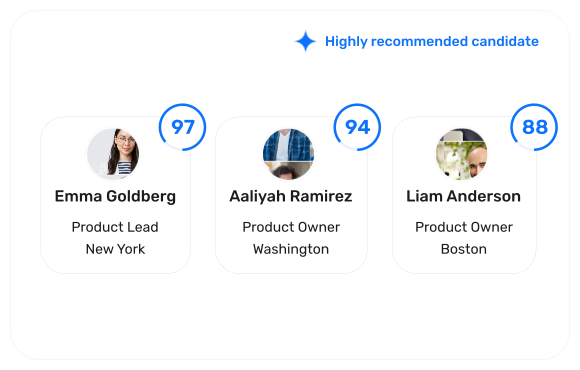
Turn a pile of resumes into a ranked shortlist, backed by clear hiring evidence.
Interview software
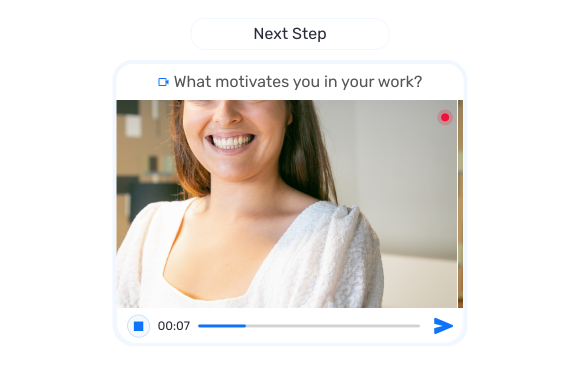
Screen candidates with structured video, audio, and conversational interviews.
AI recruiter
Ask Clara, your recruiting assistant, anything about any candidate in your hiring pipeline.
Candidate assessments
Validate cognitive ability, behavioural fit, and job-specific skills.